In the landscape of healthy aging, few physiological markers are as critical—or as frequently overlooked—as core strength. While popular culture often equates a strong core with aesthetic goals like a "six-pack" or a slim waistline, the reality for those over 60 is profoundly different. For this demographic, the core serves as the body’s internal scaffolding. It is the primary engine behind stability, posture, and the fundamental ability to navigate the world safely.
Yet, despite its importance, many older adults avoid traditional core-strengthening exercises. The standard fitness lexicon—full sit-ups, floor-based planks, or crunches—often feels daunting, if not physically prohibitive, for individuals dealing with stiff hips, sensitive knees, or a general reluctance to lower themselves onto a hard, unforgiving gym floor.
However, the path to improved stability does not require a gym membership or an expensive yoga mat. According to experts, the most effective "testing ground" for your core is already in your bedroom. By utilizing the forgiving surface of your mattress, you can accurately assess your structural integrity without the high-impact stress often associated with floor exercises.
The Vital Role of the Core in Longevity
To understand why core strength is a non-negotiable component of healthy aging, one must look beyond the muscles of the abdomen. The "core" is a complex system involving the deep abdominals, the obliques, the lower back, and the pelvic floor. Together, these muscle groups act as a stabilizer for the entire kinetic chain.
When these muscles weaken—a process often accelerated by sedentary habits—the body loses its ability to maintain an upright posture. This leads to a cascade of issues: increased strain on the lumbar spine, a decrease in balance, and a higher vulnerability to falls. According to data from the Centers for Disease Control and Prevention (CDC), falls are a leading cause of injury-related death and hospitalization among older adults. A strong core is, quite literally, a safety mechanism; it is the physical "brakes" that allow you to catch yourself if you stumble or maintain your balance while reaching for an object on a high shelf.
Expert Insight: The Bed-Based Assessment
To bridge the gap between necessary fitness and physical comfort, we consulted James Bickerstaff, a Certified Personal Trainer (CPT) at OriGym. Bickerstaff emphasizes that the cushioning of a mattress provides a unique environment for testing strength. While a hard floor is standard for gym training, the slight instability of a mattress can actually act as a "proprioceptive challenge," forcing your stabilizer muscles to work harder to maintain form.
Bickerstaff has curated a three-part, bed-based diagnostic series. These moves mimic traditional floor exercises but prioritize joint health, allowing you to gauge your muscular endurance without the intimidation factor of traditional gym equipment.
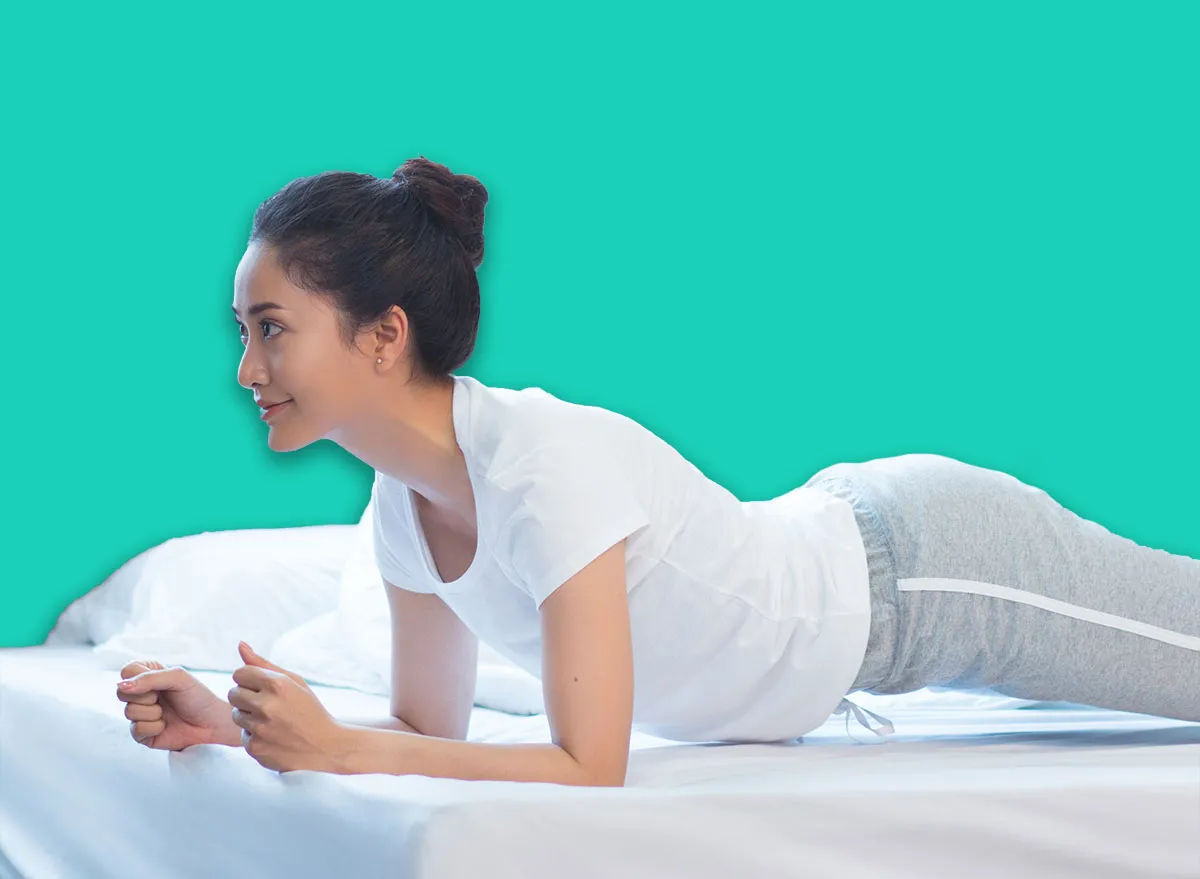
1. The Forearm Plank: The Gold Standard of Stability
The forearm plank is arguably the most efficient diagnostic tool for measuring total-body trunk stability. By holding a rigid position, you are asking your abdominals, lower back, shoulders, and glutes to fire in unison to resist the pull of gravity.
How to Perform the Test
- Positioning: Start by kneeling on your mattress. Place your forearms flat on the bed, ensuring your elbows are directly beneath your shoulders.
- Alignment: Extend your legs behind you, resting your weight on your toes. Your body should form a straight line from your head to your heels.
- Engagement: Draw your belly button toward your spine and squeeze your glutes. Do not let your lower back sag or your hips pike upward.
- The Goal: Time yourself. A "passing" mark for a healthy individual over 60 is typically 30 to 45 seconds of maintained, perfect form. If you begin to shake uncontrollably or your hips drop within 10 seconds, it is a clear indicator that your core stability needs prioritized attention.
2. The Side Plank: Targeting the Oblique Stabilizers
While the standard plank addresses the front of the body, the side plank focuses on the obliques and the hip stabilizers. These muscles are the "lateral" support system of the body, essential for preventing side-to-side swaying during movement.
How to Perform the Test
- Positioning: Lie on your side on the mattress with your legs extended. Place your bottom elbow directly under your shoulder.
- Execution: Engage your obliques to lift your hips off the mattress until your body forms a straight line. Your top arm can be placed on your hip or extended toward the ceiling.
- The Challenge: Hold this position while breathing deeply. If you feel your hips dipping toward the mattress, use your strength to push them back up.
- The Goal: Aim for 20 to 30 seconds per side. Because this move is inherently less stable, it is common to find one side stronger than the other. Addressing this asymmetry is vital for balanced gait and fall prevention.
3. The Dead Bug Hold: Functional Coordination
The final test, the "Dead Bug," introduces the concept of dynamic stability. It is one thing to hold a static position; it is another to maintain core tension while limbs are in motion—a skill required for walking, climbing stairs, or carrying groceries.
How to Perform the Test
- Positioning: Lie on your back in the center of your mattress. Extend your arms toward the ceiling and lift your legs, bending your knees at a 90-degree angle (the "tabletop" position).
- Execution: Press your lower back firmly into the mattress. This "imprinting" is the most critical part of the test.
- The Movement: Slowly lower your right arm behind your head while simultaneously extending your left leg straight out, hovering just above the mattress.
- The Goal: Hold for 5 seconds, then return to center and switch sides. The test is to see if you can complete 10 repetitions without your lower back arching away from the mattress. If your back arches, it indicates that your deep core (the transverse abdominis) is struggling to support your spine under load.
Chronology of Progress: Building Strength Safely
If you find that you cannot pass these tests, do not be discouraged. Fitness after 60 is not about immediate performance; it is about consistent, progressive adaptation.
- Weeks 1–2: Focus on "Time Under Tension." If you can only hold a plank for 10 seconds, do three sets of 10 seconds. Focus on the quality of the contraction rather than the length of time.
- Weeks 3–6: Add 5 seconds to each hold every week. Consistency is the primary driver of neuromuscular adaptation.
- Weeks 6+: Once you can reach the 45-second mark on these moves, you will likely notice improvements in your daily life, such as increased stamina during walks or less back pain after household chores.
Implications for Healthy Aging
The implications of these tests go far beyond the bedroom. When you improve your ability to hold these positions, you are strengthening the neurological pathways that govern balance and proprioception. As we age, the connection between the brain and the core muscles can become sluggish. These exercises act as a "re-syncing" tool.
Furthermore, these holds are low-impact. The foam of a mattress, while less supportive than a floor, prevents the acute pressure on the patella (kneecap) that often causes older adults to give up on exercise programs. By removing the pain barrier, you increase the likelihood of adherence, which is the most important factor in any health regimen.
Supporting Data and Medical Context
Data from the CDC and the National Institute on Aging consistently highlight that sedentary behavior is a primary contributor to frailty. Frailty, in turn, is a precursor to a loss of independence. Strength training, even at a sub-maximal level like these mattress holds, has been shown to improve bone density and muscle mass—two key defenses against the ravages of sarcopenia (the age-related loss of muscle mass).
When you dedicate time to these three movements, you are not just "working out"; you are performing preventative medicine. You are investing in the musculature that will allow you to remain mobile, independent, and confident in your physical capabilities for years to come.
The Bottom Line
Your core is the anchor of your physical life. It dictates how you sit, how you stand, and how you react to the unpredictable movements of daily existence. By integrating these three simple, bed-based holds into your morning routine, you gain a clear, objective view of your current physical baseline.
If you struggle with these movements, consider it a wake-up call—not of failure, but of opportunity. You now have a low-impact, accessible, and scientifically grounded roadmap to regain the strength required to move through your sixties and beyond with grace and stability. Start small, stay consistent, and remember: the strongest version of yourself starts the moment you wake up, right where you are.