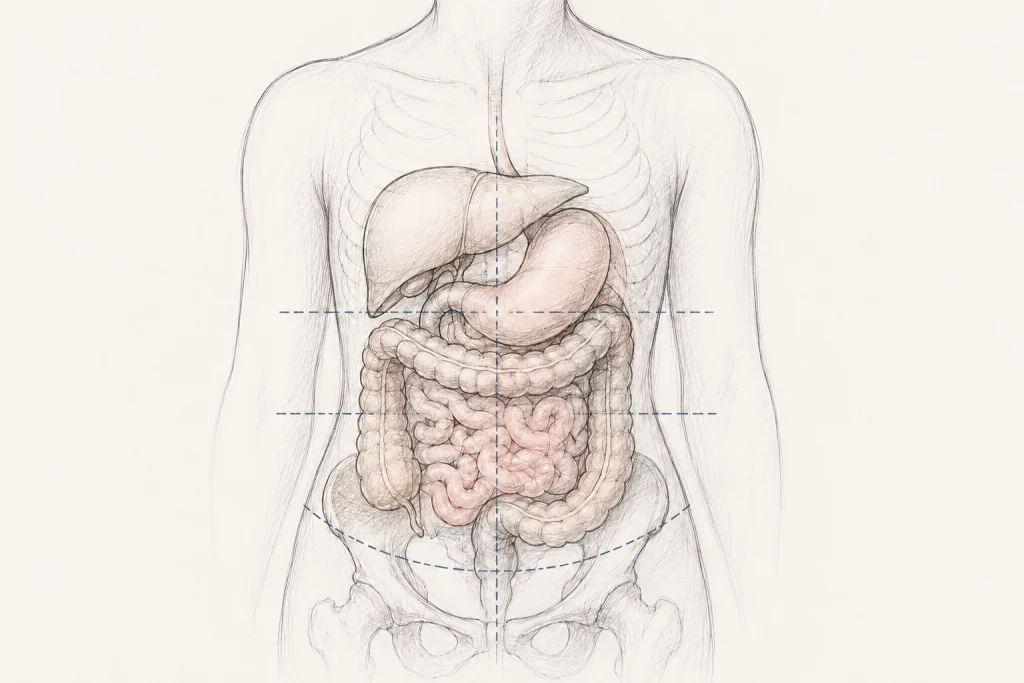
In the landscape of modern medicine, where diagnostic technology allows us to peer into the human body with unprecedented clarity, some conditions slip through the cracks of clinical practice. One such phenomenon is visceroptosis—the downward displacement of internal abdominal organs. While pelvic organ prolapse and rectal prolapse are well-documented features of Hypermobile Ehlers-Danlos Syndrome (hEDS), the possibility that connective tissue laxity may trigger similar displacement higher in the abdomen remains a frontier of medical research that is only now beginning to re-emerge from a century of obscurity.
Understanding Visceroptosis: An Anatomical Descent
At its core, the term "visceroptosis" is derived from the Latin viscera (the internal organs of the abdominal and thoracic cavities) and the Greek ptosis (a falling or downward displacement). In a healthy individual, ligaments, fascia, and surrounding musculature hold the stomach, liver, intestines, and kidneys in precise anatomical positions. When these connective tissues are weakened—as is often the case in individuals with collagen-related disorders—the body’s "internal scaffolding" may fail, allowing organs to migrate downward under the force of gravity.
It is critical to distinguish between anatomic visceroptosis and clinical visceroptosis. An organ may appear displaced on a diagnostic scan, yet the patient may remain entirely asymptomatic. Clinical visceroptosis, however, refers to cases where this displacement creates a functional obstruction or physiological burden, resulting in chronic, life-altering symptoms.
A Historical Chronology: From Prominence to Obsolescence
To understand why visceroptosis is often overlooked today, one must look back to the late 19th century.
1885: The Glénard Era
In 1885, French physician Dr. Frantz Glénard revolutionized the study of abdominal anatomy by describing a condition he observed in patients whose organs had descended significantly. His findings were widely accepted, and the condition—eventually termed "Glénard’s disease"—became a standard diagnosis in medical journals throughout the early 20th century. During this period, the condition was a staple of clinical inquiry; surgeons and radiologists in prestigious institutions, including those publishing in The New England Journal of Medicine and The Lancet, treated visceroptosis as a legitimate structural pathology.
The Mid-Century Disappearance
By the mid-20th century, visceroptosis quietly faded from the medical lexicon. The reasons for this remain speculative, though historians of medicine often point to the rise of psychosomatic theories. During this period, many of the symptoms associated with visceroptosis—such as fatigue, bloating, and abdominal pain—were increasingly categorized as "neurasthenia" or anxiety-related. Because early imaging techniques were limited, the structural displacement was often dismissed as a secondary, incidental finding, while the patient’s physical distress was attributed to their mental state.
The Modern Re-emergence
The past decade has seen a resurgence of interest in visceroptosis, largely driven by the growing awareness of Ehlers-Danlos Syndrome (EDS). As clinicians observe more patients with systemic connective tissue disorders, they are rediscovering that the structural weaknesses causing joint hypermobility may also lead to visceral instability. What was once considered a "forgotten diagnosis" is now being re-evaluated through the lens of modern genetics and imaging.
Supporting Data and Clinical Manifestations
The clinical presentation of visceroptosis varies based on the organ affected, but common threads have emerged from current case reports and observational studies.
Symptom Profiles
While pelvic-level prolapse manifests with well-known urinary and fecal issues, abdominal visceroptosis often mimics other common gastrointestinal disorders, making it notoriously difficult to diagnose:
- Gastroptosis: Displacement of the stomach, often leading to early satiety, nausea, and vomiting.
- Transverse Colon Ptosis: Displacement of the large intestine, frequently resulting in severe, chronic constipation and abdominal distention.
- General Abdominal Discomfort: A sensation of dragging or heaviness that worsens throughout the day as gravity exerts its influence on the unsupported organs.
The EDS Connection
The link between hEDS and organ displacement is becoming increasingly substantiated. The 2017 international diagnostic criteria for hEDS explicitly recognize pelvic organ prolapse as a potential feature of the condition. However, researchers are now looking "upward" into the abdomen. A pivotal 2023 study involving 139 patients with slow-transit constipation found a strong correlation between transverse colon ptosis and the severity of symptoms, with more profound descent often necessitating surgical intervention. While this study was not limited to EDS patients, it provides a critical framework for understanding how structural anatomy directly influences bowel motility.
The Diagnostic Dilemma
One of the primary obstacles to treating visceroptosis is the lack of standardized diagnostic protocols. Modern GI evaluations are optimized to detect mucosal diseases, tumors, or motility disorders like gastroparesis. They are rarely designed to assess the positional status of an organ relative to gravity.
Consequently, patients often undergo a battery of tests that return "normal" results because the organs, while displaced, may not show signs of internal disease or inflammation. This leads to a cycle of medical gaslighting, where the patient is told their tests are normal, despite experiencing clear physical symptoms. The diagnosis of clinical visceroptosis requires a paradigm shift: physicians must move beyond "ruling out" pathology and begin to look at the structural integrity of the abdominal cavity itself.
Implications for Treatment and Management
Treatment for visceroptosis remains a subject of intense debate, as the evidence base is currently composed primarily of case reports and small-scale studies rather than large-scale clinical trials.
Conservative Management
For many, the first line of defense is conservative support. This includes:
- Pelvic Floor Physical Therapy: Crucial for managing lower-abdominal and pelvic prolapse.
- Core Stabilization: Strengthening the abdominal wall to provide better extrinsic support for the organs.
- Compression Garments: Many patients report significant relief from abdominal binders, which act as an external "corset," providing the support that the internal connective tissue cannot.
- Dietary Modifications: Adjusting food intake to manage the symptoms of motility issues, such as small, frequent meals for gastroptosis.
The Surgical Question
Surgery for visceroptosis remains controversial. While procedures exist to "tack" or suspend organs back into their anatomical positions (such as gastropexy or colopexy), these surgeries are not without risk—particularly in the EDS population, where tissue fragility and poor wound healing are significant concerns. Any surgical intervention must be weighed carefully against the risks of complications, and should generally be reserved for cases where conservative management has failed and quality of life is severely impacted.
Moving Toward a New Standard of Care
The history of visceroptosis serves as a cautionary tale of how medical "fashion" can eclipse the lived reality of patients. As we look toward the future, the medical community must prioritize:
- Standardized Imaging: Developing protocols that assess organ position in both supine and upright positions to capture true displacement.
- Multidisciplinary Approaches: Integrating gastroenterology, rheumatology, and pelvic floor physical therapy to treat the patient as a whole rather than focusing on a single organ.
- Validation: Moving away from the "somatic/anxious" dismissal that has historically hampered the treatment of these patients.
While the relationship between connective tissue laxity and organ displacement is still being mapped, the voices of patients—who have long described the sensation of their internal organs "falling"—are finally being heard. By combining historical clinical observations with modern physiological understanding, medicine may be on the cusp of re-embracing a diagnosis that was never truly gone, but simply waiting to be understood.
Key Takeaways:
- Visceroptosis is real: It is the downward displacement of organs due to structural or connective tissue weakness.
- Historical Context: Once a recognized diagnosis in the late 1800s, it fell out of favor, leading to a long period of under-diagnosis.
- The hEDS Link: The condition is increasingly recognized as a potential complication for those with connective tissue disorders, warranting further research.
- Clinical vs. Anatomic: Not all organ descent causes symptoms; clinical visceroptosis is defined by the impact on function and quality of life.
- Management: Conservative treatments, such as physical therapy and compression, are the current standard, while surgery remains a complex, highly individual decision.