For millennia, human beings navigated the landscape of health and performance using a singular, sophisticated instrument: the self. We relied on the burn in our muscles to gauge effort, the quality of our dreams to assess recovery, and the pang of hunger to dictate our nutritional needs. Today, that ancient internal compass is being supplemented—and often superseded—by a new generation of sleek, wrist-bound, and ring-based technology.
From heart rate variability (HRV) and step counts to sleep staging and caloric expenditure, we are currently living in the era of "quantified health." While these devices offer a bridge between subjective experience and objective measurement, they have also birthed a new set of psychological and physiological challenges. As we increasingly outsource our self-awareness to algorithms, we must ask: Are we becoming healthier, or are we simply becoming more anxious?
The Evolution of Self-Assessment: From Intuition to Precision
Historically, our ancestors were remarkably attuned to their physiological states. However, humans are notoriously poor at quantifying these experiences with "cold precision." We are prone to cognitive biases, overestimation of our physical output, and underestimation of our caloric intake.
Consider the case of a professional athlete like Ben Johnson. At the height of his career, he was famously able to estimate his 100-meter sprint time within a tenth of a second of the official stopwatch. This is a rare, outlier level of body awareness. For the average person, however, self-assessment is far less accurate. A common example involves nutritional tracking: many individuals believe they are eating within a modest caloric deficit, only to discover—after rigorous data logging—that they are consuming an additional 500 calories a day through "hidden" sources like sauces, oils, and small snacks.
In this context, technology serves as a vital reality check. By providing objective data, these devices can correct our misperceptions, helping us align our behavior with our health goals. But this precision comes with a caveat: the data is only as good as the hardware and software generating it.
The Hierarchy of Reliability: Understanding Data Accuracy
Not all health metrics are created equal. In the rapidly expanding market of wearables—ranging from basic pedometers to advanced medical-grade sensors—the margin for error varies significantly.
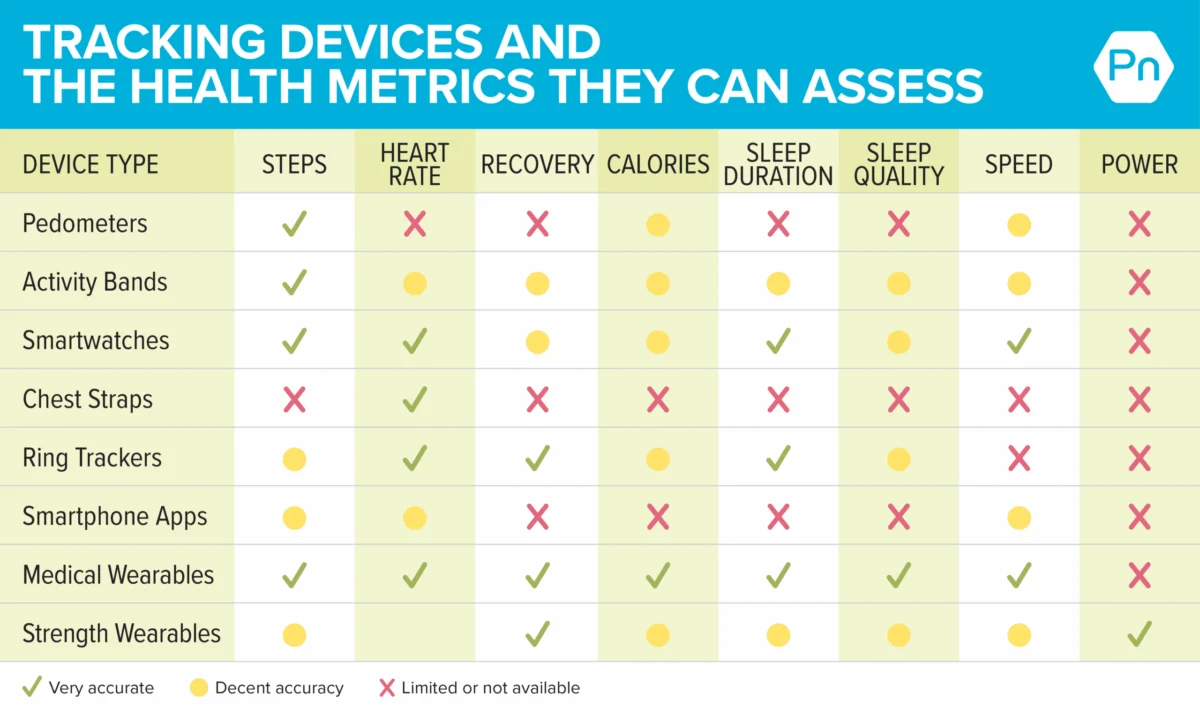
According to industry data, metrics like step counts and heart rate are generally reliable, providing a consistent baseline for daily activity. However, when we move into more complex territories, such as "calories burned" or "movement velocity," the margins for error expand. These outputs are often based on proprietary algorithms that may not account for individual metabolic differences, biomechanical variations, or environmental factors.
Reliability Breakdown
- High Reliability: Heart rate, step count, and basic sleep duration.
- Moderate Reliability: Recovery scores (often based on HRV) and aerobic intensity.
- Low Reliability: Estimated calorie burn and complex "readiness" scores.
Consumers must recognize that these devices are tools for observation, not absolute arbiters of truth. Over-reliance on "yellow-dot" metrics (those with decent but not perfect accuracy) can lead to decisions that contradict our physical reality.

The Paradox of Information: The "Sweet Spot" of Decision-Making
There is a fundamental paradox in the digital health movement: while data is intended to empower, an excess of it can induce paralysis. Computer scientist Samantha Kleinberg, who specializes in the study of decision-making, has noted that even small amounts of extraneous information can negatively impact our ability to make sound choices.
This creates an "inverted U" curve in decision-making. At one end, having too little information leaves us guessing; at the other, having too much creates a state of analysis paralysis. The "sweet spot" exists in the middle, where we possess enough relevant data to inform our actions without being overwhelmed by white noise.
The challenge today is that the health industry is obsessed with providing "more"—more science, more complexity, and more metrics. When these data points start to blur, the path forward becomes obscured. If you find yourself agonizing over a sleep score or obsessing over a caloric surplus while feeling perfectly energetic and capable, you have likely moved past the peak of the curve and into the territory of counterproductive tracking.
When Tracking Becomes a Hindrance: Three Red Flags
To determine whether your relationship with technology is healthy, one must evaluate the impact of that data on your psychological state.
1. The Stress-Validation Loop
For many, tracking is a form of reassurance. Take the case of "Zak," a high-performing athlete who struggled to trust that low-intensity "Zone 2" training was effective. He felt like he wasn’t "grinding" hard enough. However, by monitoring his resting heart rate, he saw objective proof that his cardiovascular system was improving. In this instance, the data acted as a calming agent, validating his method and reducing his anxiety.
However, there is a dark side. When tracking becomes a source of stress—such as when a new parent receives a "poor" sleep score despite having no control over their infant’s sleep schedule—it becomes a burden. If the data provides feedback on things you cannot change, it is time to turn the device off.
2. Motivation vs. Burnout
Behavior change requires three elements: motivation, ability, and a prompt. Trackers are excellent at providing that final prompt. A classic example is the individual who believes a "nightcap" improves their sleep, only to see their sleep quality score plummet when they consume alcohol. The data acts as an undeniable prompt to change behavior.
Conversely, consider the recreational cyclist who becomes obsessed with digital leaderboards. By focusing exclusively on "demolishing records," they lose the joy of the ride. When the numbers become the primary goal, technique, experience, and enjoyment often wither, leading to burnout. If your workout is no longer about the movement, but about the data, you have lost the essence of physical activity.

3. The Erosion of Internal Signals
Perhaps the most significant risk of modern tracking is the erosion of our own interoception—the ability to sense internal states like hunger, fullness, and fatigue. During the infamous "MyFitnessPal blackout" of 2019, millions of users reported feelings of anxiety and confusion when they couldn’t log their food. This mass panic revealed a startling reality: many had become so reliant on the app that they could no longer trust their own hunger cues.
When we disconnect from our internal signals, we lose a vital survival mechanism. A healthy approach involves using technology as a training wheel, not a permanent crutch.
Integrating Tech with Intuition: Three Practical Strategies
To leverage the power of wearables without sacrificing your autonomy, consider these three strategies for better self-assessment:
1. The "Pre-Check" Method
Before you glance at your watch to see how you slept or how hard you ran, pause. Ask yourself: How do I feel? Rate your energy, your mood, and your perceived effort. Then, look at the data. By performing this "pre-check," you begin to calibrate your own internal senses against the objective readout. Over time, you will find that your internal intuition becomes significantly more accurate.
2. Develop Sensory Shortcuts
While technology can measure power output or heart rate, it cannot measure "grit" or "effort" in the way an experienced athlete can. Utilize the Rate of Perceived Exertion (RPE) scale. By mapping your RPE (e.g., "This feels like an 8 out of 10") to the data provided by your device, you create a mental shortcut. Eventually, you will be able to gauge your intensity with high accuracy without needing to check a screen.
3. Trust the Biological Network
Remember that your body is a masterpiece of evolutionary engineering. You have a complex network of proprioceptors, chemoreceptors, and thermoreceptors that constantly monitor your internal and external environment. Technology is a tool, but it is a primitive one compared to the human nervous system. When the data contradicts how you feel, prioritize your lived experience. Use the mirror, your energy levels, and your overall sense of well-being as the primary indicators of your health.
The Future of Health Optimization
The goal of health technology should not be to replace the human experience, but to enhance it. We are entering a phase where the most "optimized" individuals will be those who can seamlessly blend the precision of digital tracking with the wisdom of intuitive living.
If you find yourself lost in a sea of metrics, remember that your health is not a spreadsheet. It is a lived, felt, and dynamic process. By all means, use the technology to learn, to grow, and to calibrate—but never forget to look up from the screen. The most valuable data you will ever collect is the signal that comes from within.