








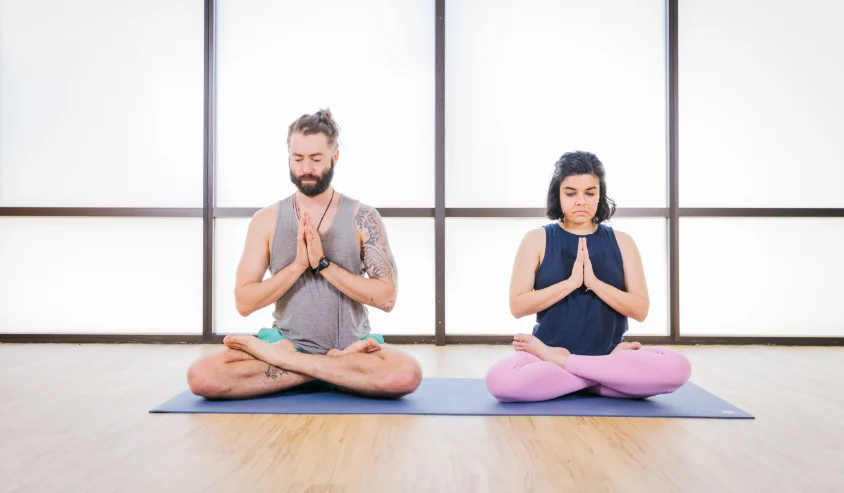
In the ancient Sanskrit text of the Yoga Sutras, the sage Patanjali offers a definition of yoga that has served as the bedrock of contemplative practice for millennia: yogaschitta vritti nirodha. Translated, this foundational aphorism posits that "yoga is the cessation of the movements of the mind." While seemingly simple, this statement outlines a profound metaphysical dichotomy between two fundamental energies: purusha (consciousness or spirit) and prakruti (material nature).
For the modern practitioner, understanding this relationship is not merely an academic exercise; it is the key to resolving the tension between the desire for inner peace and the chaotic demands of contemporary life. To master the practice, one must learn to navigate the ever-shifting landscape of the material world while anchoring oneself in the immutable stillness of the Self.
The Philosophical Paradigm: Defining the Two Realities
At the core of Patanjali’s system—and the broader Sankhya philosophy—lies the recognition of two distinct principles. Prakruti encompasses everything that changes: our thoughts, our physical bodies, the environment, and the subtle impressions of our past actions (karmas). It is the realm of the "doer," driven by the three gunas (qualities of nature: sattva, rajas, and tamas).
Conversely, purusha is the observer. It is the only element within the human experience that remains inherently unmoved. When Patanjali defines yoga as the cessation of vritti (the fluctuations of the mind), he is essentially prescribing a method to peel away the layers of prakruti to reveal the underlying purusha. The challenge, however, lies in the fact that our consciousness is almost perpetually identified with the movements of the mind, a phenomenon Patanjali describes in Chapter 1, Verse 4: vritti sarupyam itaratra—"In any other state, the Self is mistaken for a false form."
The Difficulty of Stillness: Why Meditation Often Feels Like a Struggle
When a practitioner sits to meditate, the immediate experience is rarely one of instant enlightenment. Rather, it is often a battle against the "protests" of the body and the relentless "pulling" of the mind. Even when a person overcomes physical restlessness, they often encounter subtler distractions.
"Blissful states" encountered during meditation, while pleasant, can become a "spiritual trap." A practitioner may believe they have "made it" because they feel a sense of peace or heightened sensory perception. However, from a classical yogic perspective, if these states are still governed by the laws of cause and effect (the gunas), they are still manifestations of prakruti. To mistake these experiences for the ultimate goal of purusha is to remain caught in the cycle of distraction.
The Tanmatra Realm and the "I’ve Made It" Trap
A significant obstacle on the yogic path is the allure of the tanmatra realm. These are the subtle essences of the senses. In this state, a meditator might experience profound, vivid, or even supernatural sensory perceptions. Because these phenomena are objectively "real" within the realm of prakruti, they feel like breakthroughs.
However, Patanjali warns against getting caught in these experiences. They are not the final goal of yoga; they are merely waypoints. The danger is the "I’ve made it" trap, where the ego claims these experiences as evidence of spiritual superiority. True yoga requires the discernment (viveka) to witness these experiences without becoming attached to them, maintaining the focus on the witness-consciousness that remains when the lights and sounds of the mind fade away.
Prakruti as Maya: The Art of Measurement
If prakruti is often viewed as an obstacle, it is also, paradoxically, the most valuable tool for living a meaningful life. The term maya, often used to describe the illusory nature of the world, shares a root with the Sanskrit word ma, meaning "to measure."
Prakruti provides the framework through which we can measure and understand our reality. Through the lens of the gunas—the heating or cooling, the heavy or light, the drying or moistening qualities of life—we can make informed decisions. Ayurveda, the sister science to Yoga, utilizes this logic to heal the body. Similarly, we can measure our spiritual progress not by "feeling" or "visions," but by the tangible impact of our practice on our relationships and our capacity for selfless action.
Developing Discernment (Viveka): The Bridge Between Worlds
The consistent ability to discern the difference between the fleeting mind and the eternal Self is known as viveka. This is not a product of intellectual judgment or social criticism, but a direct result of deep, consistent meditation.
To cultivate this, one must refine the senses. Ayurveda teaches that rasa (taste/fluidity/essence) plays a critical role in perception. If one’s rasa is imbalanced—through poor diet, lack of sleep, or chaotic environments—the perception of reality becomes distorted, leading to clouded judgment. By stabilizing the body and the senses, the practitioner creates the necessary "clean glass" through which the light of purusha can shine.
The Satguru and the Power of Invisibility
A poignant story from Indian tradition illustrates the nature of purusha versus prakruti. A satguru sits in a run-down cottage. Visitors enter, marveling at the beauty of the place, yet they often fail to notice the guru himself. The environment (the prakruti) is flashy and observable, while the spiritual presence (the purusha) is subtle, passive, and "invisible" to the materialistic mind.
This teaches us that the greatest power—the power of spirit—does not compete for attention. It is not "forceful." In a culture that equates success with being noticed, the spiritual path requires a radical shift in values. We must move from the "breadth" of external experience to the "depth" of internal presence.
Integrating Spirit and Matter: The Daily Practice
If the goal is to abide in purusha, does that mean we abandon the world of prakruti? Quite the opposite. The Yoga Sutras provide a roadmap for navigating both. The consensus among scholars is that one must take a passive position in relation to spirit and an active position in relation to material nature.
- Active Engagement: We must manage our daily responsibilities, our health, our career, and our social interactions with vigor, strategy, and intention. This is the realm of prakruti.
- Passive Awareness: When it comes to the Self, we do not "manage" it. We do not strategize our way to enlightenment. Instead, we cultivate the stillness required for purusha to reveal itself.
This requires a delicate oscillation. Throughout the day, the practitioner moves between the active engagement of the relative world and the passive surrender of the meditative state. Patanjali’s system of ethics (Yamas and Niyamas) is designed precisely for this purpose: to keep the "movements of the mind" (the vritti) calm enough so that the transition between activity and stillness remains fluid.
Implications for the Modern Seeker
The duality presented by Patanjali is not meant to alienate us from our lives but to empower us within them. By acknowledging that our "self" is a construct of prakruti—shaped by education, ambition, and experience—we can build a healthy, functioning ego while remaining tethered to the infinite, silent witness that resides beneath it.
The implications for the modern seeker are profound:
- Reframing Failure: When we struggle with a busy mind, we are not failing; we are simply witnessing the natural activity of prakruti.
- Redefining Progress: Success is not measured by the accumulation of mystical experiences, but by the increasing clarity of our discernment and the quality of our service to others.
- Holistic Living: By integrating Ayurvedic lifestyle practices with the meditative discipline of the Yoga Sutras, we ensure that our physical vehicle is capable of supporting the intensity of high-level consciousness.
As we continue to explore the nature of vritti and the interaction between the seen and the unseen, we realize that the path of yoga is not about rejecting the world. It is about understanding the mechanics of reality so deeply that we can live fully within the material realm without ever losing our grip on the eternal stillness that defines our true nature. In the final analysis, the union of purusha and prakruti is not a distant goal, but a lived experience, found in the quiet space between every thought.