











In the era of the quantified self, our relationship with our own bodies has undergone a radical transformation. Where our ancestors once relied on the subtle, intuitive signals of hunger, fatigue, and physical vitality to gauge their well-being, the modern individual is increasingly tethered to a digital tether. Today, a single sleek device on the wrist can pulse with data, tracking everything from heart rate variability and step counts to sleep architecture and exercise intensity.
While these technological advancements provide an unprecedented bridge between subjective feeling and objective reality, they have also introduced a new psychological complexity. Are we becoming more attuned to our health, or are we simply outsourcing our self-awareness to algorithms? As we navigate this landscape, the challenge lies not in the data itself, but in our ability to interpret it without losing our connection to the visceral, human experience of living.
The Evolution of Self-Assessment: From Intuition to Algorithm
Historically, humans were remarkably adept at assessing their physiological states. A hunter-gatherer did not need a calorie tracker to know when they were under-fueled or over-exerted. However, in our modern environment—rife with hidden caloric density and sedentary traps—our innate senses can fail us.
Consider a common scenario: a colleague tracks their diet meticulously, yet finds their weight plateauing. Upon closer inspection, they realize that a daily "harmless" addition of barbecue sauce is contributing an extra 500 calories—enough to derail their progress. Here, technology serves as an essential corrective lens.
Yet, there are outliers who possess a preternatural ability to self-assess. Ben Johnson, the legendary Canadian sprinter, was famous for his ability to accurately predict his 100-meter dash time within a tenth of a second. This level of bodily awareness is the "gold standard" of internal calibration. For the rest of us, technology acts as a training tool to move closer to that level of precision.

The Accuracy Hierarchy: What Can We Actually Trust?
Not all data points are created equal. When evaluating the utility of a fitness tracker, one must first recognize the distinction between "hard" and "soft" data.
The Reliability Spectrum
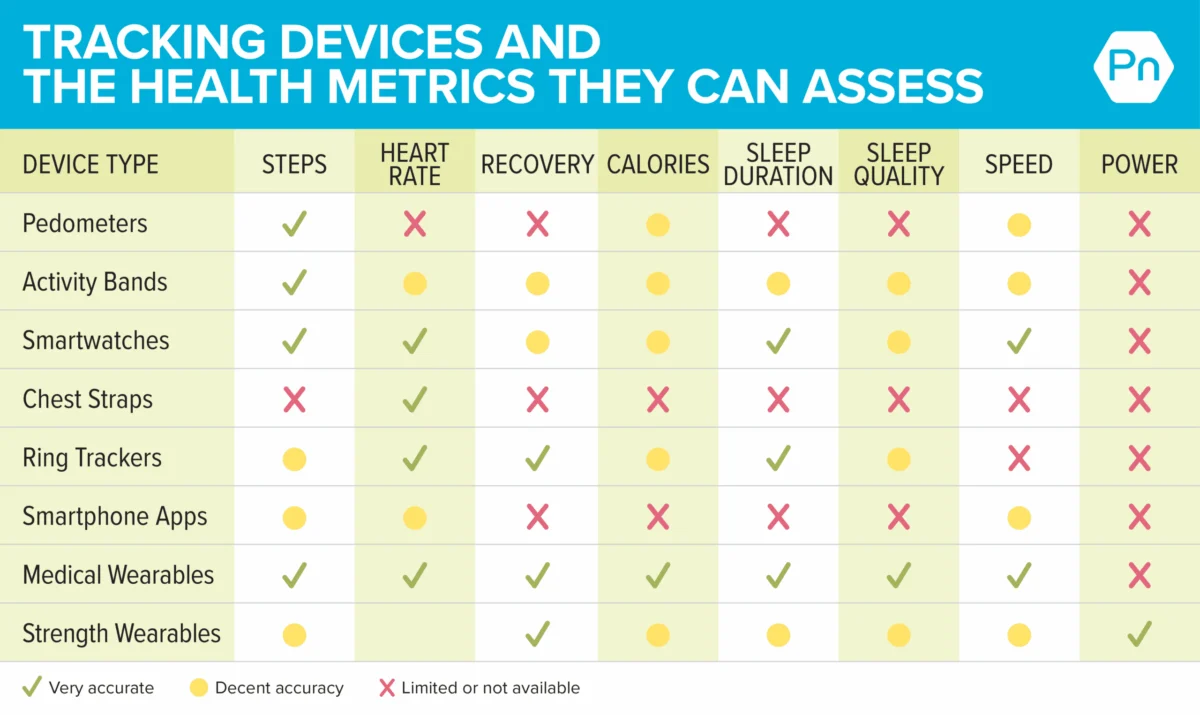
- High Reliability: Metrics like step count and heart rate are generally robust. Modern accelerometers and photoplethysmography (PPG) sensors have reached a level of maturity that makes them highly dependable for general health monitoring.
- Variable Reliability: Metrics such as "calories burned," "sleep quality," and "movement velocity" often carry significant margins of error. These figures are frequently estimates derived from proprietary algorithms rather than direct measurements.
For the consumer, this creates a "black box" problem. When a watch reports that you burned 450 calories, it is making an inference based on age, weight, heart rate, and movement patterns. It is an educated guess, not a metabolic chamber analysis. Understanding the limitations of your hardware is the first step toward using it wisely.
The Paradox of Information: The Inverted U-Curve
The most significant hurdle in the age of wearable tech is the "Paradox of Information." Computer scientist Samantha Kleinberg, a specialist in decision-making, notes that even small amounts of superfluous information can have a detrimental effect on our decision-making capacity.
This follows an inverted U-shaped curve. At the low end, a lack of data makes it impossible to make informed choices. However, once we cross the "sweet spot" of optimal information, we descend into the territory of analysis paralysis. We have all experienced the exhaustion of choosing a restaurant based on hundreds of conflicting reviews; in health, this leads to the "optimization trap," where we become so obsessed with tweaking data points that we lose the joy of the activity itself.
Chronology of a Healthy Relationship with Tech
To determine if your tracking habits are serving you or hindering you, it is helpful to view your usage through a three-stage lifecycle:

- The Calibration Phase: You are new to tracking. You use the device to compare your "gut feelings" (e.g., "I feel tired") with data (e.g., "My heart rate variability is low"). During this phase, you are building a mental map of your physiology.
- The Integration Phase: You rely on the device for specific, actionable insights. You aren’t obsessed with every step; you use the data to validate your training intensity or sleep hygiene. You trust the data, but you trust your body more.
- The Autonomy Phase: You have successfully "internalized" the data. You no longer need to check your watch to know you are overtraining; you can feel it in your nervous system. You use the device only sporadically, treating it as a reference tool rather than a crutch.
Signs Your Tracker is Working For You (or Against You)
The Positive: Validation and Motivation
For many, tracking is a powerful motivator. If you are a high-achiever who doubts your progress, data can be a therapeutic reassurance. When a user like "Zak" sees his resting heart rate drop, he gains the objective proof needed to trust that his low-intensity "Zone 2" training is working. This validation reduces anxiety and allows the user to push harder with confidence. Furthermore, trackers act as a "nudge" for those who struggle with consistency, turning abstract health goals into tangible daily tasks.
The Negative: The "Blackout" Effect and Burnout
Conversely, tracking can become a source of profound stress. If you are a new parent suffering from sleep deprivation, a tracker telling you that your "sleep quality" is poor is not only redundant but psychologically taxing. Worse is the "Blackout Effect"—the genuine panic experienced when a device fails or an app goes down. If your motivation collapses because your app isn’t syncing, you have moved from using a tool to being managed by one.
Implications for Future Health
The future of health technology must shift away from "more data" toward "smarter synthesis." As we move forward, the most successful users will be those who master the art of the "Check-in-First" protocol.
Implementing the Protocol
- Check in with yourself first: Before looking at your watch after a run, ask: How do my legs feel? Is my breathing labored? Did I enjoy this?
- Compare, don’t substitute: Only after you have made your own assessment, check the device. If the data matches your feelings, your internal sensors are well-calibrated. If they diverge, ask why.
- Use shortcuts over metrics: When training, use the "Rate of Perceived Exertion" (RPE). Can you hold a conversation? Are you at a 7/10 effort? These sensory-driven metrics are often more predictive of long-term health than a digital output.
Conclusion: The Mirror and the Machine
Ultimately, the most sophisticated tracking technology you possess is the one you were born with. Your nervous system, your proprioception, and your internal hunger cues provide a real-time, high-fidelity stream of data that no algorithm can fully replicate.
Fitness trackers are not inherently good or bad; they are amplifiers. They amplify our strengths, our anxieties, our progress, and our insecurities. To use them effectively, we must maintain a healthy distance. We must ensure that we are using the machine to understand the body, rather than using the body to feed the machine. By prioritizing our "felt experience"—mindfulness, mastery, and the simple joy of movement—we ensure that our health journey remains human-centered, sustainable, and truly our own.