In a landmark achievement for global health security, a team of researchers from the University of Cambridge and the biotech spinout DIOSynVax (DVX) Ltd has successfully completed the first human clinical trial of a universal coronavirus vaccine. This experimental candidate, designed entirely through artificial intelligence, represents a fundamental shift in how humanity prepares for viral threats. By moving away from reactive, strain-specific vaccine development, this "super-antigen" technology offers a glimpse into a future where pandemics might be neutralized before they even begin.
The study, published in the Journal of Infection, confirms that the vaccine is safe and well-tolerated in humans, successfully priming the immune system to recognize not just current threats like SARS-CoV-2, but an entire family of coronaviruses that have yet to emerge.
Main Facts: A New Paradigm in Immunization
The core innovation of the DIOSynVax project lies in its departure from traditional vaccine methodology. For decades, the global response to viral outbreaks—such as influenza or COVID-19—has been reactive. Scientists wait for a virus to mutate, isolate the new strain, and then scramble to re-engineer a vaccine to match the specific surface proteins of that variant. This "cat-and-mouse" game often leaves public health systems trailing behind the virus’s rapid evolution.
The Cambridge-developed vaccine changes this dynamic by targeting the conserved regions of the Sarbeco coronavirus family. This group includes SARS-CoV-2, the original SARS virus, and a vast reservoir of related bat coronaviruses currently circulating in the wild.
Key takeaways from the initial trial:
- Safety Profile: The Phase 1 study involved 39 healthy volunteers between the ages of 18 and 50. Results indicated no significant side effects, confirming the safety of this novel approach.
- Broad-Spectrum Protection: The vaccine stimulated immune responses against SARS-CoV-2, SARS, and various bat-derived coronaviruses that have not yet crossed the species barrier into humans.
- AI-Driven Design: This is the first vaccine in history to utilize an active ingredient—a synthetic "super-antigen"—conceived entirely through machine learning simulations rather than traditional laboratory trial-and-error.
Chronology: From Digital Design to Human Testing
The journey toward this milestone began in 2017, when DIOSynVax was founded as a University of Cambridge spinout with the support of Cambridge Enterprise. The vision was to create "Digitally Immune Optimised Synthetic Vaccines."
2017–2020: The Computational Phase
Researchers utilized high-performance computing to analyze vast datasets of genetic information collected from global virus surveillance programs. The AI was tasked with identifying "common denominators"—structural features shared across the entire Sarbeco virus family. By distilling these shared traits into a single synthetic sequence, the AI created a "super-antigen" capable of training the immune system to recognize the broader viral family, regardless of specific mutations.
2021–2023: Preclinical Validation
Before moving to humans, the team conducted rigorous animal studies. These tests demonstrated that the super-antigen could elicit robust immune responses, providing a protective shield against multiple coronavirus strains. These findings formed the basis for the regulatory approval of the Phase 1 human trial.
2024: The Human Trial
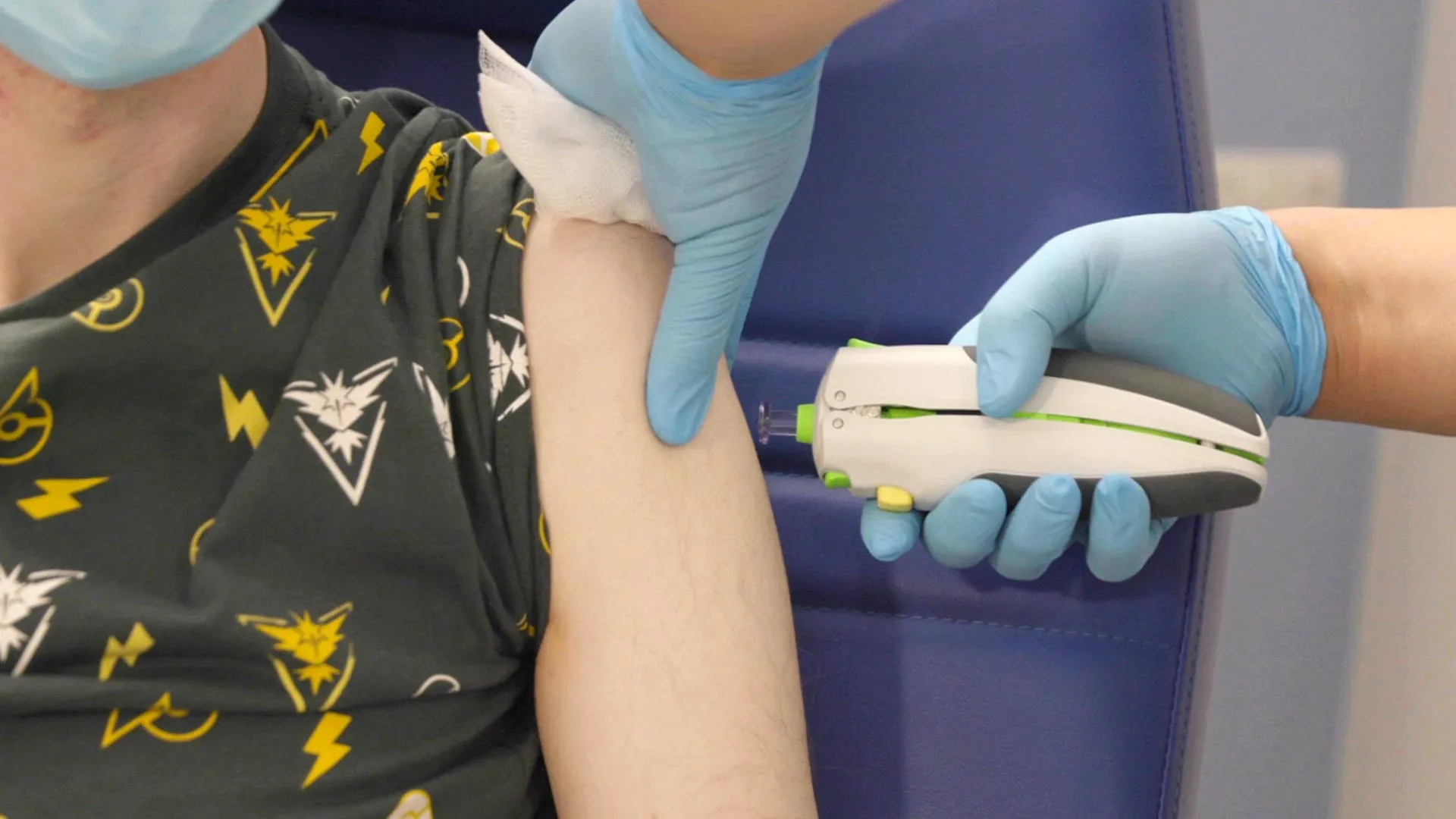
The trial was conducted at the National Institute for Health and Care Research (NIHR) Clinical Research Facilities in Southampton and Cambridge. The vaccine was administered using a needle-free, micro-fluid jet delivery system. This method of administration—which uses pressure to deliver the vaccine through the skin—is not only more comfortable for patients but also potentially more efficient for large-scale global vaccination campaigns.
Supporting Data: Why "Super-Antigens" Work
The traditional approach to vaccine design focuses on the "spike protein," the component of the virus that attaches to human cells. However, the spike protein is the part of the virus that evolves most rapidly, leading to "immune escape," where a vaccine becomes less effective as the virus changes.
The DIOSynVax approach utilizes machine learning to identify structural motifs within the virus that are functionally essential and therefore less likely to mutate. By targeting these "bottleneck" regions, the vaccine ensures that even if the virus mutates its outer shell, the immune system will still recognize the underlying "scaffolding" of the pathogen.
The trial’s data suggests this strategy works. Participants who received the vaccine showed immune markers that were effective against a diverse array of Sarbeco viruses, proving that the digital design effectively translated into biological reality. The success of this trial serves as a proof-of-concept for the entire platform, which researchers intend to adapt for other viral families, including Ebola and influenza.
Official Responses and Expert Commentary
The significance of this trial has drawn praise from across the scientific and medical communities.
Professor Jonathan Heeney, who led the research at the University of Cambridge’s Department of Veterinary Medicine, described the breakthrough as a transition from "reactive" to "future-proof" medicine. "We’ve overcome the problem of traditional vaccines, which have limited protection," Heeney stated. "It means we can escape the constant cycle of chasing the virus variants circulating in humans and updating the vaccines to try to catch up, like a dog chasing its tail."
Professor Saul Faust, the trial’s chief investigator from the University of Southampton, highlighted the economic and societal stakes. "If we can develop and clinically advance this new class of vaccines before a virus outbreak begins, millions of lives could be saved, lockdowns avoided, and the economy preserved," he noted.
The collaborative nature of the study was underscored by Professor Marian Knight of the NIHR, who stated, "The remarkable success of this AI-designed ‘super-antigen’ trial marks a pivotal leap forward in our ability to deliver broad, lasting viral protection. This milestone was only made possible through partnerships between the life sciences sector and our world-class NIHR infrastructure."
Implications: The Future of Global Health Security
The implications of the DIOSynVax trial extend far beyond the specific threat of coronaviruses. We are currently living in an era where the frequency of zoonotic spillovers—viruses jumping from animals to humans—is increasing due to environmental encroachment and globalization.
A New Era of Pandemic Preparedness
- Speed to Response: Because the technology relies on digital modeling, the time required to design a vaccine candidate for a new, emerging virus could be reduced from years to mere weeks.
- Universal Protection: By moving toward "universal" vaccines, public health agencies could theoretically stockpile vaccines for entire viral families, rather than waiting for a specific pandemic strain to arise.
- Ease of Distribution: The success of the needle-free micro-fluid jet delivery system suggests that future vaccines could be administered more easily in low-resource settings, where trained personnel to perform traditional injections are often in short supply.
The Road Ahead
While the Phase 1 results are highly promising, researchers caution that there is still significant work to be done. A larger Phase 2 trial is currently being planned to evaluate the vaccine’s efficacy in a more diverse population and to determine the duration of the immune protection.
The project, funded primarily by Innovate UK, remains a flagship example of how interdisciplinary collaboration—combining artificial intelligence, comparative pathology, and public health infrastructure—can tackle the most complex problems in modern medicine.
As we look toward the future, the "super-antigen" approach offers a beacon of hope. By encoding the wisdom of machine learning into the biology of our immune systems, we are finally moving away from the reactive, uncertain nature of past pandemic responses. We are entering a new age of immunological foresight, where the next potential pandemic might be met with a defense that is already in place, long before the first case is ever recorded.