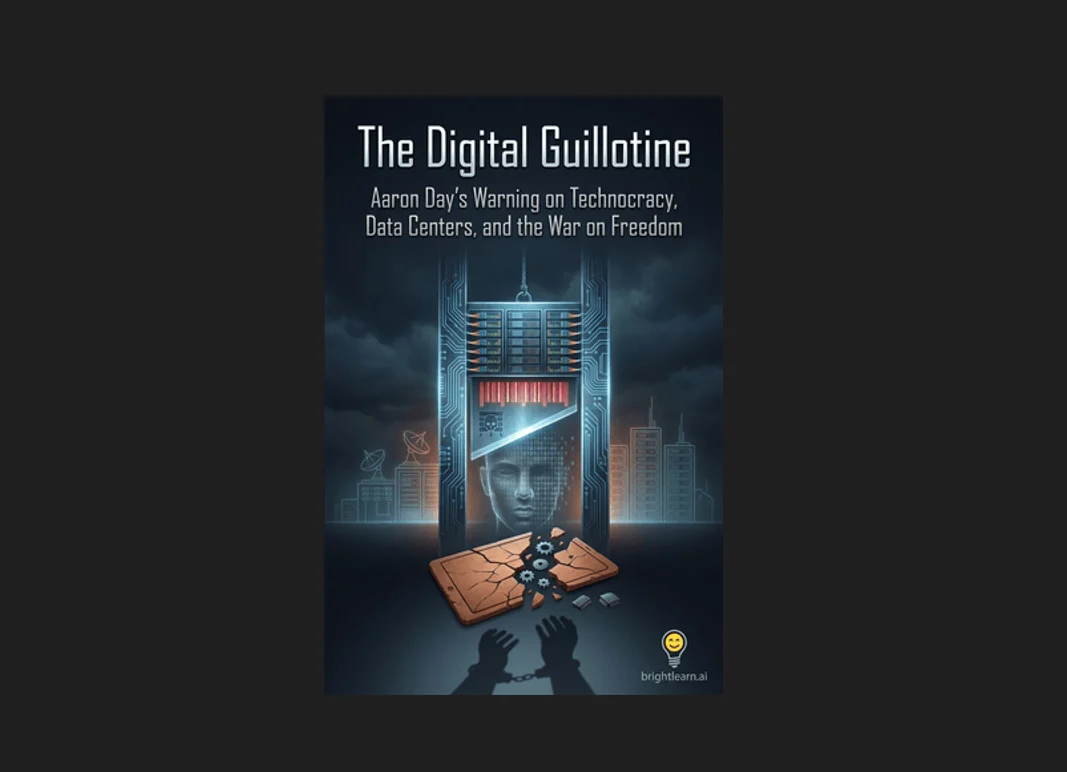
In an era defined by rapid digital transformation, the line between "technological convenience" and "totalitarian control" has become increasingly blurred. Aaron Day, founder of the Daylight Freedom Foundation, argues in his new book, The Digital Guillotine: Aaron Day’s Warning on Technocracy, Data Centers, and the War on Freedom, that this erosion of privacy is not accidental. It is a systematic, decades-long project designed to replace the American republic with a centralized technocratic apparatus.
Day’s work serves as both a chilling exposé of current legislative trends and a pragmatic survival guide for those seeking to reclaim their digital sovereignty. By connecting the dots between massive industrial data centers, the criminalization of peer-to-peer financial transactions, and the forced implementation of digital IDs, Day posits that we are witnessing the construction of a permanent "digital cage."
The Architecture of Control: A Chronology of Technocracy
To understand the current state of digital surveillance, one must look at the historical trajectory of technocratic ambition. Day identifies a ninety-year evolution in his opening chapter, tracing the roots of modern control back to the 1930s.
The Historical Foundation
- The 1930s: The genesis of the technocratic movement, characterized by the belief that society should be managed by experts and scientists rather than through democratic consensus.
- The Post-9/11 Era: The passage of the Patriot Act, which fundamentally shifted the legal landscape regarding the government’s ability to monitor private communications and financial records.
- The 2008 Financial Crisis: A turning point where corporate bailouts and increased regulatory oversight began to centralize the power of the financial sector.
- The COVID-19 Pandemic: The final catalyst, according to Day, which normalized the use of "digital health passes" and paved the way for the integration of biometric tracking into everyday life.
- The Current Epoch: The transition toward Central Bank Digital Currencies (CBDCs) and the deployment of AI-driven domestic monitoring systems.
Day argues that these events are not isolated; they are sequential pillars supporting the modern "Great Reset" agenda, utilizing the speed and reach of contemporary computing to enforce compliance on a global scale.
Supporting Data: The Hyper-Scale Data Center Enigma
Perhaps the most startling revelation in The Digital Guillotine is the physical reality of the surveillance state. It is not merely software or code; it is massive, power-hungry infrastructure being built on public and private land.
The Resource Drain
Day highlights the proposed "Stratos" data center project in Utah as a primary case study. The facility is slated to require nine gigawatts of electricity—the equivalent of ten nuclear power plants. In an arid region already struggling with water scarcity, these facilities consume millions of gallons of water daily for cooling, effectively prioritizing corporate data processing over local agricultural and residential needs.
Eminent Domain and National Security
The book reveals a disturbing trend: the use of eminent domain to seize farmland for corporate data centers owned by tech giants like Amazon and Palantir. These projects are often shielded from public scrutiny under the guise of "national security," preventing local communities from having any meaningful say in how their environment is transformed into a hub for AI-driven surveillance.
The War on Ownership: Financial Surveillance and Privacy
Day’s investigation into the financial sector reveals a systematic effort to eliminate privacy-preserving transactions. He points to the case of Ian Freeman, who was sentenced to nine years in federal prison for operating a Bitcoin exchange. According to Day, this sentencing represents a direct attack on peer-to-peer exchange, intended to ensure that all financial movement remains under the watchful eye of state regulators.
The Stablecoin Trap
The book provides a critical analysis of stablecoins, warning readers that they are being positioned as "backdoor CBDCs." Legislative efforts, such as the GENIUS Act, would require stablecoin issuers to adhere to strict Know Your Customer (KYC) protocols. Day asserts that this turns digital currency into a tool for state control, where funds can be frozen or seized with a single keystroke, stripping users of the true sovereignty promised by decentralized finance.
Official Responses and the Legislative Landscape
Day encourages readers to move beyond speculation and engage directly with the legislative record. He points to several bills that form the backbone of the current technocratic shift:
- The Clarity Act: Critics argue this legislation is designed to stifle the growth of decentralized protocols by imposing heavy-handed regulatory hurdles.
- The GENIUS Act: A regulatory framework that Day argues would effectively outlaw non-custodial financial interactions, forcing all digital commerce into a surveilled ecosystem.
- The STABLE Act: A precursor to the current push for strict oversight of digital assets, aiming to treat private digital tokens like traditional banking instruments.
While government proponents of these acts cite "consumer protection" and "anti-money laundering" as justifications, Day provides evidence that these measures are, in reality, designed to monitor and control the flow of value within the economy.
Implications: The Path to Resistance
The most compelling aspect of The Digital Guillotine is its shift from diagnosing the problem to providing a toolkit for resistance. Day rejects the notion of inevitable defeat, instead offering a path toward "local compute as self-custody."
Building Parallel Systems
Day advocates for the adoption of open-source technology, such as local AI models (e.g., Llama.cpp), which allow individuals to process information without relying on centralized servers owned by Big Tech. By running models on private hardware, individuals can insulate themselves from the data-harvesting practices inherent in commercial AI.
Four Demands for Accountability
Day outlines a clear, actionable agenda for citizens to engage their representatives:
- Free the Crypto Prisoners: Challenging the weaponization of the judicial system against financial innovators.
- Kill the Clarity Act: A direct legislative challenge to the expansion of surveillance powers.
- Fire Howard Lutnick: A demand for accountability within the administrative state.
- End the Draft: Opposing the continued militarization of the state and the expansion of the Pentagon’s role in domestic life.
Conclusion: A Guide for the Living
The Digital Guillotine is not merely an academic critique; it is an urgent wake-up call. Aaron Day makes the case that the American experiment is under existential threat, but that the tools for survival are within our grasp.
For the average citizen, the implications are clear: reliance on centralized infrastructure is a strategic liability. By prioritizing privacy, fostering local energy and food independence, and reclaiming technological autonomy, it is possible to bypass the "digital guillotine" altogether.
As Day concludes, the Republic may be under siege, but it is not yet extinct. For those who value their liberty, the task is simple: stop relying on the machinery of your own oppression, learn to build your own tools, and begin the work of constructing a future that is not defined by surveillance, but by individual agency.
For further reading and resources on these topics, readers can explore the Books.BrightLearn.AI repository, which provides access to literature on privacy and freedom. Additionally, the Health Ranger Report offers in-depth interviews with figures like Aaron Day, providing further context on the ongoing struggle against technocratic control.