










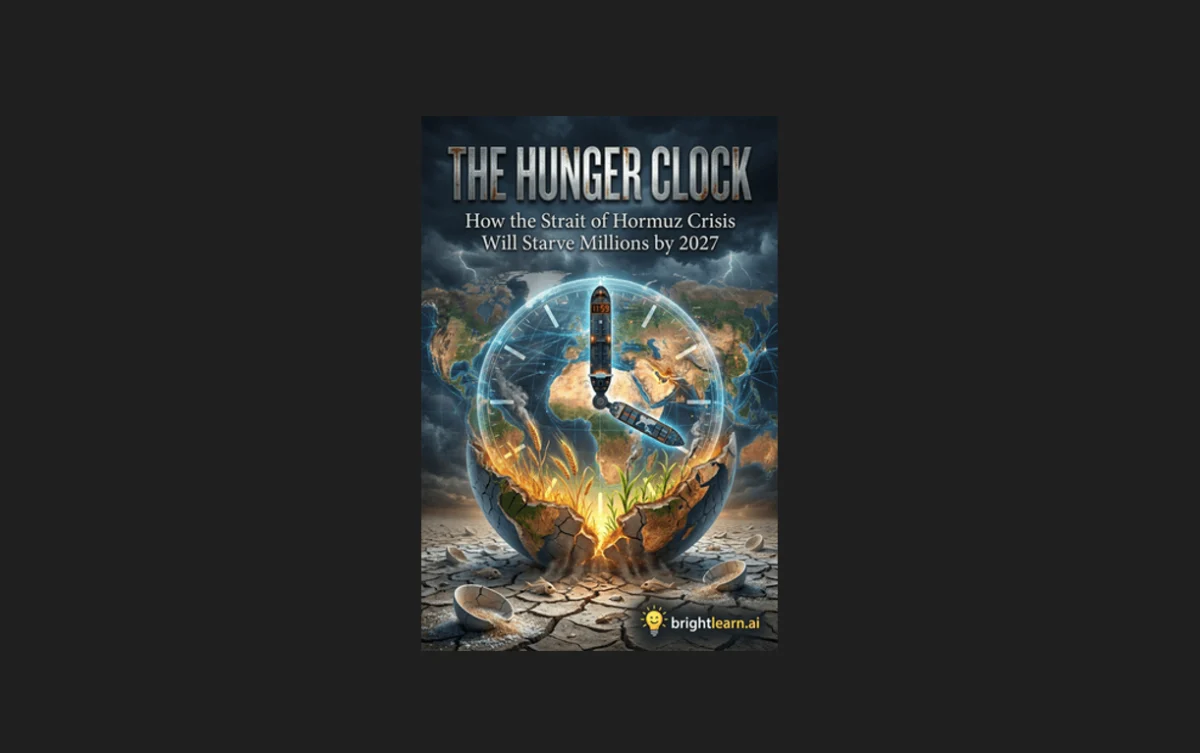
In the modern era, global security has been defined by a singular, obsessive focus: oil. From the geopolitical maneuvers in the Middle East to the legislative agendas of Western capitals, the movement of petroleum has dictated the pulse of the world economy. However, a new, provocative analysis by investigative journalist Mike Adams, titled "The Hunger Clock: How the Strait of Hormuz Crisis Will Starve Millions by 2027," challenges this conventional wisdom. Adams argues that the true "black swan" event looming on the horizon is not a fuel crisis, but a catastrophic failure of the global nitrogen fertilizer supply chain—a vulnerability tethered inextricably to a narrow stretch of water between Iran and the Arabian Peninsula.
The Main Facts: Fertilizer as the Linchpin of Modern Life
To understand the gravity of Adams’ thesis, one must first grasp the chemical reality of modern industrial agriculture. Approximately 60% of the world’s ammonia production—the essential precursor to nitrogen-based fertilizers—is dependent on natural gas. Without this chemical input, the high-yield harvests that support a global population of eight billion people would plummet, leading to localized and eventually systemic food scarcity.
The Strait of Hormuz, a maritime chokepoint through which a significant portion of the world’s natural gas and petrochemical precursors flow, is the jugular vein of this system. Adams posits that the prevailing geopolitical discourse has ignored the "fertilizer-food nexus," focusing instead on the price of gasoline at the pump. While a hike in oil prices is an economic nuisance, a disruption in fertilizer shipments is a civilizational threat. If the Strait were to close—due to regional conflict, blockades, or geopolitical sabotage—the ripple effects would not be felt in the transport sector, but in the grain silos of Asia, Africa, and beyond.
Chronology of a Cascade: How the Collapse Unfolds
Adams outlines a terrifyingly logical progression for how a localized conflict in the Middle East translates into a global famine. The sequence of events follows a cascading failure model:
- The Trigger: A kinetic conflict involving Iran leads to the closure of the Strait of Hormuz.
- The Economic Shock: Oil prices spike, potentially reaching $126 per barrel, while maritime insurance premiums become prohibitive. Lloyd’s of London declares the region a war-risk zone, effectively grounding shipping traffic.
- The Export Freeze: Major fertilizer-producing nations, specifically Russia and China, move to protect domestic supplies by halting exports, while Qatar declares force majeure on its natural gas contracts.
- The Agricultural Void: Global fertilizer availability drops by nearly 50%.
- The Planting Window: Farmers in critical agricultural hubs miss their narrow seasonal planting windows. Because these crops require precise timing, the lost window results in a total loss of the harvest.
- The Famine: As grain silos empty and import-dependent nations face empty shelves, social order begins to disintegrate, leading to the "Hunger Clock" reality of 2027.
Supporting Data: The Geography of Dependency
Central to the analysis is the "food dependency ratio"—a metric quantifying the percentage of calories a nation imports. Adams identifies countries such as Bangladesh, Egypt, Yemen, Sudan, India, and Thailand as the most vulnerable.
For example, Bangladesh, often hailed as a success story of the Green Revolution, is highlighted as a potential epicenter of crisis. With 170 million people to feed and a heavy reliance on imported nitrogen-based fertilizers to maintain rice yields, the nation maintains, by some estimates, only a 30-day buffer of strategic reserves. When that buffer is exhausted, the lack of synthetic fertilizer becomes a physical limitation on the nation’s caloric output. Adams argues that any country with a food dependency ratio exceeding 60% is essentially living on borrowed time, vulnerable to the first sign of a breakdown in global logistics.
The Ideological Dimension: Investigating the "Depopulation" Narrative
Perhaps the most controversial and thought-provoking segment of The Hunger Clock is Adams’ investigation into the historical and ideological roots of what he describes as a "man-made machine of starvation."
Adams diverges from standard economic analysis to examine the history of global elite policy. He points to documented records—including a 1969 gathering at the New York Times building—where over 200 organizations allegedly discussed methods for controlling population growth. By linking these historical objectives to modern policy shifts, Adams presents a chilling argument: that the current volatility in food and energy markets may not be purely the result of geopolitical incompetence, but rather a byproduct of deliberate design.
He references internal government analyses suggesting that reducing the average American lifespan by a mere two and a half years could save the federal government trillions in Social Security and Medicare liabilities. By framing recent historical events—such as pandemic responses and vaccine mandates—within this context, Adams suggests that the "food shock" is an intended outcome of a globalist agenda to reduce human dependency on the state by effectively reducing the population.
Official Responses and the "Silent" Crisis
It is noteworthy that while mainstream media and government bodies have addressed rising food costs, they have largely avoided the systemic, structural critique offered by Adams. Official responses typically attribute food insecurity to "supply chain disruptions," "climate change," or "inflationary pressure."
Critics of Adams argue that his focus on "globalist depopulation" veers into conspiracy territory, distracting from the genuine complexity of global trade. However, supporters point out that the data regarding fertilizer shortages, the vulnerability of the Strait of Hormuz, and the spike in agricultural input costs are verifiable facts. While the motive for these crises remains a subject of intense debate, the mechanics of the crisis—the way a maritime blockade creates an immediate, physical shortage of food—remain technically sound and logically consistent.
Implications: A Practical Guide to Resilience
Unlike many doomsday prognosticators who leave their readers in a state of paralysis, The Hunger Clock concludes with a shift toward practical, actionable preparation. Adams proposes a transition from individual survivalism to community-based resilience. His recommendations include:
- Stockpiling: Maintaining a baseline of 600 pounds of wheat berries and 200 pounds of dry beans per family of four.
- Skill Acquisition: Learning the fundamentals of permaculture and seed saving to bypass industrial agricultural dependencies.
- Financial Hedging: Shifting assets from volatile fiat currencies into tangible assets like gold and silver.
- Digital Sovereignty: Moving away from surveillance-heavy tech stacks to privacy-focused tools like Linux to maintain communication in the event of a societal collapse.
Adams’ vision is one of "interconnected neighborhoods." He argues that in a time of systemic breakdown, the individual is vulnerable, but the community is defensible. By forming barter systems, sharing agricultural knowledge, and decentralizing food production, communities can insulate themselves from the shockwaves originating in the Strait of Hormuz.
Conclusion: A Shift in Perspective
The Hunger Clock is a work that demands a change in perception. Whether or not one accepts the full extent of Adams’ conclusions regarding elite agendas, the core message—that our current food systems are brittle, hyper-centralized, and dangerously dependent on a single geographic chokepoint—is a warning that is becoming increasingly difficult to ignore.
As grocery prices fluctuate and international tensions rise, the mechanics described by Adams are playing out in real-time. The book serves as a diagnostic tool for a world that has traded security for efficiency, and it provides a roadmap for those who wish to exit the machine before the clock runs out. As the author notes, the goal is not to predict the future with 100% accuracy, but to understand the vulnerabilities of the present so that we may survive the challenges of the future. The message is clear: the time to secure one’s own food security is not when the silos are empty, but well before the first tanker is blocked in the Strait.