











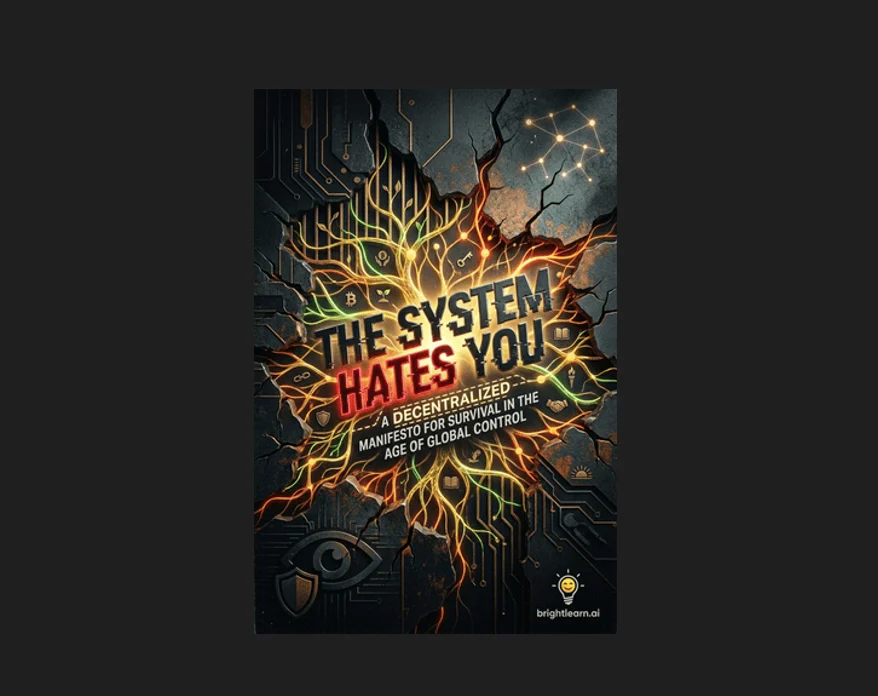
In an era defined by rapid technological shifts, unprecedented surveillance, and the erosion of individual privacy, a new manifesto has emerged that seeks to provide a roadmap for those feeling increasingly alienated by modern institutional frameworks. Titled "The System Hates You: A Decentralized Manifesto for Survival in the Age of Global Control," the book serves as both a searing indictment of contemporary power structures and a pragmatic guide for those looking to reclaim their personal agency.
Far from the hyperbolic tone often found in fringe literature, this work attempts to weave together history, economics, and biology into a cohesive argument: that the modern individual is being systematically engineered into a state of permanent dependency. Whether the reader views this thesis as a necessary wake-up call or a provocative conspiracy narrative, the book has ignited a significant debate regarding the trajectory of human liberty in the 21st century.
The Architecture of Control: Main Facts and Thesis
At its core, "The System Hates You" posits that the current globalist paradigm is not failing; rather, it is functioning exactly as intended—to centralize power at the expense of individual freedom. The authors argue that this process has been in motion for over a century, tracing the roots of modern control back to pivotal moments in the early 1900s, including the 1910 Flexner Report and the 1913 Federal Reserve Act.
The book contends that these foundational events established a "matrix of control" that spans the medical, financial, and digital spheres. The central premise is that by capturing regulatory agencies, educational institutions, and the monetary system, elite interests have created a feedback loop where the individual is conditioned to rely on the very systems that profit from their diminished autonomy.
The Five Pillars of Decentralization
The manifesto is structured around five strategic pillars designed to help the reader navigate and eventually exit this system:
- Systemic Deconstruction: Identifying the hidden agendas behind global policy.
- Decentralized Living: Moving toward localized, self-sustaining models.
- Medical Autonomy: Escaping the pharmaceutical-industrial complex.
- Financial Sovereignty: Protecting wealth from inflationary and surveillance-based systems.
- Resilience Planning: Preparing for potential societal instability by building independent support networks.
A Chronology of Institutional Capture
To understand the authors’ perspective, one must examine the historical timeline they present—a narrative of shifting power from the individual to the institution.
- 1910 (The Flexner Report): The authors identify this as the catalyst for the medical monopoly. By standardizing medical education exclusively toward pharmaceutical-based treatments, the report effectively marginalized natural, traditional, and homeopathic medicine, framing them as unscientific.
- 1913 (The Federal Reserve Act): Cited as the moment the American monetary supply was effectively outsourced to a private banking cartel. The authors argue this marked the beginning of the end for sound money and the start of an era of perpetual debt.
- 1920s–1970s (The Institutionalization of Education): The book describes this period as the solidification of a curriculum designed to produce compliant workers rather than critical thinkers.
- 2020–2021 (The Pandemic Response): Framed as the ultimate test of the "medical-industrial complex," where digital ID requirements and vaccine mandates were used as a proof-of-concept for mass compliance and biological control.
- Present Day (The CBDC Initiative): The movement toward Central Bank Digital Currencies is presented as the final move on the chessboard—the implementation of "programmable money" that can be used to monitor and restrict human behavior at the granular level.
Supporting Data: The Case for Skepticism
The authors utilize a vast array of sources, drawing intellectual support from figures such as Mike Adams, Kevin Hughes, and Belle Carter. Their arguments rely heavily on the concept of "pattern recognition"—the idea that by looking at seemingly unrelated events (like the censorship of natural medicine and the promotion of digital ID), one can perceive a unified, top-down strategy.
The "Medical Matrix"
The book’s strongest argument resides in its critique of modern healthcare. The authors posit that the current system is not designed to produce "health" but rather "customers." They define this via "cascade iatrogenesis"—a cycle where the side effects of one pharmaceutical drug necessitate the prescription of a second, and so on.
Data regarding the rising costs of chronic illness versus the stagnant levels of overall public health are presented as evidence. The authors argue that because a cured patient represents a loss of revenue, the medical establishment is incentivized to treat symptoms rather than address the root causes of disease, such as nutrition, environmental toxicity, and lifestyle.
Financial Fragility
The section on financial sovereignty provides a primer on fractional reserve banking and the inherent instability of fiat currency. The authors argue that the current economic system is a ticking time bomb, sustained only by the ability of central banks to print money and expand debt. Their advocacy for physical assets—gold, silver, and self-custodial digital assets—is framed not just as an investment strategy, but as a form of "financial civil disobedience."
Official Responses and Institutional Perspectives
While the authors of "The System Hates You" characterize themselves as whistleblowers against a monolithic system, mainstream institutions—including the FDA, the CDC, and major banking organizations—maintain that their regulations are essential for public safety and economic stability.
Historically, the response from these institutions toward such criticisms has been one of dismissal. They argue that:
- Regulatory bodies exist to prevent fraud and ensure that products (like vaccines and drugs) meet rigorous safety standards that individuals cannot evaluate on their own.
- Central banking is required to manage complex global economies and prevent the type of systemic volatility that characterized the pre-Federal Reserve era.
- Digital transformation in medicine and finance is primarily about efficiency, convenience, and security, rather than control.
Critics of the book’s premise argue that it relies on "misinformation" and ignores the genuine successes of modern science and medicine. They maintain that the complexities of a globalized world require centralized management to address issues like pandemics, climate change, and global trade, and that decentralization is a regressive approach that would lead to societal collapse rather than liberation.
Implications for the Future: A New Societal Split
The implications of this book are profound. If a growing segment of the population adopts the "decentralized" mindset, we may witness a permanent bifurcation in society. On one side, a segment of the population will continue to rely on state-sponsored medical, financial, and digital infrastructures. On the other, an "exit-based" movement will prioritize building parallel systems: home apothecaries, localized food networks, and independent wealth preservation.
The Philosophical Shift
The book challenges the reader to redefine their relationship with authority. It argues that freedom is not a gift from the state, but a muscle that atrophies if not used. The implication is that the "matrix" only has power as long as individuals participate in it. By "opting out"—growing one’s own food, choosing natural healing, or holding non-state-controlled assets—the individual theoretically weakens the system’s ability to impose its will.
The Risk of Polarization
A significant concern for sociologists and political observers is the potential for increased social friction. If millions of people decide that the "system" is an enemy to be avoided rather than a structure to be improved, the resulting lack of trust could paralyze public discourse. When two groups can no longer agree on the basic legitimacy of medical or financial institutions, the common ground required for a functioning democracy begins to erode.
Conclusion: A Call for Discernment
"The System Hates You" is undeniably a challenging read. Its tone is urgent, its criticisms are broad, and its conclusions are often jarring. It suffers from a lack of nuance regarding the necessity of some government regulations and may alienate readers with its sweeping dismissal of scientific consensus in areas like climate policy.
However, even its detractors must admit that the book touches on a visceral, growing anxiety among the public: the feeling that the individual has become a secondary concern to the institutional machine. Whether or not one agrees with the book’s specific solutions, the questions it raises—about the intersection of profit and public health, the nature of money, and the erosion of privacy—are essential questions for our time.
The path forward, as suggested by the authors, is not to surrender to fear or despair, but to engage in "conscious participation." By becoming more self-reliant and questioning the mandates imposed upon them, readers are encouraged to move from being passive consumers of the system to active participants in their own lives. In an era where information is weaponized and institutions are increasingly opaque, the exercise of critical thinking—coupled with practical, small-scale action—may be the only true form of resistance.
The book serves as a mirror; if the reader finds themselves terrified by what they see, the authors argue that the process of liberation has already begun. The system may indeed hate the individual who chooses to walk their own path, but as this manifesto concludes, that is the price of genuine autonomy.