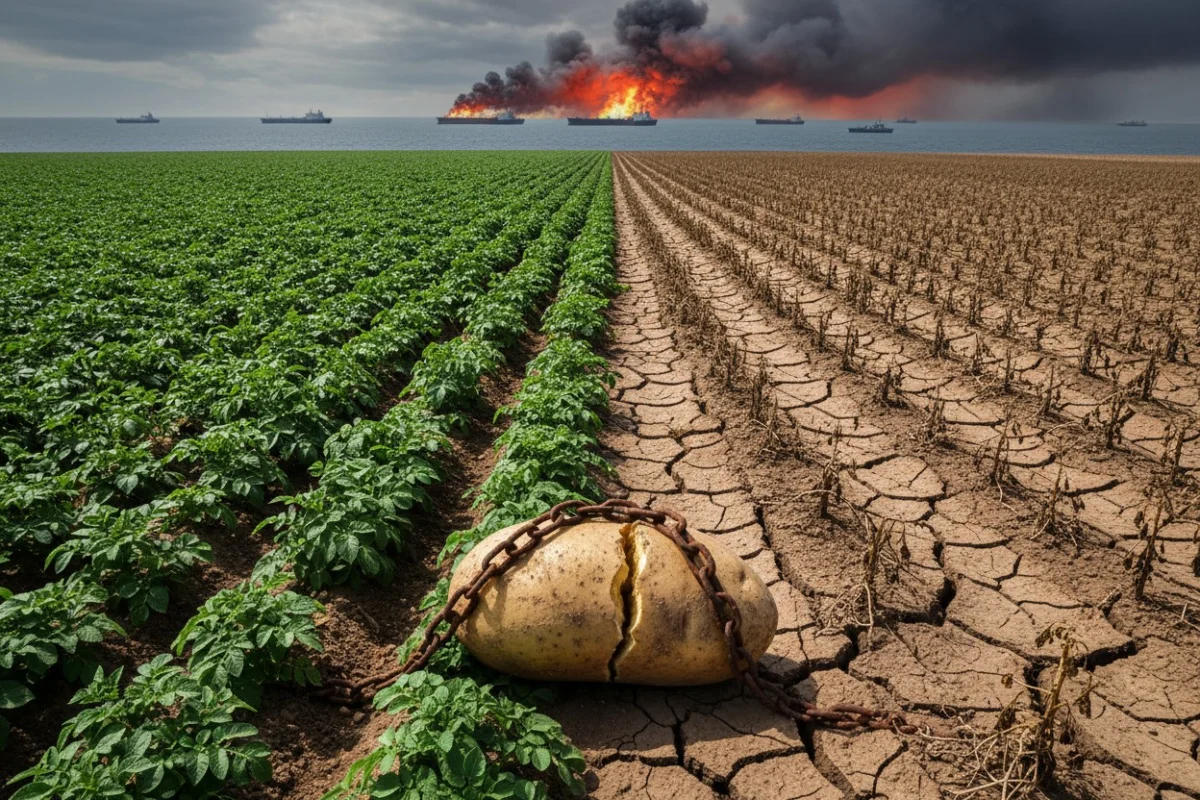
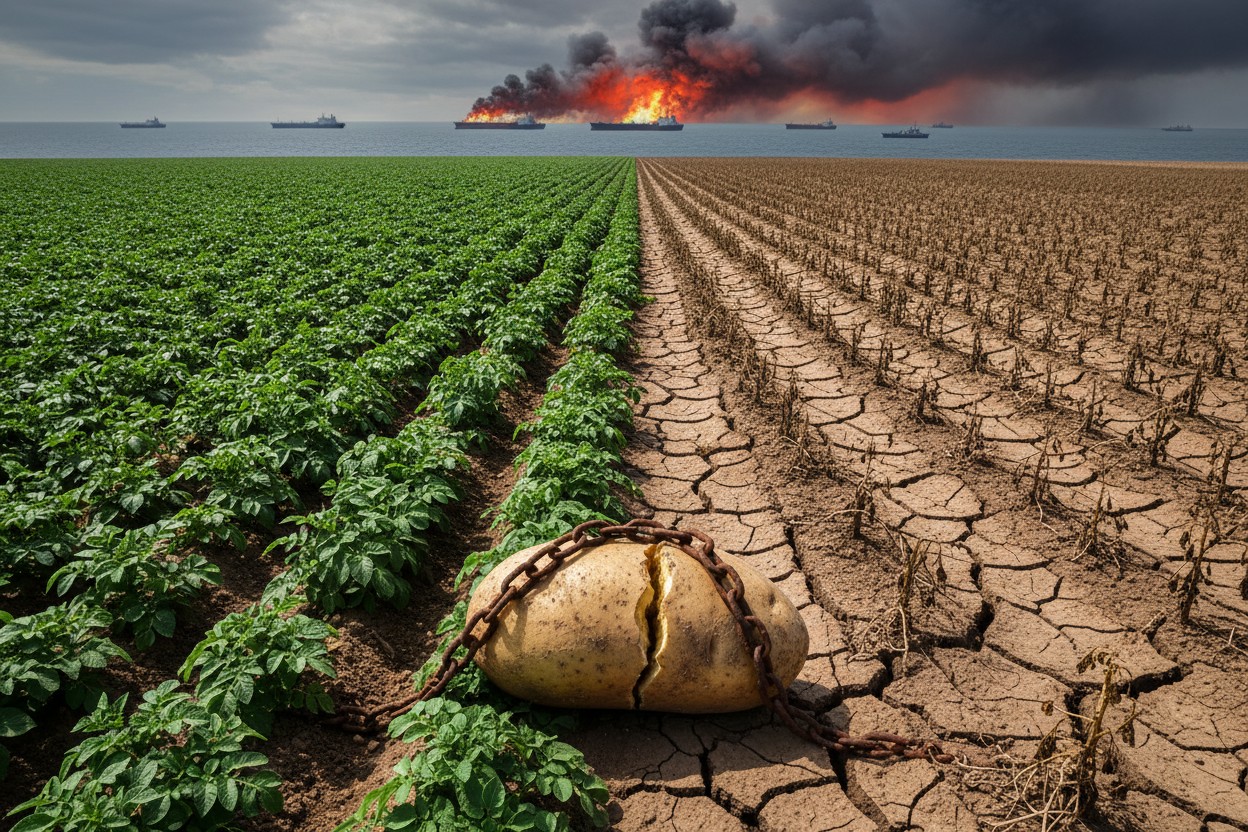
The global agricultural market is currently staring down the barrel of a potential systemic crisis, with the humble potato serving as the canary in the coal mine. According to data from Trading Economics, potato futures have witnessed an unprecedented surge, climbing over 700% in the past month alone, with year-on-year prices up by 34% as of mid-May. While supermarket shelves in regions like Europe currently remain well-stocked due to recent production gluts, the financial markets are signaling a deeper, more structural anxiety: the fragility of a global food supply chain inextricably linked to the volatile geopolitics of the Strait of Hormuz.
The Catalyst: A Perfect Storm in the Gulf
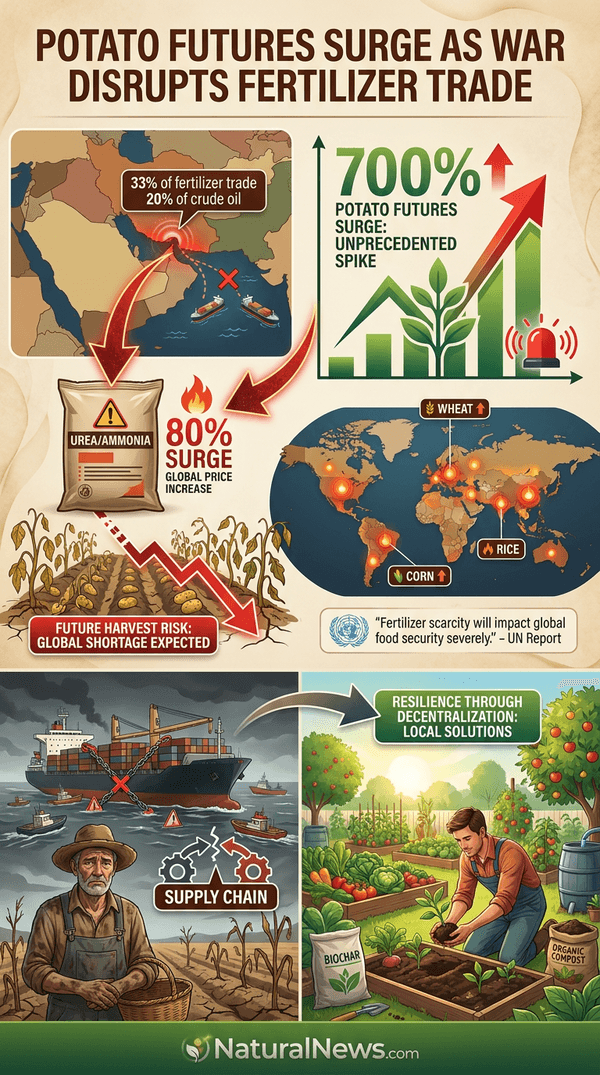
The primary driver behind this price explosion is the escalating conflict involving the United States, Israel, and Iran. The Strait of Hormuz—a narrow maritime chokepoint—is not merely a conduit for crude oil; it is the jugular vein of the global agricultural input market. United Nations estimates suggest that roughly 20% of global crude exports and a staggering one-third of the world’s fertilizer trade pass through this narrow waterway.
As hostilities intensify, the risk of a total blockade or sustained disruption has sent shockwaves through the commodities exchange. Because modern industrial agriculture is heavily reliant on nitrogen-based fertilizers like urea and ammonia—which are produced using natural gas feedstocks—the surge in energy prices has created a direct, linear escalation in farming costs. Industry estimates indicate that fertilizer prices have already spiked by approximately 80% since the conflict began to escalate, effectively pricing the marginal farmer out of the future planting season.
Chronology of the Crisis: From Ukraine to the Strait of Hormuz
To understand the current predicament, one must look at the cumulative nature of the pressure on global food systems.
- 2008 Food Price Crisis: The historical benchmark for volatility. It taught the world that financial speculation often compounds geopolitical risks, turning localized supply shocks into global price spikes.
- 2022-2023 (The Ukraine Conflict): This period marked the beginning of a supply chain breakdown. The war in Ukraine, a breadbasket of the world, strained fertilizer and grain logistics, leading to severe shortages of commodities like sunflower oil in European markets.
- Early 2026 (The Current Escalation): As the U.S.-Israeli conflict with Iran deepened, energy and fertilizer markets began to decouple from "just-in-time" delivery expectations.
- Mid-May 2026: Potato futures reach their 700% month-over-month peak, reflecting market consensus that the "cushion" of current supplies will soon be exhausted by the reality of higher input costs for the next harvest.
Supporting Data: The Anatomy of a Market Spike
The rise in potato futures is a manifestation of "risk-pricing." Analysts argue that the market is not necessarily reacting to a current shortage of potatoes, but rather to the certainty of future scarcity. If farmers cannot afford the current cost of nitrogen-based fertilizers, they will logically choose to reduce planting acreage in the coming seasons.
This behavior creates a feedback loop:
- Input Cost Inflation: Fertilizer and diesel prices rise due to energy market instability.
- Speculative Hedging: Commodity traders buy futures contracts to hedge against anticipated price increases.
- Market Decoupling: Prices in the futures market begin to rise far faster than the physical commodity, as speculation exacerbates the psychological fear of shortages.
- Supply Contraction: Farmers, facing high input costs and uncertain yields, scale back production, ultimately fulfilling the market’s prophecy of a supply squeeze.
This pattern is not unique to potatoes. The UN’s Food and Agriculture Organization (FAO) reports that global food prices have trended upward for three consecutive months. Vegetable oils, wheat, corn, and rice have all followed the potato’s upward trajectory, driven by the same rising transport and energy costs linked to the instability in the Middle East.
Official Responses and Expert Warnings
The gravity of the situation has not been lost on global industry leaders and humanitarian figures.
Svein Tore Holsether, CEO of Yara International—one of the world’s largest fertilizer companies—has issued a stark warning: the escalating hostilities in the Gulf are not just a regional issue, but a global agricultural threat. He cautioned that the world is heading toward a "bidding war" for food, where wealthy nations will outbid poorer, import-dependent countries, leaving the latter facing acute food insecurity.
Chef Jose Andres, the founder of World Central Kitchen, has echoed these concerns, emphasizing that the disruption to fertilizer supplies is a "slow-moving disaster" that will disproportionately impact the world’s most vulnerable populations. The United Nations Development Programme (UNDP) has projected that if the current economic fallout continues, more than 30 million people across 162 countries could be pushed into extreme poverty, directly linked to the broader inflationary impact on food and energy.
The "Glut" Mirage
A critical point of confusion for the average consumer is the current oversupply of potatoes in the European market. Analysts warn that this is a temporary illusion—a "glut" that masks the underlying systemic rot. Because the European agricultural sector expanded production during previous, more stable years, the immediate impact on retail prices has been dampened.
However, this cushion is thinning. As energy costs for transport and storage rise, the retail price of even these "abundant" potatoes will likely increase. Furthermore, the reliance on just-in-time logistics means that any prolonged closure of shipping lanes would exhaust current inventories in a matter of weeks, leading to sudden, sharp price hikes at the grocery store.
Implications: A Shift Toward Decentralization
The recurring theme of this crisis is the inherent fragility of centralized, globalized food supply chains. When the system relies on thousands of miles of transit, stable energy prices, and uninterrupted shipping lanes, there is zero margin for error.
The Rise of Personal Sovereignty
As the global food system faces more frequent shocks, some analysts are suggesting a return to localized, decentralized production as a survival strategy.
- Home Gardening: Growing staples like potatoes and sweet potatoes is being framed not just as a hobby, but as a form of personal food security.
- Permaculture and Organic Amendments: To mitigate the dependence on nitrogen-based, imported fertilizers, many are turning to natural soil amendments, biochar, and regenerative farming practices that build soil health and fertility locally.
- Community Networks: Local food systems—cooperatives, farmers’ markets, and regional distribution networks—are being touted as the essential "buffer" against the volatility of international commodity markets.
Conclusion: Preparing for an Uncertain Harvest
The 700% surge in potato futures is more than just a headline-grabbing statistic; it is a clear warning that the era of cheap, reliable food is being challenged by the realities of geopolitical conflict. The global food system’s dependence on centralized logistics, synthetic inputs, and stable energy has left it dangerously exposed to the currents of war.
While governments and international bodies struggle to stabilize trade routes and energy supplies, the long-term outlook remains clouded by uncertainty. For the individual, the lesson is increasingly clear: as the global supply chain becomes more prone to disruption, self-sufficiency and the development of local, resilient food networks are no longer radical ideas, but necessary precautions. The potato, often taken for granted, has become the symbol of a new age where food security is once again a personal and local responsibility.
Summary of Indicators (As of Mid-May 2026)
| Commodity | Price Trend | Primary Driver |
|---|---|---|
| Potatoes | +700% (Monthly) | Fertilizer/Energy Costs |
| Vegetable Oils | 2022 Highs | Global Supply Chain Strain |
| Fertilizers | +80% (Since Conflict) | Strait of Hormuz Instability |
| Global Poverty Risk | 30M+ People | Economic Fallout/Inflation |
Disclaimer: This analysis is based on current market trends and geopolitical assessments. The volatility of commodity markets remains high, and investors should consult financial advisors before making decisions based on futures data.