





For millennia, the Indian subcontinent has been the cradle of Ayurveda—a comprehensive system of medicine that views health not merely as the absence of disease, but as a blissful state of equilibrium between the body, mind, and spirit. Central to this holistic philosophy is the practice of Ayurvedic massage. Far from being a mere luxury or a recreational indulgence, Ayurvedic massage is a sophisticated therapeutic discipline used for both Shamana (palliative care) and Shodhana (purificatory therapy).
By employing intentional touch governed by the five elemental principles of nature, practitioners seek to restore the body’s innate intelligence. As we navigate the complexities of modern wellness, the ancient wisdom of the brhat trayi—the "Great Three" foundational texts of Ayurveda (Caraka, Sushruta, and Vagbhata)—offers a timeless blueprint for longevity, vitality, and deep-seated health.
The Foundations: Five Elements and Three Doshas
To understand Ayurvedic massage, one must first grasp the Ayurvedic view of the universe. Ayurveda posits that all matter is composed of five great elements (panchamahabhutas): Space, Air, Fire, Water, and Earth. These elements combine to form the three doshas, or biological humors, that govern our physical and mental constitutions:
- Vata: Comprised of Space and Air, it governs movement and communication.
- Pitta: Comprised of Fire and Water, it oversees transformation, digestion, and metabolism.
- Kapha: Comprised of Water and Earth, it provides structure, stability, and lubrication.
Every individual possesses a unique blueprint of these doshas, known as Prakruti. When these doshas deviate from their natural state, illness or discomfort arises, a condition known as Vikruti. Ayurvedic massage is fundamentally an act of "opposites therapy"—treating a doshic imbalance by applying techniques and substances with opposing qualities.
A Historical Chronology: From Warriors to Postpartum Care
The methodologies of Ayurvedic massage are deeply rooted in history. While the brhat trayi provides the theoretical framework, other texts like Bhavaprakasha and Yogaratnakara further refined the practical applications.
In ancient times, these techniques were not reserved for the elite or the ill. They were integral to daily life:
- Athletic and Warrior Support: Massage was utilized to build physical resilience, improve circulation, and speed recovery after combat or intense training.
- Virilization and Vitality: Specific protocols were designed to support reproductive health and systemic vigor.
- Postpartum Care: Ayurveda has long recognized the intense depletion associated with childbirth, employing oil-based therapies to ground the mother and stabilize her nervous system.
- Preventative Maintenance: Regular oleation was considered as essential as eating or sleeping, serving as a prophylactic measure against seasonal shifts and aging.
Individualized Care: The Precision of Ayurvedic Therapy
Unlike standardized Western massage, which often follows a singular, universal protocol, Ayurvedic massage is strictly individualized. A practitioner’s strategy is informed by a comprehensive assessment of the client’s Prakruti (constitution) and Vikruti (current imbalance).
The Role of Digestive Fire and Toxins
The practitioner evaluates Agni (the digestive fire) and Ama (metabolic toxins). If the body is burdened with Ama, standard oil massages are often contraindicated. Because oil shares the heavy, sticky, and unctuous qualities of Ama, it can exacerbate congestion. In these cases, the practitioner may pivot to Udvartana—a dry massage using hot, herbalized powders that cut through stagnation and stimulate lymphatic drainage.
The Science of Oil Selection
The choice of carrier oil and the specific herbs infused within it are not arbitrary; they are prescribed with the precision of a pharmacy.
- Vata Imbalance: Heavy, warming oils like sesame are preferred to ground the "airy" nature of Vata.
- Pitta Imbalance: Cooling, soothing oils like coconut or sunflower are utilized to extinguish the "fire" of Pitta.
- Kapha Imbalance: Lighter, heating oils such as mustard are employed to stimulate metabolism and reduce the accumulation of fluid.
Special Considerations: Vata and the Architecture of the Mind
According to the Samkhya school of philosophy, the air element is intimately linked to the sense of touch (Sparshendriya). Because Vata is composed of air and space, the nervous system is uniquely susceptible to the healing influence of touch.
This makes Ayurvedic massage a potent tool for mental health. By calming the nervous system, it addresses the "restlessness" associated with the modern mind. Furthermore, the practice nourishes the skin (Tvak), which is governed by bhrajaka pitta. By feeding the skin through regular oil application, the therapeutic benefits penetrate deeper—past the dermis to the muscles, nerves, bones, and internal organs—enhancing the body’s resilience from the inside out.
Categories of Therapeutic Massage
Ayurvedic massage manifests in various forms, each serving a specific physiological need.
Abhyanga: The Art of Oleation
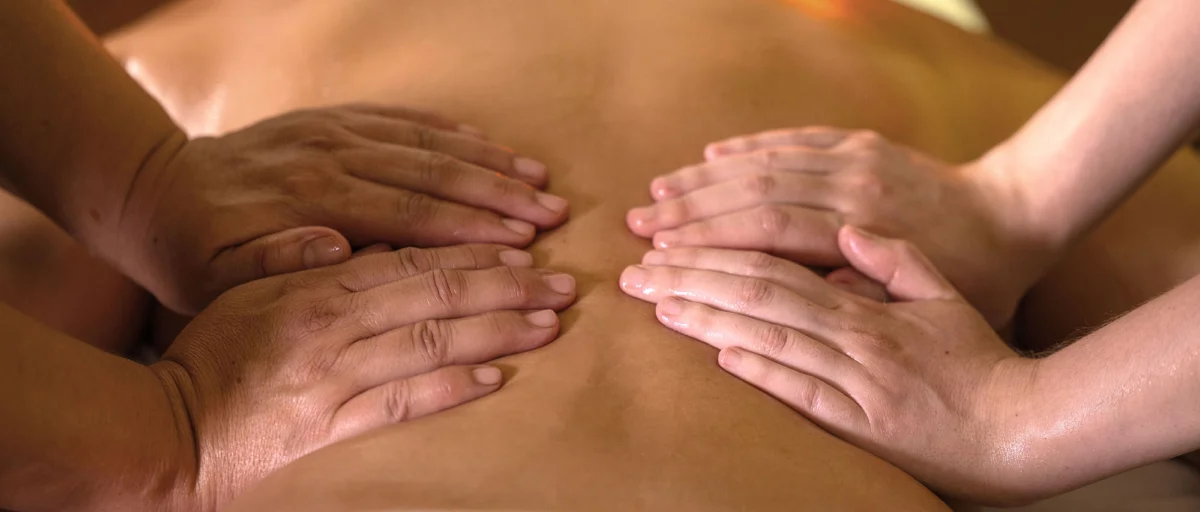
Abhyanga is the most widely recognized form of Ayurvedic massage. Whether performed as a self-care ritual or a professional treatment (sometimes involving two therapists for a "four-handed" massage), its primary goal is Snehan. In Sanskrit, Snehan means both "oil" and "love." The practice is literally a way of saturating the cells with a vibration of care. When combined with internal oleation (as seen in Panchakarma), Abhyanga becomes a powerful tool for dislodging deep-seated toxins and allowing them to be eliminated by the body’s natural detoxification pathways.
Mechanical and Manual Techniques
Beyond oiling, the practitioner uses a diverse repertoire of strokes to achieve specific outcomes:
- Udvartana & Udsadana: Dry herbal powders used for detoxification and beautification.
- Udgarshana: Herbal pastes designed to treat specific skin conditions.
- Anuloma/Pratiloma: The direction of the stroke matters. Moving away from the heart (Anuloma) induces calm and grounds the nervous system, while moving toward the heart (Pratiloma) stimulates lymph flow and aids in vascular circulation.
Supporting Data: The Mechanics of Touch
The efficacy of these treatments relies on a specific taxonomy of movements:
- Garshana/Mardana (Friction): To generate heat and clear pathways.
- Peedana (Kneading): To release tension in the muscular tissue.
- Udvesthana (Twisting/Wringing): To mobilize fluids and tissues.
- Praharana (Percussion): To stimulate blood flow and tone.
- Trashana (Stroking): To soothe the subtle energy channels.
- Sandhi Calana (Joint Movements): To maintain the health of the skeletal system.
Marma Therapy: The Energetic Frontier
Perhaps the most profound dimension of Ayurvedic massage is Marma therapy. Marmani are specific anatomical points where the physical body intersects with the energetic field. These points act as gateways to the internal organs and glands.
While often compared to Chinese acupuncture, Marma therapy is distinct in its methodology. The points in Ayurveda are often larger and are stimulated using pressure, friction, or specialized oil applications rather than needles. By clearing blockages at these intersections, a practitioner can restore the flow of Prana (life force), triggering the body’s "inner pharmacy" to accelerate self-healing.
Implications for Modern Wellness
In an era of high-stress living and digital disconnection, the tactile, intentional nature of Ayurvedic massage provides a necessary remedy. The implications of this practice extend far beyond skin-deep results; it offers a systemic reset for the nervous system.
By aligning the body with its natural elemental rhythm, individuals can move from a state of reactive stress to one of proactive, grounded health. As scientific interest in the mind-body connection grows, the 5,000-year-old tradition of Ayurvedic massage stands as a validated, sophisticated, and deeply effective pathway for reclaiming human vitality.
For those interested in deepening their knowledge, the study of the "Healing Touch of Marma" continues to be a cornerstone of professional Ayurvedic education, blending the wisdom of ancient sages with the needs of the contemporary practitioner.