
Published September 28, 2026
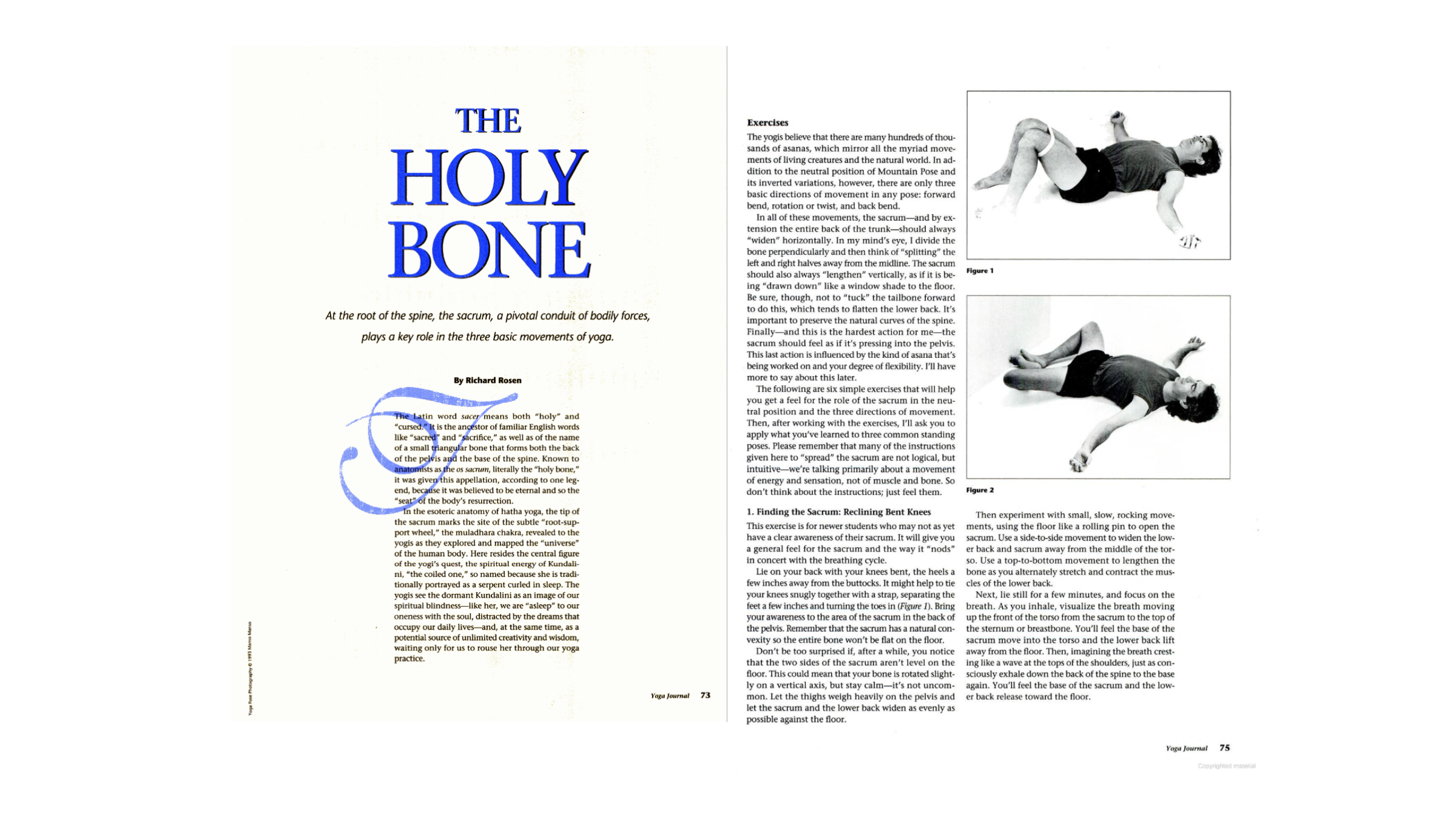
In the vast lexicon of human anatomy, few structures carry as much linguistic and spiritual weight as the sacrum. Derived from the Latin sacer—meaning both "holy" and "cursed"—the sacrum is a triangular powerhouse at the base of the spine. While anatomists view it as the keystone of the pelvic girdle, yogic tradition views it as the "holy bone," a seat of latent energy and the structural foundation of the human microcosm.
This exploration, drawn from the archives of Yoga Journal, bridges the gap between the clinical reality of our bones and the profound, subtle energy systems that have defined the practice of hatha yoga for centuries.
Main Facts: The Anatomy of the Foundation
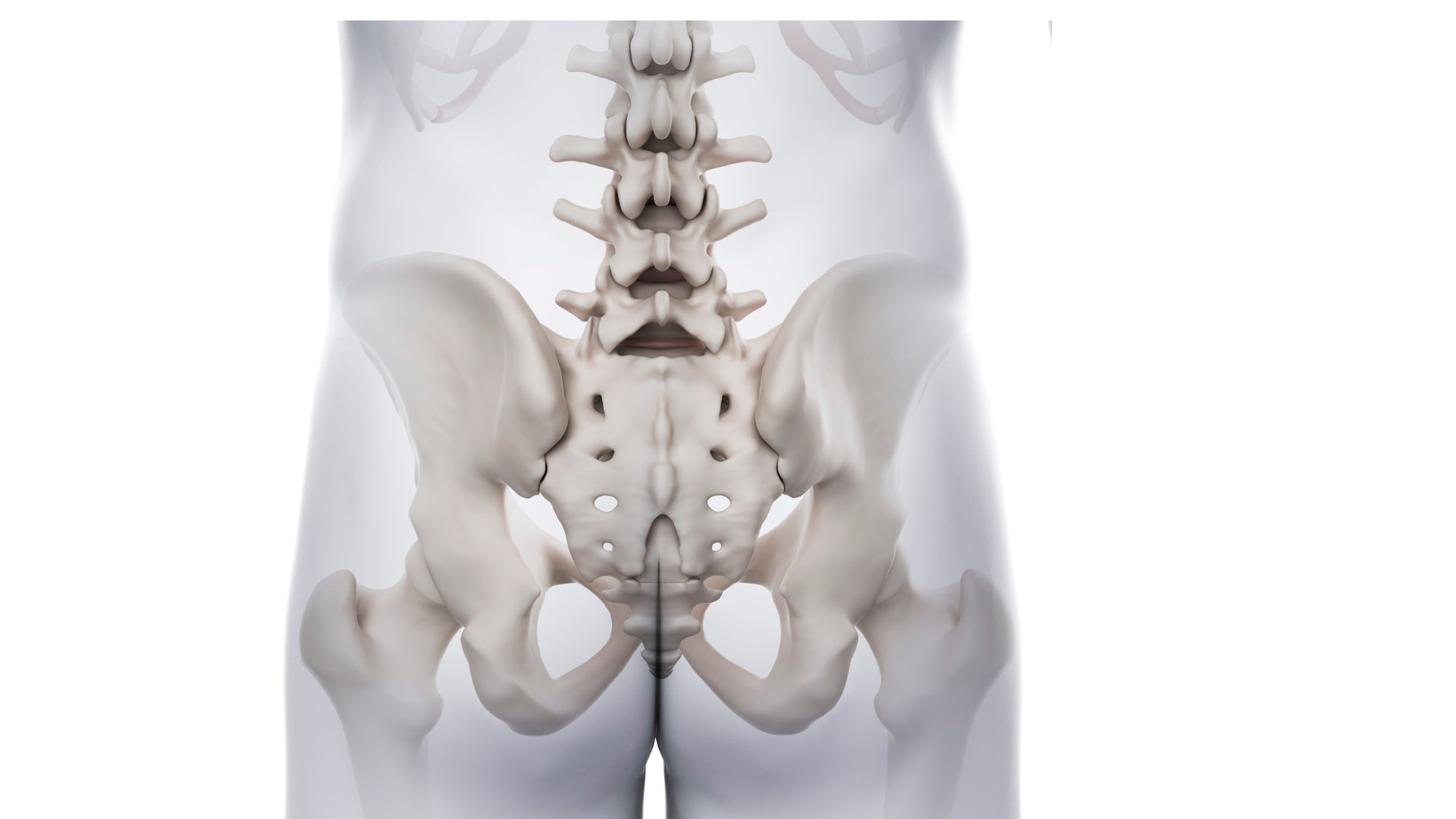
The sacrum is not merely a bone; it is a structural bridge. Positioned at the base of the vertebral column and between the two hip bones, it acts as the pedestal upon which the flexible spine rests. Anatomically, the sacrum is broad at the top—the "base"—and tapers down to the "apex," which connects to the coccyx, or tailbone.

For the uninitiated, locating the sacrum is a foundational lesson in body awareness. In a neutral standing position, such as Tadasana (Mountain Pose), the sacrum can be identified as the flat, hard surface nestled between the firm, rounded muscles of the gluteus maximus. Understanding this bone is essential for anyone seeking to correct postural misalignments, particularly those that manifest as chronic lower back pain.
A Chronology of Discovery: From Ancient Lore to Modern Practice
The history of the sacrum is a tale of two worlds: the physical and the metaphysical.
- Ancient Antiquity: Early anatomists dubbed it os sacrum—the "holy bone." Legend suggests it was named for its perceived role as the seat of resurrection, believed to be the last part of the body to decay.
- The Yogic Mapping: Thousands of years ago, Indian yogi-explorers began mapping the "universe" of the human body. They identified the tip of the sacrum as the site of the Muladhara, or root chakra. This area was recognized as the home of the Kundalini—the spiritual energy described as a serpent coiled in sleep.
- 1993 Re-evaluation: An influential analysis published in the November-December 1993 issue of Yoga Journal brought this esoteric knowledge to the forefront of the modern yoga community, emphasizing that our bones are not just inert matter but vessels for energetic flow.
- 2026 Perspective: Today, as modern science increasingly validates the link between structural alignment and nervous system regulation, the teachings of the 1993 archives remain a cornerstone for injury prevention and holistic wellness.
Supporting Data: The Dual Functions of the Sacrum
The sacrum serves two primary functions that dictate the health of the entire skeletal structure:
- Structural Support: As the "earth" of the spine, the sacrum grounds the downward pressure of the trunk and head, transmitting it through the pelvis into the legs. Simultaneously, it facilitates the upward thrust of the planet, supporting the spine’s natural curves.
- Energetic Conduit: Within the chakra system, the sacrum is the anchor. If misaligned, the "staff of Meru" (the spine) loses its structural integrity, leading to physical stagnation and emotional listlessness. When properly positioned, it allows prana (life force) to move through the nadis (energy channels) without obstruction.
Official Perspectives: The Mechanics of Movement
Yoga practitioners and biomechanics experts agree that the sacrum must be handled with nuance. The objective is to achieve samatva, or equanimity—a state where all vertebrae share the load of daily movement equally.
When performing asanas, three directional movements are critical:
- Horizontal Widening: Splitting the left and right halves of the sacrum away from the midline.
- Vertical Lengthening: Drawing the apex down toward the floor, akin to a window shade, without tucking the tailbone.
- Sacral Pressing: Engaging the bone toward the pelvis to create stability without tension.
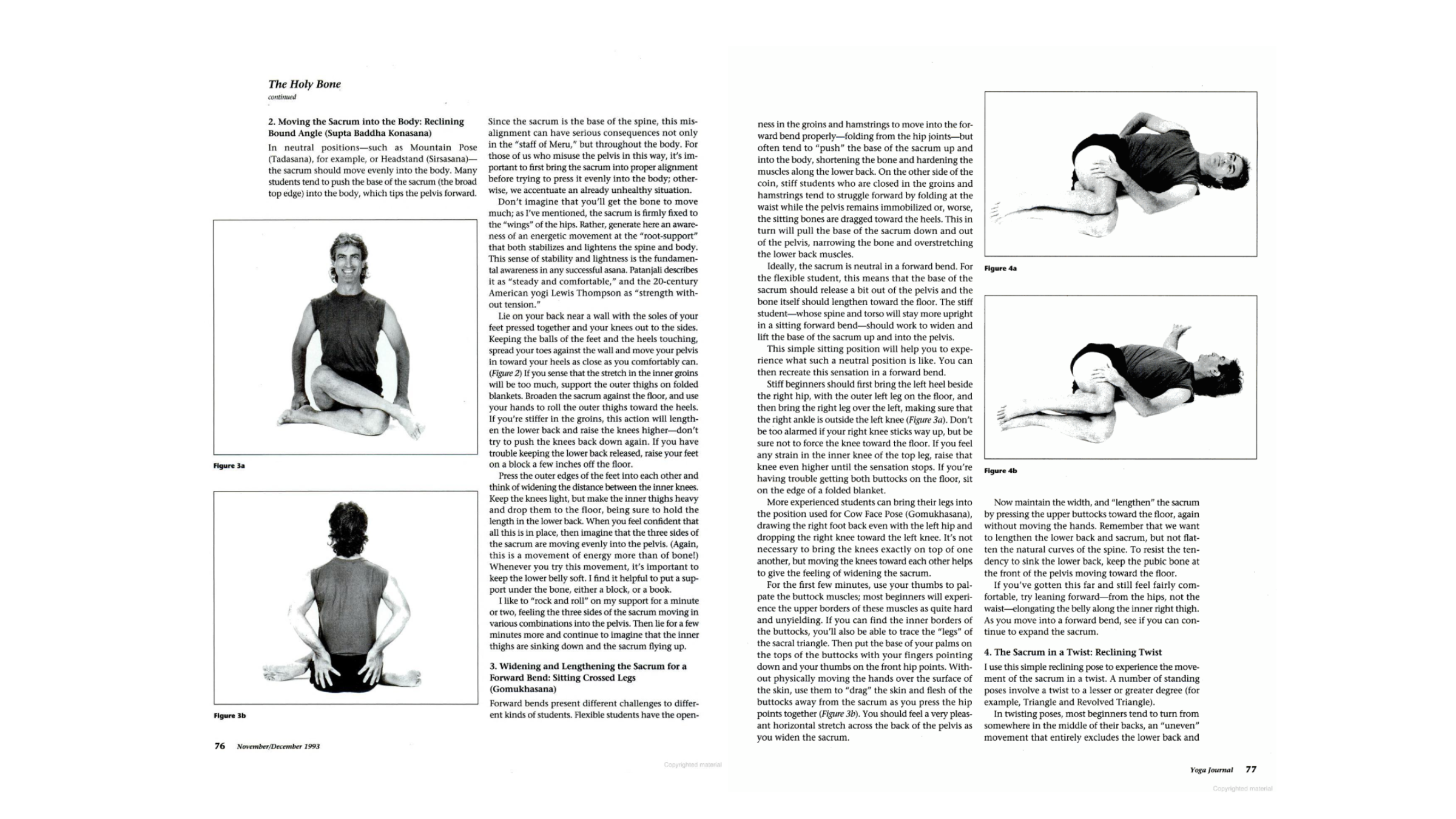
The 1993 archive highlights six foundational exercises—from Reclining Bent Knees to Low Lunge—designed to help students cultivate this "internal eye." These exercises move beyond simple stretching, focusing instead on the subtle, intuitive sensation of energy shifting within the pelvic bowl.
Implications: The "Infinite Game" of Yoga
The implications of sacral awareness extend far beyond the yoga mat. If the body is indeed a "microcosmos"—a minute replica of the whole of creation—then the way we hold our sacrum reflects the way we hold our lives.
Emotional and Spiritual Resonance
The root chakra is associated with the earth element, representing our connection to the material world. When we "root" through the sacrum, we are not just correcting posture; we are grounding our spiritual quest. A misaligned sacrum can leave an individual feeling "unsupported" by the world, whereas a balanced sacrum fosters a sense of being anchored in reality, capable of both descent into matter and ascent toward spirit.
The Philosophy of Skillful Action
The Bhagavad Gita defines yoga as "skillful action"—action that is effortless, coordinated, and direct. When we act from the "root" (the sacrum), our movements cease to be forced. This translates to a life where decisions are not dictated by selfishness or external pressure, but by the "needs of the presented situation." In the words of philosopher Martin Buber, such action becomes a "sign of the eternal."
A Call to "Keep Everyone in Play"
Ultimately, the yogic view of the universe is lila—the joyous, divine play of the Goddess. The sacrum is the pivot point of this play. By maintaining the health and alignment of this "holy bone," we participate in what James Carse calls an "infinite game." Unlike finite games with winners and losers, the infinite game has no end; its only purpose is to continue, to explore, and to keep the energy flowing.
Conclusion: Integrating the Sacrum into Daily Life
Whether you are a newcomer to yoga or a seasoned practitioner, the sacrum remains your most vital, yet often overlooked, ally. By integrating the simple, intentional movements described in these archives—widening, lengthening, and pressing—you invite a profound shift in your physical and spiritual well-being.
Do not merely treat your bones as structural scaffolding. View them as the sacred architecture of your existence. As you move through your practice, remember that the sacrum is the foundation upon which your "staff of Meru" rises. By honoring the holy bone, you honor the entire structure of the human experience, finding stability in the earth and aspiration in the sky.
For those interested in exploring the full breadth of these historical insights, the complete collection of Yoga Journal’s archives, dating back to 1975, offers a comprehensive library of wisdom for the modern seeker. By returning to these foundational texts, we ensure that the "infinite game" of yoga continues to serve, support, and inspire generations to come.