









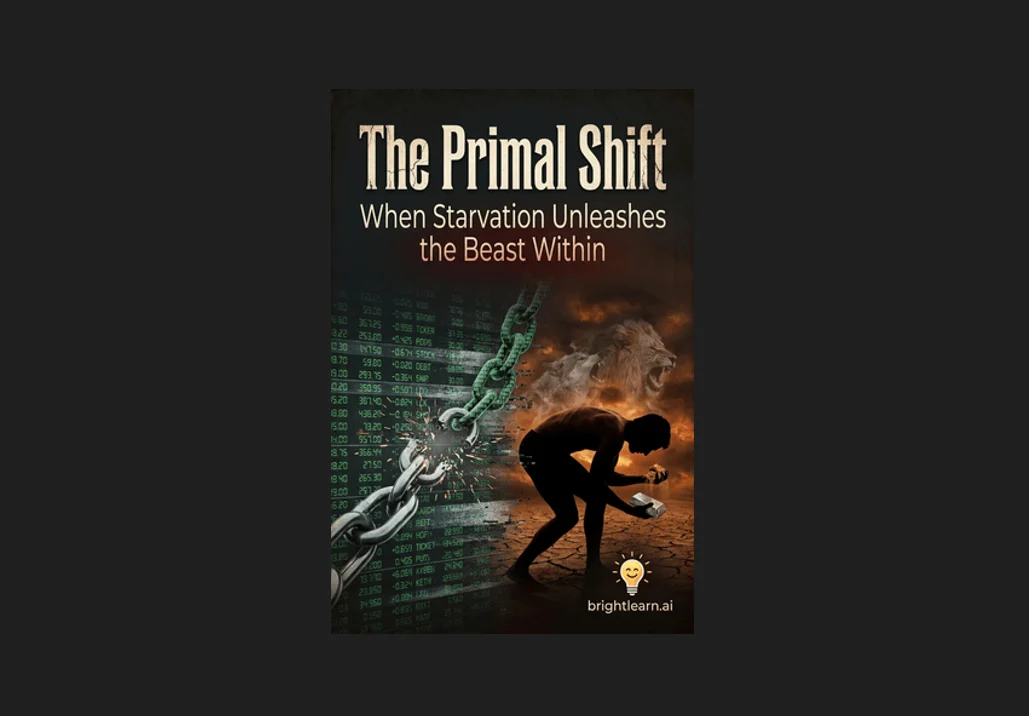
In an era defined by digital transactions and the seamless convenience of mobile banking, the average citizen perceives their savings account as a personal vault—a secure repository for their life’s labor. However, a provocative new work, The Primal Shift: When Starvation Unleashes the Beast Within, argues that this perception is not merely flawed, but a dangerous fabrication. The book posits that what we call "wealth" is, in reality, a fragile digital IOU, tethered to a banking system that relies more on public confidence than on actual physical assets.
As global economic volatility increases, the mechanisms of fractional reserve banking have come under renewed scrutiny. To understand the vulnerability of modern savings, one must first dismantle the illusion of ownership and examine the structural reality of the financial institutions we trust with our futures.
The Mechanics of Fractional Reserve Banking
At the core of the modern financial system lies the practice of fractional reserve banking. Contrary to popular belief, when a depositor places money into a commercial bank, that money is not held in reserve for the depositor’s exclusive use. Instead, the bank is legally permitted—and indeed incentivized—to lend out the vast majority of those funds.
Historically, central banks mandated that commercial institutions hold a significant percentage of deposits in liquid reserves. In the United States, that figure once hovered around 10%. Over time, however, regulatory changes have eroded these requirements, allowing banks to lend out nearly every dollar deposited, keeping only a minute "sliver" on hand.
When a customer checks their bank balance, they are not looking at a stored pile of cash. They are looking at a promise—a contractual obligation from the bank to return those funds upon request. If the bank has invested those funds into illiquid assets or long-term loans, the money is physically absent from the vault.
Chronology of Systemic Fragility: From Theory to Crisis
The inherent instability of this system becomes visible during periods of economic stress. History provides a roadmap for what happens when the "confidence" underpinning the banking system evaporates.
2013: The Cyprus Bail-In
In March 2013, the banking system of Cyprus faced a catastrophic collapse. To prevent a total systemic failure, the European Union, the International Monetary Fund, and the European Central Bank forced a "bail-in" strategy. Unlike traditional bailouts, where taxpayers fund the rescue of banks, a bail-in requires the creditors of the bank—the depositors themselves—to absorb the losses. Large-scale account holders saw their wealth seized to recapitalize the failing institutions, shattering the illusion that deposits were inviolable assets.
2015: The Greek Capital Controls
Two years later, Greece provided a masterclass in the loss of financial autonomy. Facing a sovereign debt crisis, the Greek government imposed strict capital controls. Citizens were limited to withdrawing a mere €60 per day from ATMs. For the average depositor, the bank account was no longer a tool of financial freedom, but a prison cell. The inability to access one’s own capital proved that ownership of currency is contingent upon the stability and goodwill of the state.
The Present: A System of Digital Entries
Today, the disparity between total deposits and actual physical reserves is staggering. In the U.S. banking system, total deposits exceed $17 trillion. Yet, the reserves held against those deposits sit at roughly $3 trillion. Crucially, even these reserves are largely digital ledger entries at the Federal Reserve, rather than tangible, physical currency.
Supporting Data: The FDIC and the Safety Net Fallacy
A primary pillar of public confidence in the banking system is the Federal Deposit Insurance Corporation (FDIC). The guarantee of protection for up to $250,000 per account is widely viewed as an ironclad safety net. However, critics point to the fundamental math behind this promise.
The FDIC’s Deposit Insurance Fund (DIF) currently holds approximately $125 billion. When measured against total U.S. deposits, this represents less than 1% of the potential liabilities the agency is tasked with protecting. In the event of a isolated bank failure, the fund is more than adequate. However, in the event of a systemic, multi-bank crisis—where panic triggers mass withdrawals across the country—the fund would be exhausted in a matter of days.
If the fund were depleted, the government would face a binary choice: allow the system to collapse or authorize the creation of new currency to "make depositors whole." The latter would lead to the rapid devaluation of the currency itself. In this scenario, the nominal dollar amount in a savings account might be restored, but the purchasing power of those dollars would be significantly eroded through inflation.
Official Responses and Institutional Perspective
Central banks and regulatory bodies maintain that the current system is designed for efficiency and economic expansion. By allowing banks to leverage deposits, the financial system facilitates lending for housing, business growth, and consumer credit, which theoretically drives GDP growth.
Financial institutions argue that the "digital illusion" is actually a feature, not a bug, of modern capitalism. They contend that a 100% reserve requirement would freeze the economy, making credit prohibitively expensive and stalling innovation. They point to the strength of the dollar and the stability of the U.S. financial system as evidence that the system, while technically leveraged, is sound under the stewardship of the Federal Reserve.
However, independent analysts, such as those featured in the "Health Ranger Report," argue that the system is dangerously over-leveraged and prone to "credit freezes." Discussions between experts like Gregory Mannarino and Mike Adams often highlight that as debt levels rise and the velocity of money changes, the traditional banking model becomes increasingly brittle, leaving the average saver exposed to risks they are neither prepared for nor informed about.
Implications: The Case for Tangible Assets
The primary implication of this systemic design is that the average person is an unsecured creditor to their own bank. If the bank fails, the depositor is last in line behind the government and other priority creditors.
This reality has driven a resurgence in the interest in "honest money"—physical assets that carry no counterparty risk. Gold and silver, for instance, do not require a bank to authorize a transaction or a government to guarantee their value. When an individual holds physical bullion, they are in possession of an asset that exists independently of the financial grid.
Unlike digital wealth, which can be frozen, erased, or restricted by capital controls, precious metals retain their intrinsic value. This is why central banks and the world’s wealthiest individuals have spent decades accumulating physical gold. It is not merely an investment; it is a hedge against the very instability that characterizes the modern, debt-based financial system.
Reclaiming Financial Sovereignty
The transition from a passive consumer of banking services to an active steward of one’s wealth is the central thesis of The Primal Shift. The book urges readers to stop viewing the bank as a vault and start viewing it as a commercial counterparty with significant default risk.
For those looking to secure their family’s future, the recommendations are consistent:
- Understand the Leverage: Recognize that bank deposits are loans, not savings.
- Diversification of Assets: Move a portion of wealth into physical assets that do not rely on a counterparty.
- Critical Literacy: Educate oneself on the difference between "money" (a store of value) and "currency" (a medium of exchange).
The illusion of ownership is maintained by the convenience of the status quo. However, as global economic pressures mount, the ability to discern between a promise and a possession may become the most critical financial skill of the 21st century. As the authors of The Primal Shift conclude, the banks are not inherently the "friends" of the depositor, and the government’s safety nets are thinner than they appear. True financial security begins with the realization that the system is built on confidence—and that confidence is a finite, volatile resource.
To explore these concepts further, readers are encouraged to consult The Primal Shift: When Starvation Unleashes the Beast Within, available for download at Books.BrightLearn.AI, a platform dedicated to decentralized knowledge sharing and financial awareness.