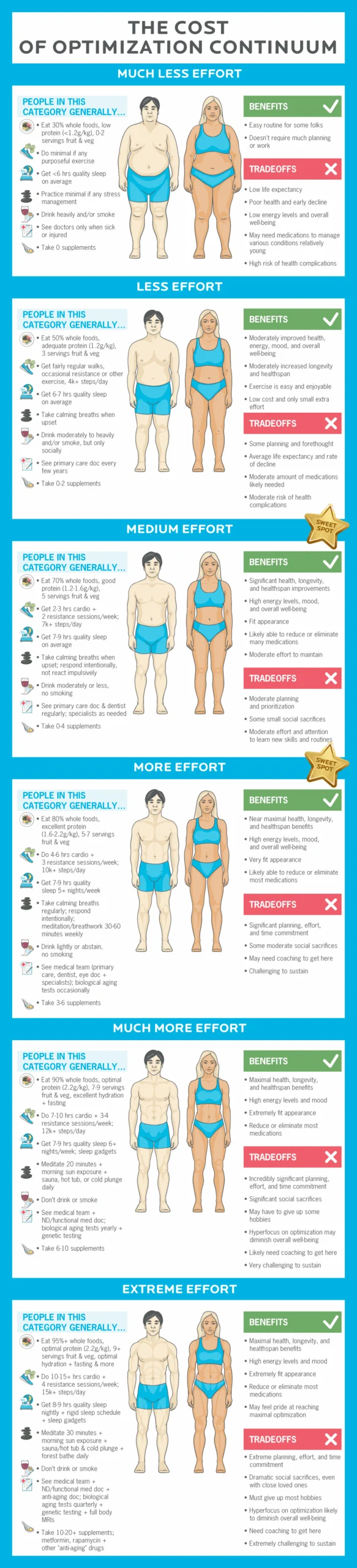
In an era defined by the pursuit of biohacking, wearable technology, and the promise of living to 120, a new cultural obsession has emerged: "Health Optimization." From podcasts hosted by prominent figures like Dr. Peter Attia and Dr. Andrew Huberman to the high-stakes, multimillion-dollar experiments of tech entrepreneurs like Bryan Johnson, the message is clear: If you aren’t tracking your biomarkers, intermittent fasting, and supplementing with cutting-edge compounds, you are falling behind.

But for the average person, this pursuit of the "perfect" health protocol presents a fundamental problem. It is often prohibitively expensive, time-consuming, and psychologically taxing. For those looking to preserve their health and extend their lifespan, the question is no longer just "What works?" but "Is the extreme effort actually worth the return?"

The Myth of Optimization
The current health discourse often conflates "optimal" with "necessary." There is a pervasive myth that foundational habits—exercise, sleep, and a balanced diet—are insufficient for those who truly want to outlive their peers. This has led many to believe that unless they are taking cold plunges, monitoring their continuous glucose levels, and utilizing experimental longevity supplements, they are failing.

However, data from hundreds of thousands of coaching interactions suggests the opposite. The "80/20 rule" applies here: 80 percent of your health results will come from 20 percent of your efforts—specifically, the basics. When we obsess over the fringe, we risk burning out, overspending, and missing the mark on the very behaviors that have the highest correlation with long-term survival.

A Chronology of Health Trends
The evolution of longevity advice has moved through distinct phases:

- The 1990s–2000s (The Calorie Era): Focus was primarily on weight management and basic food pyramids.
- The 2010s (The Bio-data Era): The rise of wearables (Fitbits, Apple Watches) introduced the world to step counts and heart rate variability (HRV).
- The 2020s (The Optimization Era): The current movement focuses on internal biomarkers, epigenetic clocks, and pharmaceutical-grade interventions to "slow" the biological aging process.
While technology has improved, our basic human biological needs have remained static. The danger of the current era is the shift from "being healthy" to "hacking biology," which often ignores the fact that human health is a complex, non-linear system.

The Pillars of Foundational Health
If you want to reduce the risk of chronic disease and maximize your healthspan, you do not need a complex protocol. You need consistency in seven key areas.

1. The Power of Movement
Physical activity is the closest thing we have to a "fountain of youth." Studies consistently show that exercise reduces the risk of all-cause mortality, regardless of body weight or genetic predisposition.

- The Sweet Spot: The most significant drop in mortality risk occurs when moving from zero activity to roughly 7.5 to 15 MET-hours per week.
- The Reality: Only 24 percent of Americans meet the recommendations for both aerobic and resistance training. Resistance training is particularly vital as we age, serving as a primary defense against sarcopenia, falls, and metabolic decline.
2. Nutritional Simplicity
The secret to a long life is not a restrictive diet, but a shift toward whole, minimally processed foods. Research spanning 10 million participants has linked ultra-processed food (UPF) consumption to 32 harmful health outcomes.

- The Goal: Aim for 70 to 80 percent of your diet to come from minimally processed sources.
- The Vegetable Metric: Five servings of fruits and vegetables daily is the "plateau" point where disease risk reduction is most significant. Eating more than this offers diminishing returns.
3. Sleep as a Foundation
Sleep is arguably the most neglected pillar of health. A single hour of sleep deprivation is associated with an 11 percent increase in cardiovascular risk. Seven to nine hours is the gold standard; anything less, or chronically more, correlates with poorer health outcomes.

4. Stress Management and Resilience
Chronic, unmanaged stress acts as a systemic poison. However, the goal is not to eliminate stress—which is a natural part of human existence—but to manage it. Recovery practices, such as mindfulness, journaling, or simply spending time in nature, serve to "refill the jug" of your physical and mental reserves.

5. Social Connection: The Longevity Multiplier
Perhaps the most overlooked factor in health is social capital. The Harvard Study of Adult Development, which has tracked participants for over 87 years, identified strong relationships as the single greatest predictor of longevity and life satisfaction. Social isolation carries a mortality risk comparable to smoking 15 cigarettes a day.

The Cost of "Optimization"
For those tempted by the "optimizer" lifestyle, the price tag is significant. A comparison between a "healthy" person and an "optimizer" reveals that the latter may spend three to four times more money and time.

| Investment Type | "Healthy" Person | "Optimizer" |
|---|---|---|
| Weekly Time | 5–7 hours | 15–25+ hours |
| Weekly Cost | Moderate | High/Extravagant |
| Focus | Consistency | Peak Performance |
The danger of this 4x increase in effort is the "diminishing return." While the optimizer might gain a marginal increase in certain biomarkers, they often sacrifice other domains of "Deep Health," including mental peace, social joy, and financial stability.

Implications: A New Approach
If you are looking to secure your health for the long term, the path forward is not found in the latest podcast episode or expensive supplement bottle. It is found in the "boring" basics:

- Audit your basics: Are you getting 7+ hours of sleep? Are you strength training? Are you eating mostly whole foods?
- Define your "Why": What kind of life do you want to live? If your health protocol prevents you from having a social life or enjoying a meal with your family, it is likely not serving your long-term well-being.
- Reject the "All-or-Nothing" mindset: Data shows that even 10 to 49 percent consistency in basic habits yields measurable, life-changing results.
Final Thoughts
Health optimization culture can make great health feel like a luxury product reserved for the wealthy or the obsessed. The truth is far more empowering: Great health is accessible, simple, and rooted in the foundations we have known for decades. By focusing on consistent movement, whole foods, adequate sleep, and strong social bonds, you aren’t just "optimizing"—you are living. And that, ultimately, is the point of a long life.