










Smell is perhaps our most primal sense. It serves as a silent guardian, alerting us to the acrid sting of smoke or the rot of spoiled food, while simultaneously acting as a vivid emotional tether, capable of transporting us back to a childhood kitchen or a long-forgotten summer evening with the mere whiff of a familiar scent. Yet, despite its profound influence on memory, appetite, and human survival, the biological architecture underlying our sense of smell has remained a "black box" for generations of neuroscientists.
Now, a landmark study published in the journal Cell has finally begun to decode this mystery. A team of researchers led by Harvard Medical School neurobiologist Sandeep (Robert) Datta has successfully mapped the complex arrangement of smell receptors in the mammalian nose. By uncovering a highly organized, stripe-like structure where previously only chaos was assumed to exist, the researchers have fundamentally shifted our understanding of how the brain perceives the world.
The Chronology: A Decades-Long Scientific Pursuit
For decades, the field of olfaction has trailed behind vision, hearing, and touch in terms of biological mapping. While scientists have long understood the precise topographies of the retina or the auditory cortex, the nasal cavity remained a confounding puzzle.
The quest began in earnest in 1991, when researchers first identified the molecular nature of olfactory receptors. Following this discovery, the scientific community spent thirty years attempting to determine how these thousands of individual receptors were distributed within the nose. Early experimental data suggested that the receptors were scattered in broad, loosely defined zones, leading to the long-standing, widely accepted assumption that their placement was essentially random or poorly organized.
However, as the resolution of genetic sequencing technology improved, the Datta lab—and others in the field—began to suspect that the perceived "randomness" was simply a failure of older tools to capture the true scale of the system. In recent years, with the advent of single-cell sequencing and spatial transcriptomics, the team set out to re-examine the olfactory epithelium of mice. This move represented a pivot from observing broad patterns to analyzing the minute, individual building blocks of the olfactory system at an unprecedented scale.
Supporting Data: Decoding Millions of Neurons
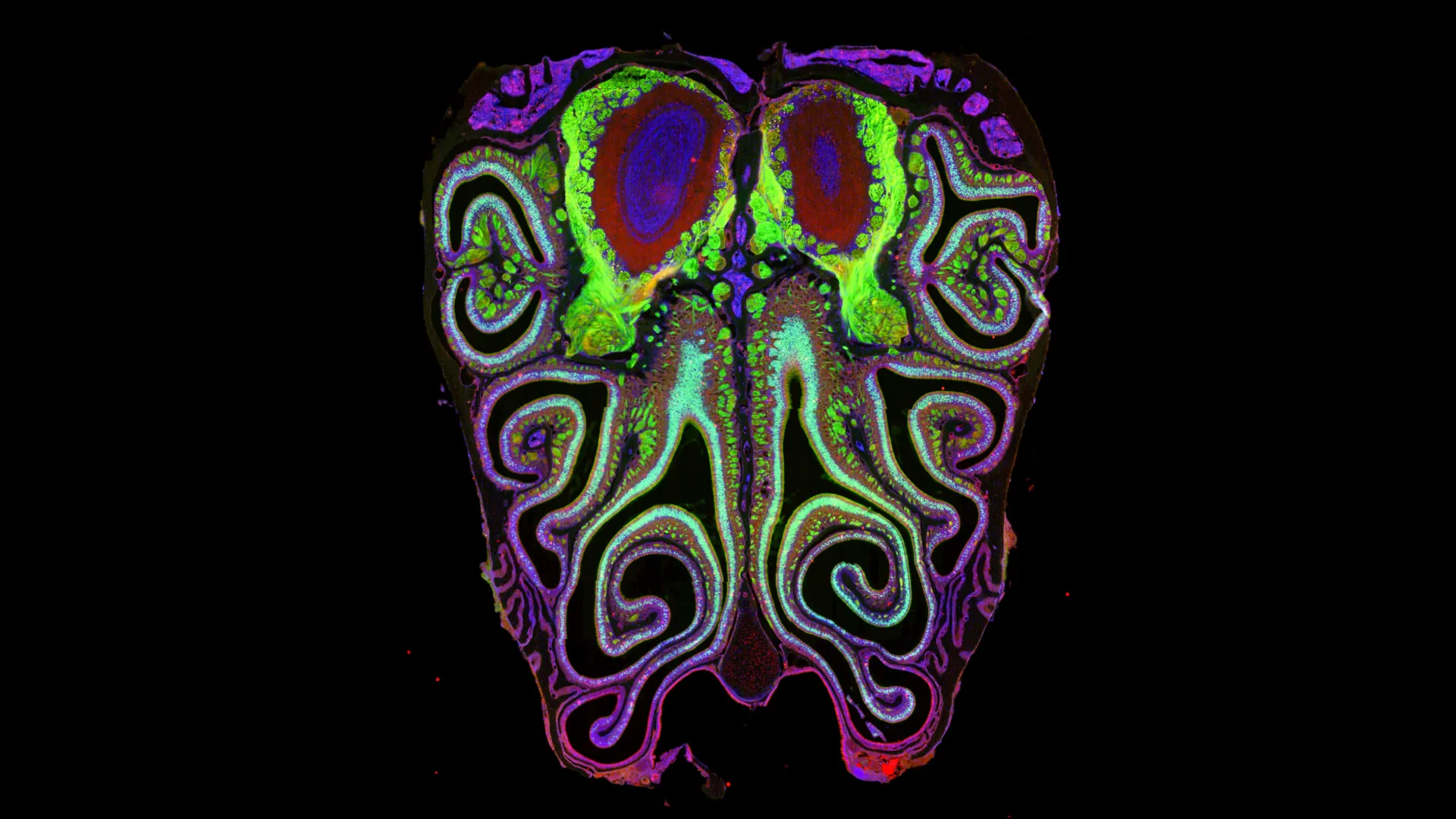
The sheer scale of the Harvard study is staggering. To map the olfactory landscape, the researchers analyzed approximately 5.5 million individual neurons across more than 300 mice. This massive dataset allowed the team to integrate two distinct types of data: the identity of the specific smell receptors expressed by each neuron and the exact spatial coordinates of those neurons within the nasal cavity.
"This is now arguably the most sequenced neural tissue ever, but we needed that scale of data in order to understand the system," Datta explained.
The results of this massive undertaking were transformative. Far from being randomly distributed, the researchers found that neurons expressing specific types of receptors aggregate into highly consistent, overlapping horizontal stripes. These stripes run from the dorsal (top) to the ventral (bottom) sections of the nasal cavity.
This discovery was validated by the consistency of the findings across the animal cohort. The map was not a fluke of a single specimen; it was a biological blueprint, nearly identical across all mice studied. Furthermore, the researchers discovered that this nasal map mirrors the organizational topography of the olfactory bulb—the region of the brain responsible for processing scent. This alignment suggests that the nose acts as a sophisticated, pre-organized input device, feeding "structured" sensory data directly into the neural circuits of the brain.
The Developmental Mechanics: How the Map Takes Shape
A critical question remained: How does the nose organize itself with such mathematical precision? To answer this, the team investigated the developmental processes that occur as the olfactory system matures.
The researchers identified retinoic acid, a derivative of Vitamin A that acts as a potent signaling molecule, as the architect of this system. They discovered a gradient of retinoic acid present in the nose during development. This gradient acts like a biological compass, guiding neurons to express specific smell receptors based on their precise location within the tissue.
To prove this, the researchers artificially manipulated the levels of retinoic acid. When the gradient was altered, the entire "map" of receptors shifted, moving upward or downward in response to the change in chemical signaling. This confirmed that the stripe-like organization is not a random byproduct of development but a strictly regulated, genetically encoded feature of the mammalian sensory system.
A concurrent study, led by the laboratory of Catherine Dulac at Harvard University, corroborated these findings, reinforcing the significance of the "map" and suggesting that this form of structural organization is a fundamental principle of olfactory biology.
Official Responses and Conceptual Shifts
For the scientific community, the implications of this study are profound. By demonstrating that the olfactory system follows a rigid, ordered architecture, the researchers have effectively ended the "randomness" debate that has persisted for decades.
"Our results bring order to a system that was previously thought to lack order, which changes conceptually how we think this works," Datta noted.
The study highlights a distinct contrast between smell and other senses. In human color vision, for instance, the brain relies on just three main receptor types to construct a complex visual spectrum. In contrast, the olfactory system is exponentially more intricate; mice—and humans—possess over a thousand different receptor types, each capable of detecting a unique set of odor molecules. Managing this complexity requires a level of internal organization that was, until now, obscured by the limitations of our research methods.
Implications: A New Era for Treating Olfactory Loss
The clinical implications of this discovery cannot be overstated. Millions of people worldwide suffer from anosmia (the loss of smell) or hyposmia (reduced ability to smell), conditions that can be triggered by viral infections, head trauma, or neurodegenerative diseases. Despite the high prevalence of these conditions, there are currently few, if any, effective therapeutic interventions.
"We cannot fix smell without understanding how it works on a basic level," Datta emphasized.
The researchers believe that this new map serves as a vital foundation for future regenerative medicine. By understanding exactly which neurons map to which receptors and how they are positioned, scientists can begin to envision potential therapies. These could include:
- Stem Cell Therapies: By understanding the molecular guidance cues like retinoic acid, researchers may eventually be able to coax stem cells to differentiate into specific types of olfactory neurons and integrate them into the correct "stripes" within the nose.
- Brain-Computer Interfaces (BCIs): If the map of the nose is known, it may be possible to develop neural prosthetics that bypass damaged tissue and stimulate the olfactory bulb directly, effectively "patching" the sensory signal.
- Diagnostic Mapping: Identifying a patient’s specific deficits through an understanding of this map could allow for targeted rehabilitation strategies.
As the team looks toward the future, their next steps involve determining whether this same organizational "stripe" structure exists in humans. If human olfaction follows a similar topographical arrangement, it would represent a massive leap forward in our ability to treat patients who have lost their sense of smell—a loss that often leads to decreased safety, poor nutrition, and significant psychological distress.
"Smell has a really profound and pervasive effect on human health, so restoring it is not just for pleasure and safety but also for psychological well-being," said Datta. "Without understanding this map, we’re doomed to fail in developing new treatments."
The discovery, supported by funding from the National Institutes of Health, the Yang Tan Collective at Harvard, and the National Science Foundation, marks a turning point in sensory biology. As we move closer to unraveling the full, intricate geography of the nose, the "super-mysterious" nature of smell is finally beginning to make sense.