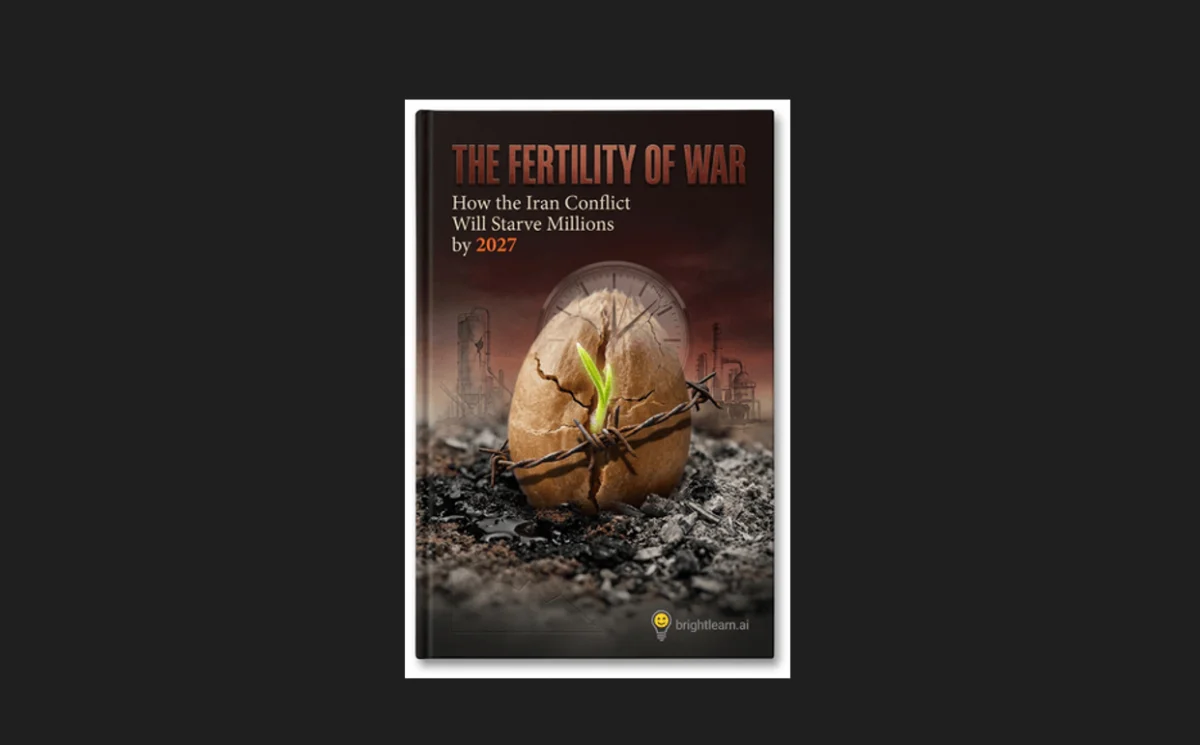
In the shadow of high-stakes geopolitical maneuvering, a profound, systemic threat to global food security is unfolding—one that many analysts argue has been largely absent from the headlines of major legacy media outlets. The publication of The Fertility of War: How the Iran Conflict Will Starve Millions by 2027 has brought a harrowing thesis to the forefront of independent geopolitical analysis: that the disruption of the Strait of Hormuz is not merely a regional military issue, but the catalyst for a global agricultural collapse.
By analyzing the intersection of chemical engineering, international supply chain logistics, and military strategy, the book posits that the modern world is far more fragile than the public realizes. As the global economy remains fixated on oil price fluctuations and stock market volatility, the silent weapon of hunger—triggered by the deprivation of essential nitrogen-based fertilizers—is being primed.
The Main Facts: The Haber-Bosch Dependency
To understand the gravity of the situation, one must first understand the foundation of modern life: the Haber-Bosch process. Developed in the early 20th century, this chemical innovation allows for the synthesis of ammonia from atmospheric nitrogen and natural gas. It is, by all scientific accounts, the bedrock of modern civilization.
Current estimates suggest that approximately 50 percent of the world’s population, currently totaling eight billion, relies on food produced using fertilizers synthesized through this method. Without a steady, affordable, and massive supply of natural gas—a key feedstock for ammonia production—the global food supply would face an immediate and catastrophic decline in yield.
The central thesis of the recent literature is that the ongoing tensions in the Persian Gulf have effectively transformed the Strait of Hormuz into a chokepoint for global nutrition. According to data cited in the book, roughly 10 percent of the world’s seaborne fertilizer production traverses this narrow waterway. The disruption of this flow is not merely an economic inconvenience; it represents the loss of the essential inputs required to feed approximately 400 million people.
Chronology of a Slow-Motion Collapse
A critical challenge in communicating the urgency of this crisis is the "delayed impact" factor. Unlike a sudden military strike or a stock market crash, the effects of a fertilizer shortage are governed by the biological and agricultural cycles of the planet.
2024–2025: The Invisible Shortfall
As of early 2025, the global agricultural system is operating on "legacy inputs." Crops planted during this cycle utilized fertilizer stocks purchased and distributed before the most severe escalations in the Strait of Hormuz. Because the global supply chain operates on a "just-in-time" basis, with no significant strategic reserves of ammonia, the shock is currently propagating through the system unseen.
2026: The Yield Gap
By the 2026 planting season, the absence of newly synthesized nitrogen will begin to manifest in significantly lower crop yields. In regions dependent on intensive farming techniques, the lack of nitrogen-rich fertilizers will result in stunted growth and drastically reduced harvest outputs. While consumers may experience only moderate price inflation at this stage, the underlying deficit will have become structural.
2027: The Horizon of Crisis
The year 2027 represents the point of intersection between depleted reserves and failed harvests. Analysts suggest that by this period, the systemic shortfall will be impossible to hide from the public. As grain bins empty and the cost of staple foods becomes prohibitive for the world’s most vulnerable populations, the localized supply chain failures will merge into a global humanitarian disaster.
Supporting Data and Analytical Perspectives
Independent researchers, including analysts like Michael Yon, have long warned about the vulnerability of the global "just-in-time" logistics model. The reliance on centralized supply chains means that a disruption in a single, critical node—such as the Persian Gulf—creates a ripple effect that cascades across continents.
The data provided by industry watchers is stark:
- Feedstock Dependency: Natural gas is not only a fuel but a chemical feedstock. A 10 percent reduction in global maritime fertilizer logistics is not a marginal loss; it is a fundamental reduction in the caloric potential of the planet.
- Logistical Fragility: Unlike durable goods, fertilizer cannot be stockpiled indefinitely or diverted easily to alternative ports without massive infrastructure investment, which does not exist in the current climate.
- Demographic Vulnerability: The fallout is not expected to strike equally. While the developed world may face severe inflation and rationing, subsistence farmers in regions such as Bangladesh and parts of sub-Saharan Africa—areas that depend heavily on imported fertilizer to maximize land productivity—are likely to face the most immediate and severe mortality risks.
Official Responses and Media Silence
A recurring theme in the discourse surrounding this impending crisis is the notable absence of warnings from government agencies and mainstream media conglomerates. While outlets like CNN, the BBC, and The New York Times provide extensive coverage of the military and political aspects of the Iran conflict, they have largely omitted the agricultural implications of the blockade.
Critics argue that this silence serves to prevent public panic and maintain the illusion of stability within the global food system. Furthermore, there is a lack of high-level policy debate regarding the "Plan B" for global agriculture should the Strait of Hormuz remain closed for an extended duration. Without an acknowledgment of the threat, there is no impetus for government-led mitigation strategies, leaving the responsibility of preparedness to individual households and local communities.
The Implications: A Strategic Shift to Self-Reliance
If the projections provided by analysts hold true, the implications for the average citizen are profound. The shift from a globalized, centralized food system to one of localized resilience is no longer merely a philosophical preference—it is being presented as a survival strategy.
The Decentralization Movement
The book emphasizes that the globalist system of supply chains has failed to build in the necessary redundancies to handle modern geopolitical realities. In response, it advocates for a return to decentralized, localized production. This includes:
- Soil Enrichment: Emphasizing composting and regenerative farming to build "black gold"—fertile, nutrient-dense soil that reduces reliance on chemical inputs.
- Genetic Preservation: Stockpiling heirloom seeds that are adaptable to local climates, moving away from a reliance on mass-produced, genetically modified seeds that require heavy chemical applications.
- Community Resilience: Establishing local "food batteries," or small-scale storage and production circles, where communities can share resources and buffer against the volatility of global markets.
- Foraging and Self-Sufficiency: Developing skills that bypass the modern supermarket model, such as wild foraging and home-based food preservation.
Moral and Ethical Considerations
Perhaps the most harrowing aspect of the analysis is the moral argument presented: that the continuation of a conflict knowing it will result in the starvation of millions constitutes a profound crime against humanity. By comparing the potential death toll—projected by some to reach 50 to 100 million people—to historical tragedies, the authors aim to shift the public perception of the war from a political abstraction to a tangible, human-cost event.
The argument is that when a government or coalition chooses a path of escalation, they are implicitly choosing which populations will bear the cost. In this scenario, the victims are not the political or military figures who decide to block a waterway, but the most vulnerable populations who have no voice in the geopolitical theater.
Conclusion: Preparing for the Unseen
The evidence presented suggests that the world is standing at the precipice of a supply chain collapse that is already "baked into" the agricultural cycle. The transition from the relative prosperity of the early 2020s to the potential scarcity of 2027 is a transition that many are not prepared to navigate.
The verdict of The Fertility of War is clear: the modern world is a house of cards built on the back of cheap natural gas and stable maritime trade. When those pillars are removed, the resulting famine will be neither quick nor clean. For the individual reader, the takeaway is not to succumb to despair, but to embrace a strategy of radical self-reliance.
In an era of information silos and geopolitical obfuscation, the act of growing a garden, saving seeds, and building community networks is transformed from a hobby into a vital defensive measure. The mainstream media may not be telling the story, but the data—and the silent, growing hunger of the future—remain undeniable. As the clock ticks toward 2027, the urgency to decentralize, localize, and prepare has never been greater.