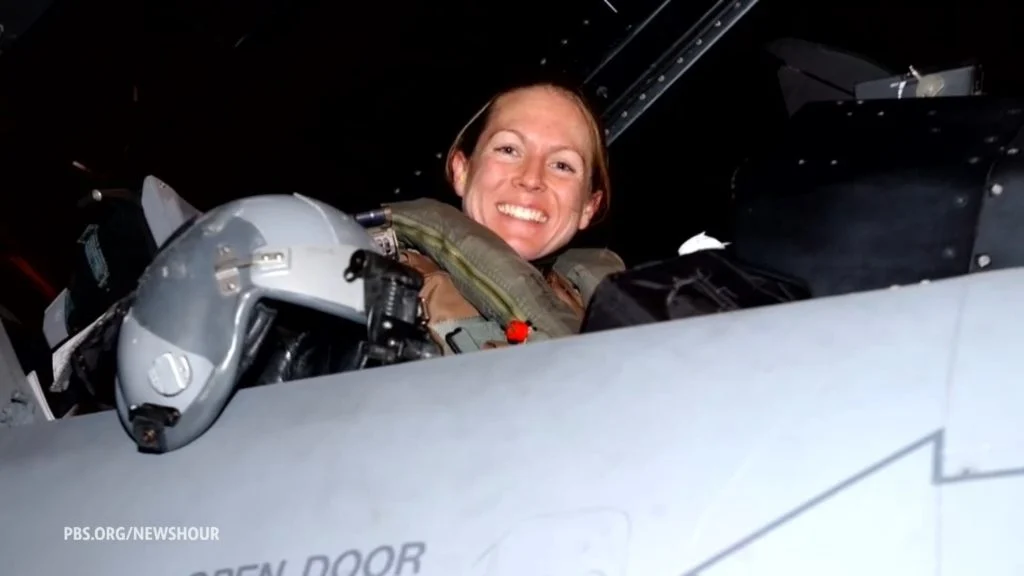
Twenty-five years after the smoke cleared over the Pentagon and the smoldering fields of Shanksville, Pennsylvania, the narrative of September 11, 2001, remains etched in the American consciousness as a day of both unfathomable tragedy and extraordinary heroism. While history books rightly celebrate the passengers of United Airlines Flight 93, whose defiance prevented a fourth target from being struck, a parallel story of sacrifice—one that never reached its fatal conclusion—remains a haunting testament to the chaos of that morning.
This is the story of Heather “Lucky” Penney, a pilot in the Washington, D.C. Air National Guard, who stood ready to trade her life to protect the nation’s capital, embodying the absolute limit of duty.
The Morning of the Blue Sky
On the morning of September 11, 2001, the sky over the nation’s capital was described by many as "crystal blue"—a perfect day for aviation. For then-Lieutenant Heather Penney, a pilot with the D.C. Air National Guard, it was business as usual until the normalcy of the day was shattered.
The first indication that the world had changed came not from official briefings, but from Tech Sergeant Dave Callahan, who entered the operations room with the news that a plane had struck the World Trade Center. The initial reaction among the pilots was one of disbelief, assuming it to be a tragic accident involving a small aircraft. However, when news of the second plane arrived, the mood shifted instantly from confusion to cold, hard clarity: the United States was under attack.
As the morning progressed, the scope of the catastrophe unfolded in real-time. The towers had fallen, the Pentagon had been struck, and the airwaves were flooded with reports of further hijacked aircraft. Penney and her wingman, Lieutenant Colonel Marc Sasseville, were ordered to scramble. They were the thin line of defense for a city suddenly exposed to an unprecedented threat.
A Mission of No Return: The Technical Realities
The orders received by Penney and Sasseville were stark and devoid of ambiguity. Their commander, Brigadier General David Wherley, issued a direct command: "You have weapons-free flight lead control."
In the sterile, professional language of military aviation, "weapons-free" is a directive that carries the ultimate weight. However, the reality of their situation was far more desperate than a typical combat engagement. The F-16s available to the D.C. Air National Guard that morning were not combat-ready; they lacked the air-to-air missiles required to intercept and neutralize a hijacked airliner from a distance.
"The problem was Sass and I didn’t have weapons," Penney recalls. "We would have had to ram our jets into what we then knew was the target, an airliner."
The plan they formulated was a grim exercise in precision and sacrifice. Sasseville, the flight lead, intended to ram his jet into the cockpit of the hijacked airliner to incapacitate the terrorists and destroy the flight controls. Penney’s role was to strike the tail of the aircraft, aerodynamically destabilizing the plane to ensure it plummeted into the ground rather than continuing toward its intended target—presumably the U.S. Capitol or the White House.
It was, by every definition, a suicide mission. There was no ejection mechanism that could guarantee survival in a deliberate mid-air collision. Yet, in the face of this reality, neither pilot hesitated.
The Philosophy of Duty and the Legacy of Service
To understand Penney’s reaction, one must look to her heritage. The daughter of a fighter pilot who flew A-7 missions over North Vietnam, Penney grew up captivated by the world of aviation. She viewed her path to becoming a pilot not merely as a career, but as a calling.
"If God had put me in that place at that moment, then that was my purpose," she reflects. "That has never changed."
The irony of the day was particularly poignant for the Penney family. Her father, John Penney, had transitioned from military service to become a commercial pilot for United Airlines. While the equipment he flew matched the type of aircraft hijacked that day, the thought of his potential involvement never deterred her from her duty. She viewed her role through the lens of a service member: the fate of the passengers on the hijacked plane was, in her eyes, already sealed. Her responsibility was to the nation and the preservation of the capital.
Implications for Modern Defense and Readiness
The events of 9/11 revealed glaring systemic failures in the American defense posture. The fact that pilots were scrambled without weapons—forced to consider an act of "aerial kamikaze"—highlights the unpreparedness of the era.
Today, Penney serves as the director of studies and research at the Mitchell Institute, an airpower-focused think tank. She uses her experience as a lens through which to advocate for military modernization. Her critique of current defense spending is sharpened by her own experience: the F-16 she scrambled in that day remains in the active inventory, and many airmen today are flying aircraft older than they are.
"I do what I do today at the Mitchell Institute so that I can advocate for what our airmen need so that they are not also sent on a suicide mission," she asserts. She argues that the failure to adequately equip the force in the 1990s directly led to the impossible choices she and Sasseville faced in 2001.
Heroes Among Us: The Legacy of Flight 93
While Penney and Sasseville were prepared to give their lives, history took a different turn. The passengers of United Airlines Flight 93—ordinary citizens with no military training—took matters into their own hands. The cry of "Let’s roll," attributed to Todd Beamer, remains one of the most significant phrases in modern American history.
Penney expresses deep, visceral gratitude for the actions of the passengers on Flight 93. Their intervention meant that the intercept mission she and Sasseville were prepared to execute was not required. To Penney, their story serves as a profound reminder that heroism is not a trait reserved for the military or first responders; it is a latent potential within every American.
"It proves to me that heroism isn’t something unique, that that exists inside every single one of us," she says.
Conclusion: Remembering the Cost
The story of Heather Penney is one of many "what-ifs" that define the 9/11 anniversary. It is a story of a pilot who accepted her death as a professional obligation, and a nation that realized, in the most painful way possible, the cost of being unprepared.
As we reflect on the quarter-century that has passed since that day, the legacy of the D.C. Air National Guard’s scramble serves as a reminder of the fragility of peace. It honors not just those who died, but those who were ready to die, and the systemic responsibility of the state to ensure that its protectors are never again placed in such an untenable position.
For Penney, the experience remains a privilege of service. It is a narrative of resilience, a call for continued vigilance in military readiness, and a testament to the fact that, when faced with the absolute worst of humanity, ordinary people—whether they are passengers on a plane or pilots in the sky—are capable of extraordinary things.