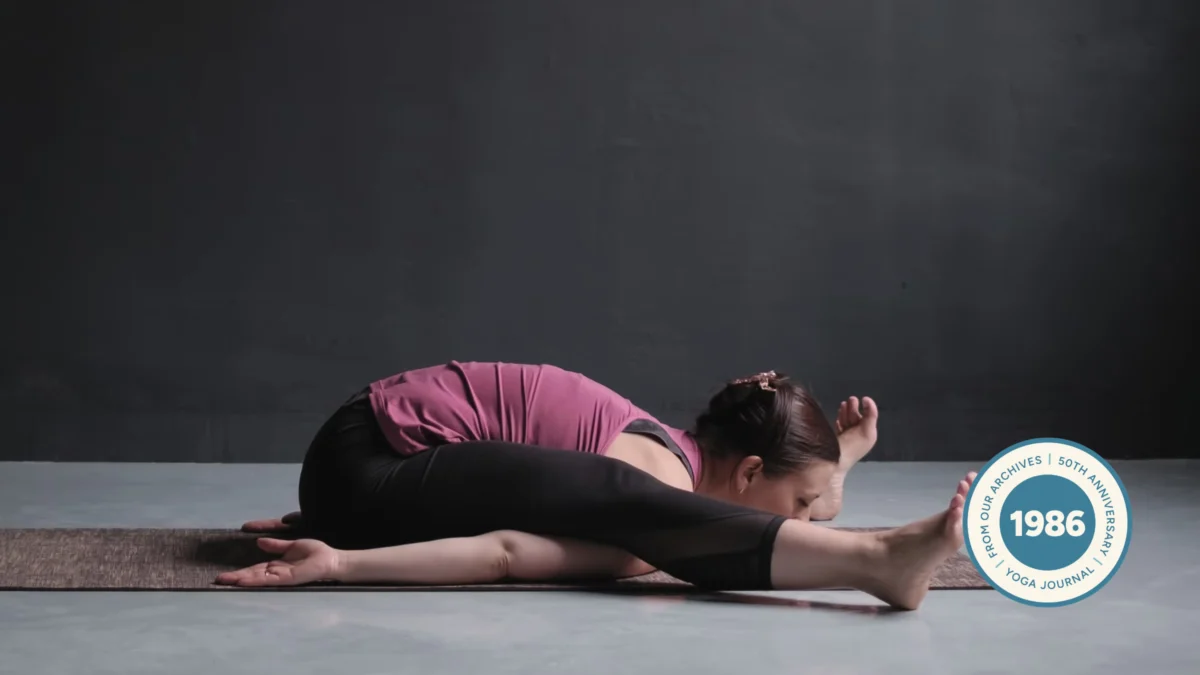
In this installment of the Yoga Journal Archives, we revisit a foundational teaching from the July-August 1986 issue. As we explore the mechanics and mysticism of Kurmasana, we discover that the bridge between the physical body and the meditative mind remains as relevant today as it was nearly four decades ago.
Introduction: The Philosophy of the Tortoise
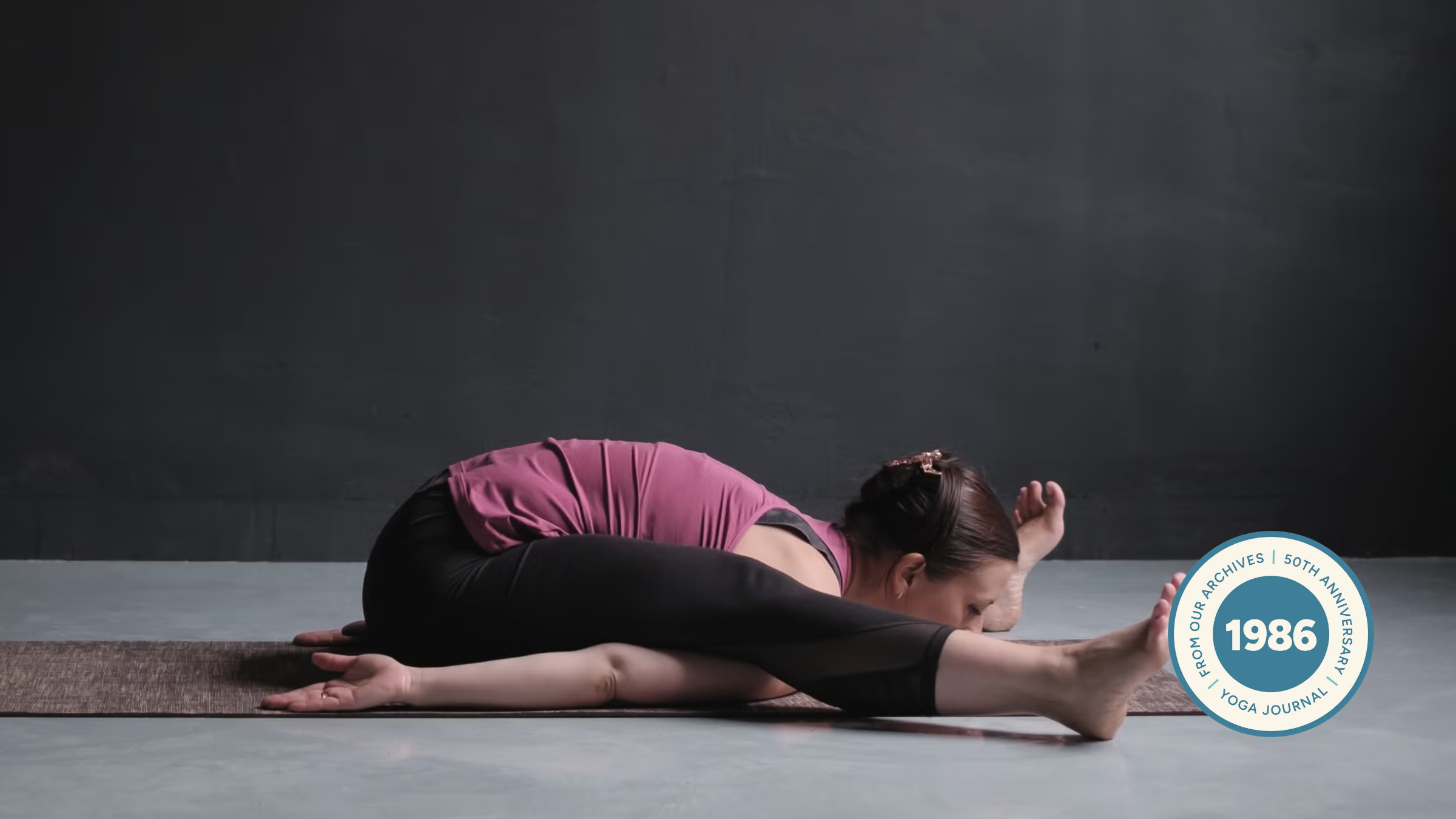
In the vast landscape of yoga asana, few postures carry as much mythological weight and psychological utility as Kurmasana, or Tortoise Pose. To the uninitiated, it is a challenging seated forward fold. To the practitioner of the ancient arts, it is a deliberate act of pratyahara—the withdrawal of the senses.
The imagery of the tortoise is profound. Much like the reptile that retreats into its shell when faced with the dangers of the external world, the practitioner of Kurmasana utilizes the physical shape of the body to create an internal sanctuary. By folding inward, we simulate the act of turning away from the cacophony of modern life—the constant stream of external stimuli—to seek the stillness that resides at the core of the human experience.
Chronology of a Classic: From 1986 to Today
The teachings surrounding Kurmasana have been passed down through lineages of masters, most notably refined in the modern era by B.K.S. Iyengar. In 1986, Yoga Journal published a seminal guide on the pose, emphasizing that yoga is not merely a form of exercise but a "science of the mind."
Since that publication, the global understanding of biomechanics has evolved, yet the core tenets of the pose remain unchanged. The practice is a bridge connecting the Yoga Sutras of Patanjali—which describe the mind as a rapid, flickering series of vrittis (agitations)—to the tangible, physical reality of the human body. By revisiting these archives, we bridge the gap between the mid-80s "yoga boom" and the contemporary mindfulness movement, proving that the search for silence is a universal human constant.
The Biomechanics of the Fold: Supporting Data
To practice Kurmasana effectively, one must move beyond the superficial desire to "touch the toes" and instead focus on the intricate architecture of the hips and spine.
The Role of the Hip Girdle
The primary physical barrier to a successful Kurmasana is rarely the back itself; rather, it is the restriction of the hip joint. The pose requires significant flexibility in the adductor muscles of the inner thigh and the hamstrings. Crucially, the external rotators—the small, powerful muscles located at the side of the hip—must be sufficiently supple to allow the pelvis to rotate forward.
When these muscles are tight, they act as a "lock," preventing the pelvis from tilting anteriorly. If a student attempts to force the forward fold without this pelvic rotation, the body compensates by rounding the lumbar and thoracic spine.
The Dangers of the "Rounded Back"
The modern sedentary lifestyle often leads to a stiff posterior chain. Many practitioners, in their eagerness to mimic the "full" expression of the pose, sacrifice the integrity of their vertebral column. This rounding creates undue pressure on the intervertebral discs and strains the ligaments and tendons supporting the spine.
Over time, this practice of "forcing" the fold leads to a weakening of the soft tissues, effectively decreasing the structural support necessary for an upright, healthy posture. As the archives remind us, "This overstretching is a form of agitation and prevents the mind from becoming quiet in the pose." The goal is not the shape, but the structural alignment that allows for physical and mental ease.
The Psychological Implications: The Science of "No-Mind"
The true brilliance of Kurmasana lies in its ability to influence the state of the mind. Patanjali’s Yoga Sutras posit that the mind is a "black box" of constant activity. We mistake this activity for reality, failing to realize that our perception is limited by the very agitation we create.
Cultivating Pratyahara
Pratyahara is the doorway to meditation. By assuming the shape of the tortoise, the practitioner creates a physical "shell." When the body is positioned correctly—without strain, with the vertebral curves preserved—the body ceases to send "emergency signals" of pain or tension to the brain. When these signals cease, the mind is afforded the space to drift away from the external world.
This is the "no-mind" state. It is not an absence of consciousness, but an absence of the ego-driven noise that typically dominates our waking lives. When the physical body is held in a position of determined, yet surrendered, stability, the delicious inner silence of the pose becomes a magnet, drawing the practitioner toward the stillness that is the ultimate essence of yoga.
The Art of Practice: Discipline and Surrender
To master the Tortoise, one must master the balance between Tapas (discipline) and Ishvara Pranidhana (surrender).
The Mechanics of Release
To stretch the large muscles of the thighs, one must apply a constant, firm engagement in the direction opposite to the muscle’s contraction. This requires tenacity. However, if this tenacity is not balanced by the ability to "let go," the practice becomes aggressive.
The instructions are clear:
- Determine the Position: Use props, such as a folded mat under the hips, to facilitate the anterior tilt of the pelvis.
- Hold and Breathe: Allow the nervous system to recognize that the body is safe in this position.
- Release the Ego: Do not force the arms under the knees if the hips are not ready. Patience is the ultimate sign of progress.
Integration into the Sequence
Kurmasana is traditionally practiced as part of a series of forward-bending asanas. It often follows Upavistha Konasana (Wide-Angle Seated Forward Bend), which serves as an excellent preparation for the inner thighs. The progression is slow: one begins by simply folding forward, eventually learning to slip the arms under the knees, and finally stretching the limbs until the chest meets the floor.
Official Responses and Contemporary Perspective
In the decades since the 1986 article, physical therapists and modern yoga teachers have largely validated these findings. The focus on "hip-hinging" rather than "spine-rounding" is now a cornerstone of safe athletic movement and injury prevention.
"The wisdom of the 1986 archives is foundational," says Sarah Jenkins, a modern anatomy-focused yoga instructor. "We have more sophisticated vocabulary now—we talk about fascia, nervous system regulation, and the Vagus nerve—but the core message remains: if you fight your body, you fight your mind. Kurmasana is the ultimate lesson in working with, not against, our limitations."
Conclusion: The Joy of Yoga
The journey of the Tortoise is a lifelong pursuit. Whether you are a beginner using a folded mat to find comfort, or an advanced practitioner linking your arms behind your back, the goal remains the same: to find the "inner silence" amidst the movement.
As you practice, remember the dual nature of the pose. It is a physical stretch for the hamstrings and hips, yes, but it is also a "stretch" for the consciousness. By maintaining the discipline to hold the pose and the faith to surrender into it, we uncover the joy of yoga. We learn that we are not the vrittis of the mind, but the witness to them. And in that realization, we find the freedom that the tortoise has known all along.
How to Practice: A Quick Reference
- Preparation: Elevate your hips on a folded mat to facilitate pelvic rotation.
- The Approach: Keep the legs at a modest width (approx. 3 feet).
- The Movement: Focus on leading with the heart, not the head. Keep the spine long and minimize rounding.
- The Insertion: Only when the legs are loose should you slip one arm at a time under the knees.
- The Hold: Maintain the pose for 30–60 seconds. Breathe deeply. If you feel sharp pain, back off. The goal is a steady, rhythmic breath that anchors the mind to the present moment.