











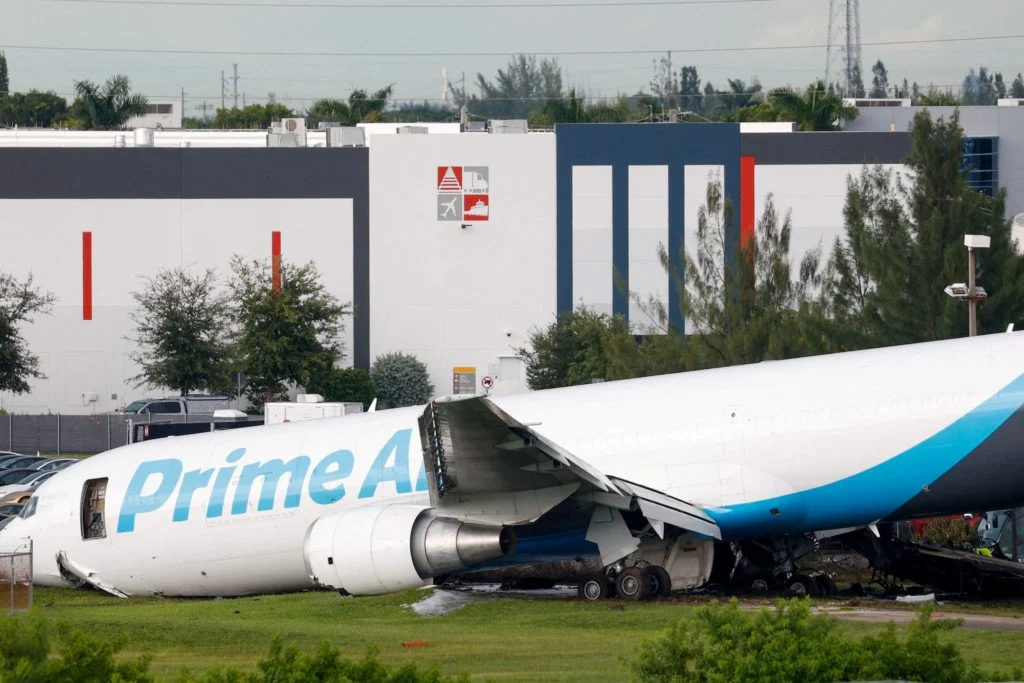
Federal investigators have launched a comprehensive inquiry into a catastrophic aviation accident at Miami International Airport (MIA) that claimed five lives and ignited a national debate over runway safety protocols. The incident involved an Amazon-contracted Boeing 767 cargo jet, which, after a turbulent approach, overran the runway, breached a perimeter fence, and collided with two civilian vehicles, resulting in the tragic deaths of all occupants within the van and SUV.
As the National Transportation Safety Board (NTSB) sifts through the wreckage, the aviation community is grappling with the factors that turned a routine cargo flight from Puerto Rico into a scene of "utter devastation," as described by NTSB Chair Jennifer Homendy.
The Sequence of Events: A Chronology of the Final Moments
The flight, originating from Puerto Rico, appeared routine until the final approach into Miami. However, meteorological data and eyewitness video suggest that the aircraft encountered significant challenges as it neared the airport.
The Unstable Approach
According to aviation experts and preliminary analysis of social media footage, the Boeing 767 was visibly struggling during its final descent. The aircraft remained airborne well past the intended touchdown point, suggesting a severe lack of stability. Observers noted that the left rear landing gear failed to settle firmly on the tarmac, an anomaly that would have critical consequences for the aircraft’s automated braking systems.
The Breach and Impact
Seconds after attempting to reconcile its altitude, the massive cargo jet barreled across the grassy safety area at the end of the runway. The momentum was such that the aircraft smashed through a heavy-duty chain-link perimeter fence. It struck two vehicles—a van and an SUV—that were in the path of the overshoot. Emergency responders confirmed that all five individuals inside those vehicles perished at the scene.
Post-Crash Site Assessment
NTSB Chair Jennifer Homendy, arriving at the scene, noted the sheer scale of the destruction. "I would describe it in one word: devastating," she stated. Investigators are currently documenting tire marks that trace the plane’s trajectory from the paved surface onto the grass, debris fields that span hundreds of yards, and the wreckage of the vehicles crushed by the impact.
Technical Analysis: Why the Aircraft Failed to Stop
Aviation correspondent Miles O’Brien, who analyzed the footage for the PBS NewsHour, provided a grim assessment of the flight’s final minutes, citing a combination of environmental factors and pilot decision-making.
The Meteorological Factor
The weather conditions at Miami International at the time of the incident were far from ideal. The airport was experiencing gusty winds, including a tailwind component that created a crosswind effect. This wind profile is particularly dangerous for large cargo jets, as it complicates the "glide slope"—the precise, imaginary path an aircraft follows during a descent.
The "High-Speed" Landing
Data indicates the aircraft was significantly above the glide slope three miles out. In an attempt to compensate, the crew performed a precipitous dive toward the runway, inadvertently increasing their airspeed.
Crucially, the plane touched down at approximately 185 miles per hour—far faster than standard protocol for a 767. Even more critical was the fact that the aircraft landed nearly halfway down the 9,000-foot runway. Because the left landing gear was not in constant contact with the concrete, the plane’s automated systems—specifically the reverse thrusters and wing-mounted speed brakes (spoilers)—failed to deploy. Without these essential decelerators, the plane exited the runway at an estimated 130 miles per hour, leaving the crew with virtually no margin to stop before hitting the perimeter.
The Decision to Continue
A major focus of the investigation will be why the crew did not execute a "go-around." According to aviation textbooks, an unstabilized approach—particularly one where the plane is significantly off-course or off-speed—should be aborted. "If you are floating over the runway and about halfway down it, that would be the time to initiate a go-around," O’Brien noted. The decision to press forward with the landing despite the lack of stabilization will be central to the cockpit voice recorder (CVR) and flight data recorder (FDR) analysis.
Safety Infrastructure: The Role of EMAS
The crash has turned a spotlight on the "Runway Safety Area" (RSA) and the technologies designed to prevent such tragedies.
The 1,000-Foot Standard
FAA regulations require a 1,000-foot buffer at the end of runways used by large commercial aircraft. Miami International was in compliance with this standard. However, the question remains whether these standards are sufficient for modern cargo operations, especially in extreme weather.
The EMAS Controversy
A focal point of the discourse is the Engineered Material Arresting System (EMAS). EMAS is essentially a bed of crushable concrete blocks placed at the end of a runway. When an aircraft’s wheels roll into the material, it acts like "quicksand," decelerating the jet rapidly without causing the structural damage of a traditional hard-surface barrier.
While EMAS is highly effective, it is not currently mandated by the FAA for all runways that already meet the 1,000-foot safety buffer requirement. Because Miami International complied with the existing buffer mandate, the installation of EMAS was not required. The NTSB is now expected to debate whether this policy should be updated to make EMAS a mandatory safety layer at all major commercial hubs, regardless of the existing runway safety area.
Official Responses and Next Steps
The investigation is in its infancy. The NTSB has secured both the flight data recorder and the cockpit voice recorder, which are currently being analyzed at the agency’s headquarters. These devices will provide precise metrics on the crew’s control inputs, the plane’s exact speed at every second, and the internal communications between the pilots during the final, frantic minutes of the flight.
Institutional Scrutiny
Amazon, which contracts the cargo flights, and the airline operating the Boeing 767 have pledged full cooperation with federal investigators. The public, however, is demanding answers. Questions regarding pilot training, corporate pressure to maintain schedules in adverse weather, and the adequacy of airport infrastructure are being raised by families of the victims and the broader aviation community.
Long-Term Implications
The findings from this inquiry will likely trigger a ripple effect across the aviation industry. Possible outcomes include:
- Updated Training Standards: A renewed emphasis on "stabilized approach" criteria and the mandatory initiation of go-arounds in gusty, crosswind conditions.
- Regulatory Overhaul: Potential mandates for EMAS installation at all runways serving large-category aircraft, regardless of existing safety buffers.
- Airport Perimeter Security: A re-evaluation of public roads and sensitive areas near runway ends to ensure that even in the event of an overrun, the impact to non-aviation personnel is minimized.
Conclusion
The tragedy at Miami International serves as a stark reminder of the fragile balance between technology and nature in modern aviation. While the investigation will eventually clarify the specific human and mechanical errors that led to this disaster, the loss of five lives has already left an indelible mark on the aviation sector. As the NTSB continues its work, the aviation industry faces a period of intense self-reflection, with the primary goal of ensuring that such a devastating "utter devastation" never occurs again.