












For many individuals over the age of 60, the simple act of rising from bed is no longer a seamless transition. Instead, it is a process akin to unfolding a rusted deckchair—a series of groans, stiff joints, and tentative movements. As we age, the “morning malaise” of physical stiffness is often accepted as an inevitable consequence of time. However, according to experts in the field of movement science, this discomfort is not a mandatory part of the aging process, but rather a functional limitation that can be reversed with a targeted, low-impact strategy.
With nearly 40 years of experience in personal training and a quarter-century at the helm of TRAINFITNESS, one of the UK’s leading fitness education providers, I have observed a consistent pattern among clients over 60. The universal complaint is the same: the first hour of the day is the most difficult. Fortunately, by implementing a specific sequence of five exercises performed before your feet ever touch the floor, you can restore fluidity to your movement and reclaim your mobility in as little as two weeks.
The Physiology of Morning Stiffness
To understand how to fix morning stiffness, we must first understand why it happens. Overnight, the body undergoes a series of physiological changes that prioritize rest over range of motion. The connective tissues—the fascia, ligaments, and tendons that encase our joints—tend to dehydrate and stiffen during long periods of inactivity. Simultaneously, synovial fluid, which acts as a lubricant within the joints, becomes viscous and settles.

When you add eight hours of static sleeping posture into the mix, the body effectively "glues" itself into place. For many, this manifests as tension in the hips, lower back, and ankles. The hips, which spend the day in a flexed, seated position, remain curled in bed, leading to chronic tightness. The lower back suffers from the compression of spinal muscles, while the ankles—often pointed downward during sleep—shorten the calf muscles, leading to that tell-tale "tight-footed" sensation when you first stand.
Furthermore, upper body mechanics are frequently compromised by daytime habits. If you spend your waking hours at a desk with rounded shoulders, your body carries that posture into the night. By morning, the shoulders are locked, and the neck is often compressed on one side depending on your preferred sleeping position. The result is a cumulative, daily loss of range of motion that eventually makes daily tasks feel like an athletic endeavor.
Why Bed Exercises Outperform Traditional Stretching
There is a common misconception that traditional static stretching is the remedy for stiffness. However, performing deep, static stretches on a "cold" body immediately after waking is often counterproductive and can lead to micro-tears or strains.

Bed-based mobility work is fundamentally different. It focuses on dynamic movement rather than holding a position. By moving joints through their full range of motion while lying on a supportive mattress, you stimulate blood flow, warm the tissues, and hydrate the joints safely. The mattress provides a "friendly" surface that supports the spine, making it easier to navigate movements that might be intimidating or painful on a hard floor.
Crucially, the "barrier to entry" is exceptionally low. By doing these exercises before you even leave the warmth of your duvet, you remove the psychological hurdle of finding a yoga mat or motivating yourself to stand up. If you can dedicate ten minutes to these movements before you reach for your phone or a coffee, you set a physiological baseline for the entire day.
The Five-Step Mobility Sequence
1. The Full-Body Starfish Stretch
This movement is designed to wake up the entire central nervous system. By reaching your arms overhead and pointing your toes, you create a longitudinal stretch that activates the core and signals to the body that the period of rest has concluded.

- The Technique: Lie flat on your back. Slowly reach your hands toward the headboard and your toes toward the foot of the bed.
- Sets and Reps: 5 repetitions, holding the peak stretch for 5 seconds each.
2. The Knee-to-Chest Hug
This is the gold standard for immediate lower-back relief. It gently decompresses the spine and releases the hip flexors that have been tightened by hours of nocturnal curling.
- The Technique: Gently bring one knee toward your chest, holding it with both hands. Feel the release in the lower back. Then, bring both knees in for a deeper stretch.
- Sets and Reps: Hold 20 seconds per side, followed by 20 seconds with both knees held together.
3. The Supine Spinal Twist
Rotation is the most neglected movement pattern in modern life, yet it is essential for spinal health. This exercise targets the entire length of the spine, helping to "unlock" the upper body.
- The Technique: Lie on your back with arms out in a "T" shape. Gently drop your knees to one side while keeping your shoulders pressed firmly into the mattress. Keep your gaze directed toward the opposite hand.
- Sets and Reps: 20 seconds per side.
4. Cat-Cow on All Fours
Moving to a hands-and-knees position on the bed allows you to mobilize the spine in both flexion and extension. The soft surface of the mattress makes this much more comfortable for the knees than a traditional exercise mat.
- The Technique: Start on all fours. As you inhale, drop your belly and look up (Cow). As you exhale, round your back toward the ceiling and tuck your chin (Cat).
- Sets and Reps: 8 to 10 slow, controlled repetitions.
5. Shoulder Rolls and Neck Stretches
These are critical for individuals who sleep on their sides and wake up with one-sided neck tension or shoulder fatigue.
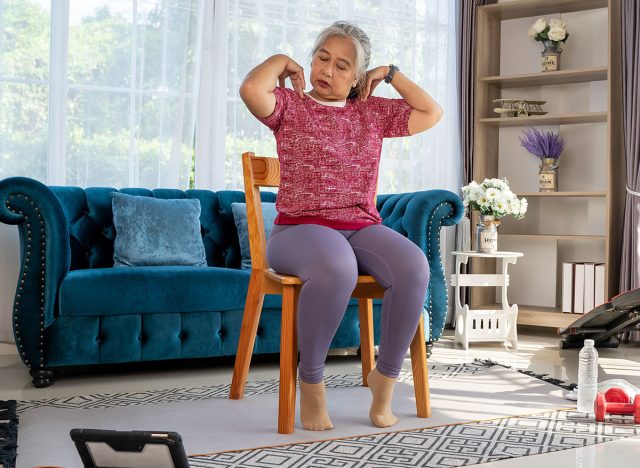
- The Technique: Sit upright on the edge of the bed. Perform slow, circular rolls with the shoulders, then gently tilt the ear toward the shoulder to stretch the neck. Follow with slow head turns.
- Sets and Reps: 5 rolls in each direction; 10-second holds for neck stretches; 5-second holds for head turns.
Chronology of Progress: What to Expect
Implementing a new habit requires patience, but the body is highly adaptive. Here is the timeline for recovery:
- Week 1: You will notice a reduction in the "first-hour" fatigue. Getting out of bed will feel less like a chore and more like a fluid movement.
- Week 2–3: The benefits begin to compound. You will notice that bending down to tie your shoes, turning to look behind you while driving, or reaching for high shelves becomes markedly easier.
- Week 4–6: This is the "maintenance phase." The gains you have made are now embedded in your tissue. Your body has regained a functional range of motion that persists even if you miss an occasional day.
- Beyond 6 Weeks: The routine becomes an effortless habit. It is no longer a "rehab" process, but a proactive strategy for long-term health, ensuring that your body remains supple and capable for years to come.
Implications for Longevity
The most significant implication of this routine is the prevention of "disuse atrophy." Many over 60 accept physical decline as inevitable, but in reality, much of this decline is caused by the slow, systematic withdrawal from movement. When we stop moving our joints through their full range, that range effectively shrinks.

By dedicating just ten minutes a day to this routine, you are making a high-yield investment in your autonomy. The ability to move without pain is the cornerstone of independent living. This sequence does not require expensive equipment or gym memberships; it requires only your commitment to your own physical well-being.
As we look toward the future of aging, the focus must shift from "treating" aches and pains to maintaining the mechanical integrity of the human frame. Morning stiffness is the body’s way of asking for attention. By answering that call with deliberate, gentle, and consistent movement, you can transform your morning from a daily battle into a refreshed, pain-free start to your day.