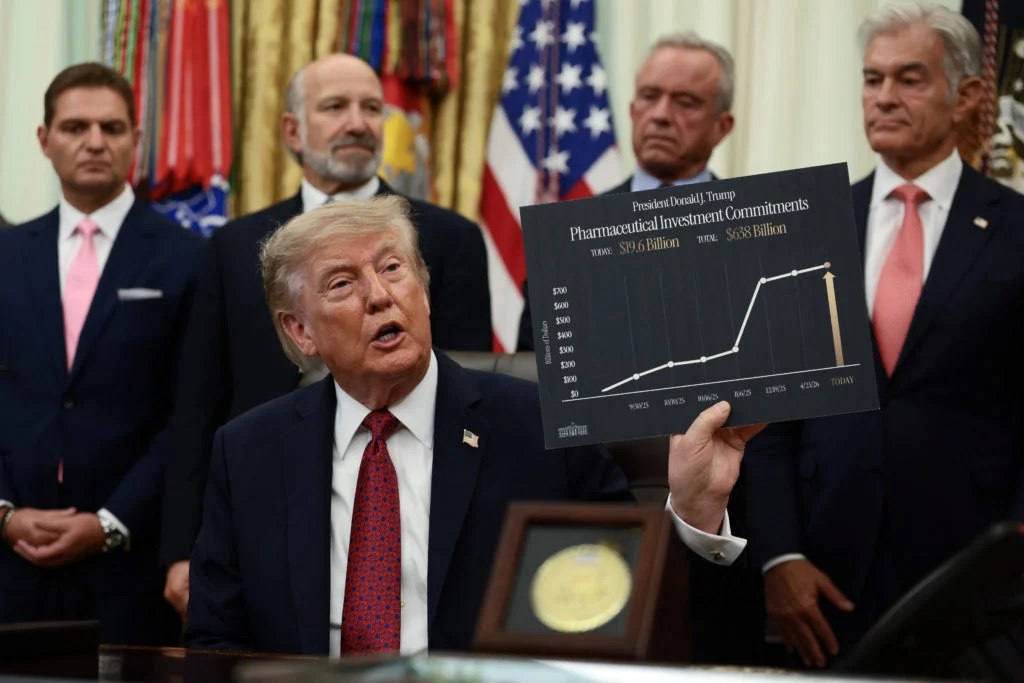
WASHINGTON — In a move designed to reshape the landscape of American healthcare costs, the President announced this week that nine additional pharmaceutical companies have agreed to participate in the administration’s "Most Favored Nation" (MFN) pricing model. The initiative, which seeks to tie the prices of prescription drugs in the United States to the lower costs found in international markets, marks a significant escalation in the White House’s long-standing effort to address public anxiety surrounding inflation and the skyrocketing cost of living.
Speaking from the Oval Office, surrounded by senior administration aides and industry executives, the President framed the expansion as a decisive step toward restoring affordability to the American healthcare system. The inclusion of these nine companies—Alcon, Astellas Pharma, BeOne Medicines, BridgeBio, CSL, Kyowa Kirin, Sun Pharma, Teva Pharmaceuticals, and UCB—represents a notable broadening of the program’s reach, which the administration claims could result in more than $500 billion in savings for the healthcare system over the next decade.
The Core Strategy: Aligning Costs with Global Standards
At the heart of the administration’s pharmaceutical agenda is the "Most Favored Nation" pricing system. The premise is simple yet controversial: the U.S. government, through its Medicaid programs, should not pay more for a medication than what is paid by other developed nations.
For years, policymakers have observed that American consumers and taxpayers often subsidize the drug research and development costs for the rest of the world, paying premium "list prices" while foreign governments negotiate significantly lower rates for the same products. By mandating that the baseline cost for prescription drugs be tethered to these lower international benchmarks, the White House aims to eliminate the disparity that has long fueled domestic frustration.
The President’s recent remarks underscored the political urgency of the mission. As inflation remains a central concern for voters, the administration is eager to demonstrate that it is taking tangible, structural action to curb costs. By securing the participation of these nine firms, the White House hopes to build momentum for a broader industry shift, putting pressure on competitors to adopt similar pricing models to remain viable in the Medicaid space.
A Chronology of the MFN Policy Development
The path to the current expansion of the MFN model has been marked by years of legal battles, industry lobbying, and shifting political strategies.
The Early Efforts (2018–2020)
The concept of international reference pricing first gained serious traction during the initial phases of the administration’s tenure. Early proposals met with immediate resistance from pharmaceutical trade groups, who argued that such measures would stifle innovation and lead to supply chain shortages. Several lawsuits were filed, effectively stalling the rollout of the initial executive orders.
The Legislative and Administrative Pivot (2021–2024)
Following the judicial pushback, the administration pivoted toward a more collaborative, albeit aggressive, approach. Rather than relying solely on sweeping executive mandates, the Department of Health and Human Services (HHS) began working to build consensus with individual manufacturers. This period saw a transition from a confrontational stance to a series of "voluntary-yet-essential" agreements that aligned participating companies with Medicaid rebate requirements.
The Current Expansion (2025)
This week’s announcement marks the most significant expansion of the program to date. By securing commitment from companies like Teva and Astellas, the administration is signaling that the policy is no longer just a theoretical framework but an operational reality. The focus has shifted from high-level policy debates to the logistics of integration and the monitoring of price benchmarks across international borders.
Supporting Data: The Arithmetic of Savings
The administration’s claim of $500 billion in savings over ten years is a figure that has drawn both scrutiny and cautious optimism from economists and healthcare analysts.
The complexity of the U.S. drug pricing market makes calculating these savings difficult. The current system relies on a convoluted network of pharmacy benefit managers (PBMs), insurance rebates, and list prices. The MFN model targets the "sticker price"—the price before insurance-related discounts are applied.
Critics argue that because insurance companies already negotiate significant discounts, the "net" savings to the average consumer might be lower than the administration suggests. However, the White House contends that by lowering the baseline price, the entire downstream cost structure—including copays and deductibles for seniors and low-income individuals—will naturally deflate.
Comparative Cost Metrics (Illustrative)
- The MFN Goal: Pegging the U.S. cost at the lowest of 10+ reference countries (e.g., Japan, Germany, Canada).
- The Medicaid Impact: Direct alignment of state-level procurement with the MFN threshold, reducing the burden on state budgets.
- The Projection: $500B+ reduction in gross spending on covered prescription drugs over the next 10 years, assuming a 15%–30% reduction in average list prices for participating categories.
Official Responses and Stakeholder Perspectives
The reception to the expansion has been predictably bifurcated.
The Administration’s View
The White House maintains that this is a "win for the American family." In a briefing following the Oval Office event, an administration spokesperson noted that "for too long, American patients have been forced to pay a premium that effectively funds the healthcare systems of other nations. This is about equity and ensuring that the market reflects the value of the medicine, not the flaws of a broken pricing system."
Industry Reaction
The nine participating companies have largely framed their involvement as a commitment to patient access. While some pharmaceutical executives have expressed concerns privately about the impact on long-term R&D funding, the public-facing response has been one of cooperation. A representative for one of the firms noted, "We are committed to working with the administration to find sustainable pricing solutions that ensure our therapies reach the patients who need them most."
The Opposition
Consumer advocacy groups and some fiscal conservatives remain skeptical. Some consumer advocates argue that the program doesn’t go far enough to regulate PBMs, which they claim capture much of the "savings" before they ever reach the patient. Meanwhile, some industry analysts fear that if the government leans too heavily on international price caps, the United States could see a decline in the availability of new, cutting-edge therapies that are first launched in more profitable markets.
Implications for the Future of Healthcare
The expansion of the MFN program carries profound implications for both the pharmaceutical industry and the American patient.
1. Market Volatility and Innovation
If the MFN model becomes the industry standard, pharmaceutical firms may need to rethink their pricing strategies globally. There is a risk that companies will raise prices in the reference countries to ensure that the "international benchmark" remains as high as possible, potentially leading to a global inflation of drug prices. Conversely, it could force a radical transparency in how drugs are valued, leading to more predictable costs for taxpayers.
2. The Medicaid Landscape
For state Medicaid programs, this is a significant victory. Medicaid budgets are often the first to feel the pressure of rising drug costs. By codifying lower prices, states may be able to expand access to high-cost specialty drugs that were previously deemed too expensive for broad coverage.
3. Political Fallout
The administration’s ability to point to concrete "wins" is essential in the current political climate. By naming specific companies that are now "on board," the White House is turning the pricing debate into a scoreboard. If this initiative results in visible, immediate price drops at the pharmacy counter, it could become the administration’s signature domestic achievement. However, if the savings prove illusory or if drug availability suffers, the policy could quickly become a political liability.
Conclusion: A Delicate Balance
The administration’s push to align U.S. drug prices with international standards is a bold, high-stakes gambit. By bringing nine additional companies into the fold, the White House has moved beyond rhetoric and into the messy, complicated business of price regulation.
As the program moves forward, the success of the MFN initiative will be judged not by the number of companies participating, but by the impact on the pocketbooks of the American public. The balance between maintaining a robust environment for pharmaceutical innovation and ensuring the affordability of essential medicine remains the most difficult tightrope walk in modern public policy.
The coming months will be critical. As the government begins the process of auditing the pricing structures of these nine firms, the eyes of both the healthcare industry and the voting public will be fixed on the outcome. For now, the administration has successfully moved the needle, but whether that movement translates into long-term relief remains the fundamental question of this policy era.