








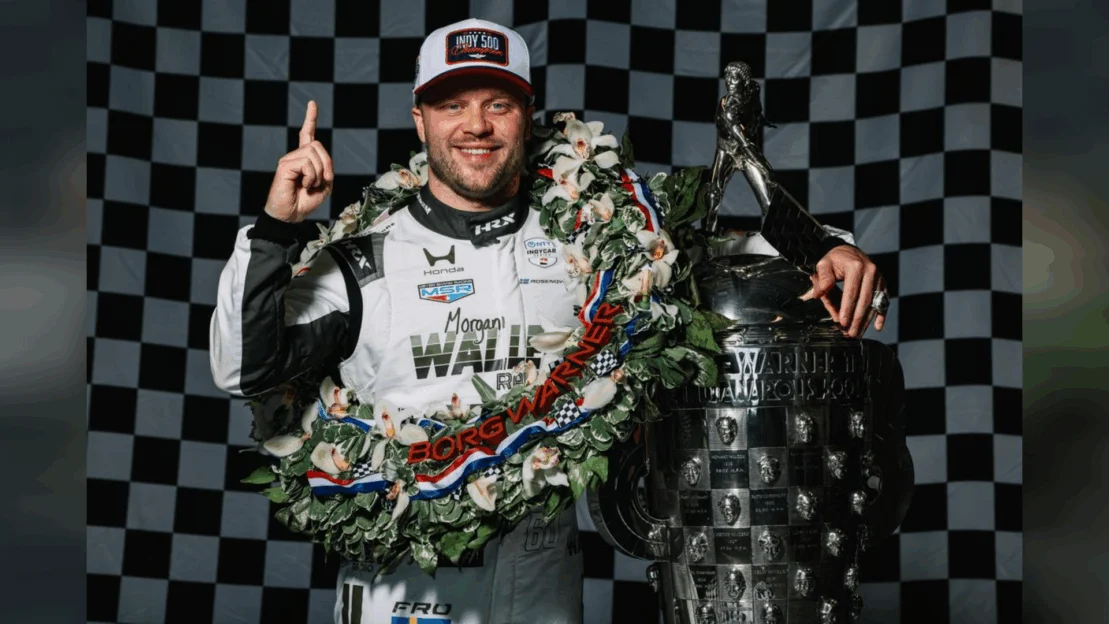
At 34 years old, Felix Rosenqvist has finally claimed the one prize that defines greatness in motorsport. After seven years of heartbreak, near-misses, and mechanical agony at the Indianapolis Motor Speedway, the Swedish driver finally found his way to the most exclusive destination in racing: Victory Lane. His victory in the 2026 Indianapolis 500 was not merely a triumph of speed; it was a masterclass in psychological fortitude, tactical evolution, and the culmination of an arduous, years-long journey toward perfection.
The Most Dramatic Finish in History
The 2026 Indianapolis 500 will be remembered by historians and gearheads alike as a benchmark for chaotic brilliance. Rosenqvist’s victory was etched into the record books with a margin of just 0.0233 seconds over runner-up David Malukas—the closest finish in the 110-year history of the event, eclipsing the legendary 1992 battle between Al Unser Jr. and Scott Goodyear.
The closing stages of the race were a microcosm of Rosenqvist’s career: full of promise, followed by sudden, devastating uncertainty. After building a commanding 20-second lead, a Lap 193 crash by Caio Collet triggered a red flag, effectively vaporizing Rosenqvist’s hard-earned cushion. For a driver who had famously suffered a gut-wrenching crash in 2023—a collision that sent a tire flying over the grandstand fence—the restart was a crucible.
When the green flag flew, he was instantly swallowed by the pack, falling behind both teammate Marcus Armstrong and David Malukas. However, a final yellow flag on Lap 197 for a Mick Schumacher incident provided a miraculous one-lap shootout. In that final, adrenaline-soaked circuit, Rosenqvist shed his previous cautious habits. He surgically dispatched Pato O’Ward, executed a high-line pass on Armstrong, and finally, in the last 50 feet, utilized a perfectly timed side-draft to overhaul Malukas. It was a move that required the precision of a surgeon and the nerves of a veteran.
A Chronology of Redemption
To understand the weight of Rosenqvist’s win, one must look at the path of frustration that preceded it. His Indianapolis tenure has been a roller coaster of "what ifs."
- 2019-2021: A rookie-year crash and a penalty-induced 27th-place finish signaled a difficult initiation to the 2.5-mile rectangular oval.
- 2022-2025: While showing flashes of elite speed—including consecutive fourth-place finishes in 2022 and 2025—he consistently lacked the late-race track position required to secure a podium. The 2024 engine failure on Lap 56 served as a low point that nearly broke his spirit.
- 2023: The "gut-wrenching" year. After qualifying fifth and leading 33 laps, a late-race slip into the Turn 1 wall ended his day in spectacular fashion.
- 2026: The Year of the Milk. Despite leading the charge throughout the qualifying sessions, he narrowly missed pole position to Alex Palou. Rather than spiraling, Rosenqvist channeled the setback as a reminder that the race is not won in qualifying, but in the final, decisive moments.
The Science of the "Clutch" Moment
The transformation of Felix Rosenqvist from a talented driver prone to bad luck into an Indianapolis 500 champion was no accident. It was the result of a rigorous, off-season overhaul of his mental and physical preparation.
Recognizing that the difference between winning and losing at the Brickyard often comes down to split-second decision-making, Rosenqvist engaged with Ares Elite Sports Vision. The goal was to increase his cognitive processing speed under extreme physiological stress. He underwent intensive training, including solving complex math equations while maintaining a high heart rate on a treadmill.
"We do drills like counting a math problem at the same time as you’re on a treadmill, where you stress the brain in different ways," Rosenqvist explained. "I’m not going to say it directly led to the win, but things like this mattered."
Furthermore, he turned to the film room. By dissecting race onboards with teammate Marcus Armstrong, he stopped viewing his competitors as obstacles and started viewing them as components in a larger, tactical puzzle. This deep dive into the "driver’s eye view" allowed him to anticipate the movements of his rivals during the final-lap shootout, turning his experience from a burden into a weapon.
Official Responses and the Human Element
The emotional resonance of the win was compounded by the fact that it occurred just three weeks after the birth of his daughter, Stella, on May 4. This confluence of life-altering events left the driver overwhelmed.
"I think it’s going to be hard to beat becoming a dad three weeks ago and winning this race," Rosenqvist remarked during his post-race media availability. "I think I have to accept to myself that I’m probably not going to have a better three weeks of my life. This last month has taken out emotions I didn’t know I had out of myself."
His team at Meyer Shank Racing was equally effusive. In an era where racing is often criticized for becoming too clinical, the bond between the driver and his crew proved pivotal during the red flag periods. While the broadcast cameras caught the frustration on the pit wall after the red flag erased his lead, the internal radio communication remained a bastion of positivity. "They were just like cheering me on, like, ‘Hey, bro, we got this, we’re looking good here, we got the best car,’" Rosenqvist recalled. That psychological support kept him in the fight, preventing the "mental spiral" that had plagued him in previous seasons.
The Implications: A New Benchmark for IndyCar
The 2026 Indy 500 did more than crown a new champion; it redefined the limits of competitive racing. With a record 70 lead changes, the race showcased the peak of the current aero-package and the depth of talent within the IndyCar field. For Rosenqvist, the victory is a vindication of his career-long project to marry raw pace with disciplined, race-craft maturity.
His average speed of 174.199 mph ranks as the sixth-fastest in history, underscoring that while the finish was dramatic, the entire race was a high-speed sprint. The implication for the rest of the 2026 season is clear: Rosenqvist is no longer just a fast driver; he is a championship contender who understands how to navigate the chaotic theater of high-stakes racing.
As the paddock prepares for the remainder of the season, starting with the Bommarito Automotive Group 500, the narrative has shifted. Rosenqvist’s ability to "win the race twice"—first by building the gap, and then by executing the final-lap pass—has set a new standard for what a driver can achieve at the Indianapolis Motor Speedway.
Final Reflection: The Legacy of a Perfect Lap
Perhaps the most telling aspect of the win is Rosenqvist’s admission that, even with the best equipment, he could not have dreamed up such a scenario. "There’s just no way you even dare to dream of having whatever happened to me happen in real life," he said. "I’m not sure the way it played out has really happened before. We were basically creating something new with that finish."
For the 77th driver to drink the ceremonial milk, the 2026 Indy 500 is the culmination of a decade of hard work, shattered parts, and personal growth. It is a reminder that in motorsport, speed is the entry fee, but experience is the currency of victory. Felix Rosenqvist has proven that with enough dedication, even the most bitter of past failures can be rewritten into the most iconic of triumphs. As the ink dries on the record books, one thing is certain: that final lap in May 2026 will be studied, analyzed, and celebrated for generations to come.