











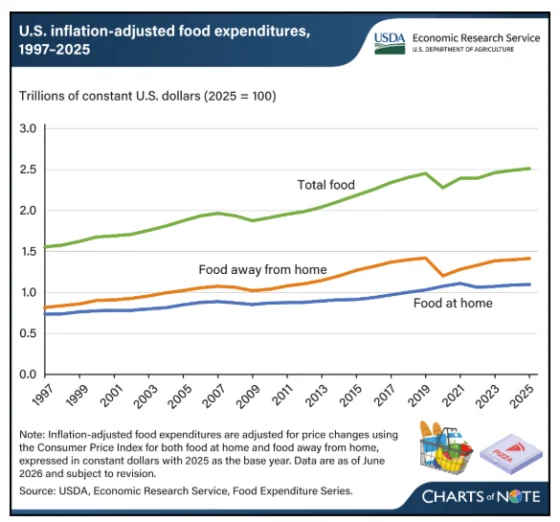
In the landscape of the American economy, few metrics provide as clear a window into the nation’s lifestyle as the USDA’s Food Expenditure Series. According to the latest data released by the U.S. Department of Agriculture in June 2026, Americans spent an astonishing $2.51 trillion on food in 2025. This figure, while reflective of a growing population and inflationary pressures, highlights a seismic shift in how the country nourishes itself—and perhaps, a decline in the cultural practice of home cooking.
Despite mounting public health warnings regarding ultra-processed foods, the rising popularity of GLP-1 weight-loss medications, and persistent economic volatility, the financial footprint of the American diet continues to expand. The trend is clear: we are spending more on food than ever before, and increasingly, that money is going toward meals prepared by someone else.
Main Facts: A $2.51 Trillion Industry
The $2.51 trillion figure represents the total national outlay for food and beverages, encompassing everything from grocery store staples to high-end restaurant dining and fast-food transactions. This data, distilled into the USDA’s "Charts of Note," serves as a definitive look at the economic reality of the American dinner table.
The growth is not merely a product of rising food costs; it represents a fundamental change in the "Food Away From Home" (FAFH) versus "Food At Home" (FAH) dynamic. While the cost of raw ingredients has seen significant fluctuations over the last decade, the demand for convenience—delivered meals, prepared deli items, and restaurant dining—has effectively decoupled from the traditional model of family home cooking.
A Chronological Perspective: From 1997 to the Modern Era
To understand the trajectory of our current spending, one must look at the historical data provided by the USDA’s Food Expenditure Series dating back to 1997.
1997–2019: The Steady Climb
For over two decades, the trendline for food spending was marked by consistent, upward growth. This era saw the expansion of the "fast-casual" dining sector, the rise of food delivery platforms, and an increased reliance on pre-packaged, convenience-focused foods. During this period, the proportion of the food budget allocated to restaurants and prepared foods steadily gained ground on traditional grocery store spending.
2020–2021: The Pandemic Disruption
The COVID-19 pandemic provided the only significant "dip" in the growth curve. With lockdowns shuttering restaurants and changing the daily habits of millions, the Food Away From Home sector plummeted. For a brief window, Americans returned to their kitchens, driving a spike in grocery store sales and a temporary, forced revival of home cooking.
2022–2026: The Post-Pandemic Rebound and Inflation
As society reopened, the "revenge dining" phenomenon took hold. Despite the onset of significant food price inflation, Americans did not abandon the habit of eating out. Instead, the total expenditure surged, driven by a combination of higher menu prices, increased service fees from third-party delivery apps, and a societal shift toward prioritizing convenience over culinary labor.
Supporting Data: The FAFH vs. FAH Divergence
The USDA data reveals a widening gap between what we buy to cook and what we buy to consume immediately.
- The Convenience Premium: The data suggests that consumers are increasingly willing to pay a premium for labor. The labor involved in preparing, cooking, and cleaning up a meal is being outsourced to the commercial food sector.
- Inflationary Buffers: Even as the Consumer Price Index (CPI) for food-at-home items rose, the demand for convenience did not crater. This suggests that food is increasingly viewed not just as sustenance, but as a service commodity.
- The "Real Food" Deficit: Health advocates often argue that "eating real food"—minimally processed, nutrient-dense ingredients—is the cornerstone of a healthy lifestyle. However, the economic data suggests that the average American household’s behavior is moving in the opposite direction, as the labor-intensive nature of cooking "real food" remains at odds with the modern, time-pressed lifestyle.
Official Responses and Expert Observations
Agricultural economists and health policy experts have scrutinized these findings with a mix of alarm and curiosity. The USDA’s decision to highlight this specific data point underscores a concern that the nutritional quality of the American diet is tethered to the economic decline of home cooking.
"The data is clear," notes one analyst familiar with the series. "When home cooking stagnates, reliance on ultra-processed, calorie-dense, and nutrient-poor foods usually rises. The $2.51 trillion figure is not just an economic number; it is a public health indicator."
Furthermore, there is a growing discussion regarding the impact of GLP-1 drugs on food sales. While some speculate that these medications might curb total caloric intake, the current spending data shows no such reduction in national food outlays. It appears that even if individuals are eating less, they are spending the same amount—or more—on higher-cost, perhaps higher-quality or more convenient, food options.
Implications: The Death of the Home Cook?
The implications of this shift are profound, affecting everything from public health outcomes to household financial stability.
The Health Consequence
Cooking at home is one of the most reliable indicators of a healthier diet. When individuals prepare their own food, they are more likely to control sodium, sugar, and fat levels, and they are significantly more likely to consume whole vegetables and proteins. As the proportion of spending shifts toward restaurants, we see an increase in the consumption of "ultra-processed" ingredients, which are designed for shelf-stability and palatability rather than long-term health.
The Educational Gap
The author of the USDA analysis echoes a common sentiment among nutritionists: the decline of home cooking is, in part, a failure of education. If basic culinary literacy—the ability to roast a chicken, steam vegetables, or prepare a simple grain—is not passed down, the convenience economy becomes the only viable path for the average worker.
In the mid-20th century, home economics classes were a standard fixture of the American curriculum. Today, as the economy demands longer hours and more flexibility, the time-intensive process of cooking is increasingly relegated to a luxury activity rather than a basic survival skill.
Economic Resilience
Interestingly, the fact that food spending has continued to rise despite inflation and economic uncertainty confirms that food is a "sticky" expenditure. Unlike luxury goods or entertainment, food spending is rarely slashed to the bone. However, the shift toward eating out suggests that the American public is increasingly willing to take on debt or sacrifice savings to maintain a lifestyle of convenience.
Conclusion: A Call for a Culinary Renaissance
The $2.51 trillion spent in 2025 serves as a massive, country-wide vote for convenience. However, this convenience comes with a cost that is not reflected in the dollar sign: the loss of control over what we put into our bodies.
If the goal is to improve the nutritional health of the nation, the solution may not be found in more regulations or expensive supplements, but in the kitchen. Learning to cook is not merely a nostalgic hobby; it is a critical intervention against the tide of ultra-processed food and the rising costs of the modern diet. As we look toward the remainder of the decade, the question remains: can we reverse the trend, or are we destined to remain a nation that buys its health in takeout containers?
The USDA data provides the map; it is up to the American household to decide if they will reclaim the kitchen or continue to outsource their health to the highest bidder.