










Lunges are the "love-to-hate" staple of any serious lower-body training program. They are unrivaled in their ability to isolate the quads and glutes, identify and correct muscular imbalances, and build the kind of functional hip stability that carries over into every facet of athletic performance. Whether your primary objective is hypertrophy—building bigger, more aesthetic legs—or athletic conditioning, the lunge is a non-negotiable tool.
Yet, for many gym-goers, the movement often devolves from a strength-building exercise into a frantic, chaotic struggle against gravity. Instead of feeling a deep, rewarding burn in the target muscles, trainees often find themselves cutting sets short, feeling frustrated, or nearly toppling over. If you find your lunges are more "stumble" than "strength," you aren’t alone—but you are likely missing the foundational requirements of the movement.
The Anatomy of Instability: Why Lunges Feel So Funky
When a lift feels "shaky," it is rarely a coincidence. It is almost always a diagnostic signal from your body that one or more links in your kinetic chain are underperforming. To fix the lunge, we must first identify the three primary culprits behind the wobble.
1. Weak Hip Stability
The hips are the command center of lower-body movement. Specifically, the gluteus medius acts as the primary stabilizer of the pelvis. When these stabilizers are weak, your pelvis loses its level plane, causing your knee to cave inward (valgus collapse) as you descend. This forces your larger, primary movers—like the quads and gluteus maximus—to work overtime to compensate for the lack of structural support, leading to premature fatigue and poor form.
2. Poor Foot Stability
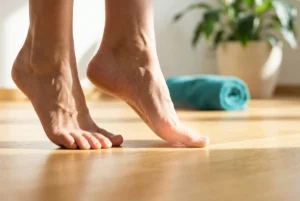
The kinetic chain begins at the floor. If your foot is not properly anchored, instability travels upward, amplifying as it reaches the ankle, knee, and hip. When your foot rolls inward (pronation) or your weight shifts onto your toes, you lose your "tripod" base—the vital connection between your big toe, little toe, and heel. Without a stable base, you cannot generate the necessary force to return to the standing position efficiently.
3. Deficient Coordination
Lunges are a complex motor task. They require a sophisticated level of inter-joint coordination. You must lower your body under absolute control, maintain a neutral spine, keep your pelvis square, and drive upward in a precise sequence. If your neural drive is lagging, the movement feels disconnected, making it impossible to load the exercise with the weight necessary for significant strength gains.
Chronology of Progress: Building the Foundation
Balance and stability are not fixed traits; they are trainable skills. If you jump straight into weighted walking lunges before you have mastered the basics, you are setting yourself up for failure. A professional approach involves a strategic progression:
- Phase 1: Stabilization (Weeks 1–2): Focus on unilateral balance drills and core-centric hip work.
- Phase 2: Patterning (Weeks 3–4): Introduce controlled, static movements like the "B-Stance" to reinforce the weight distribution.
- Phase 3: Integration (Weeks 5+): Reintroduce the full lunge pattern with increased load, moving slowly and focusing on technical mastery.
Supporting Data: The Case for Single-Leg Training
Research in sports biomechanics consistently shows that unilateral (single-leg) training provides a distinct advantage over bilateral (two-leg) movements. A study published in the Journal of Strength and Conditioning Research suggests that athletes who incorporate unilateral exercises show a marked reduction in bilateral strength deficits.
When you squat with both legs, your stronger side will almost always subconsciously take on more of the workload. Over time, this creates a "strength gap." By utilizing single-leg alternatives, you force the lagging side to work to its full capacity, effectively "evening out" your physique and reducing the risk of injury in the long term.
Expert Perspectives: The Solution-First Approach
Top-tier physical therapists and strength coaches argue that the "lunge problem" is rarely a lack of effort—it is a lack of prerequisite strength. "If an athlete cannot balance on one leg for 30 seconds," says Dr. Julian Thorne, a specialist in orthopedic sports medicine, "they lack the neuromuscular capacity to safely perform a dynamic lunge under load. The solution isn’t to force the lunge; it’s to regress to a movement where they can control the joint angles."
The 5-Step Path to Bulletproof Legs
To reclaim your lunges, you must temporarily swap them for exercises that build confidence, coordination, and strength without the risk of tipping over.
1. Controlled Step-Down
This is the gold standard for eccentric (lowering) control. By standing on a box or a bench and lowering one foot to the floor, you eliminate the "momentum" of a lunge and force your stabilizer muscles to fire.
- Why it works: It forces you to own the descent, building the glute and quad control needed for a steady lunge.
- Prescription: 3–4 sets of 6–10 reps per leg, using a 3-second lowering tempo.
2. Mini-Band Side Plank Clamshell
This movement specifically targets the gluteus medius. By performing a clamshell while holding a side plank, you force the hip stabilizers to work in a fatigued, isometric state.
- Why it works: It trains the pelvic stability required to keep your knee from caving during lunges.
- Prescription: 2 sets of 10–15 reps per side.
3. Front-Foot Elevated Split Squat
By elevating the front foot, you increase the range of motion and shift the center of gravity. This makes it easier to maintain a "tripod" foot position.
- Why it works: It provides a deep stretch to the glutes and improves ankle mobility, both of which are essential for a perfect lunge.
- Prescription: 3 sets of 12 reps per side.
4. Cossack Squat
This exercise moves you through a different plane of motion. By shifting your weight side-to-side, you learn to coordinate your hips, knees, and ankles in a way that static lunges cannot teach.
- Why it works: It improves hip mobility and adductor strength, which are vital for lateral stability.
- Prescription: 3 sets of 10–12 reps per side.
5. B-Stance Goblet Squat
The "kickstand" method. By placing your rear foot slightly behind you, you get 90% of the benefit of a single-leg squat with 50% of the balance requirement.
- Why it works: It acts as the perfect bridge between the standard squat and the lunge.
- Prescription: 3 sets of 8–12 reps per side.
Implications: Building for the Long Term
The primary implication of this training strategy is a shift in mindset. Many gym-goers view a "missed rep" or a "wobbly set" as a failure of character. In reality, it is a failure of preparation. By integrating these five movements into your routine, you are not "skipping" the hard work—you are building the infrastructure that will allow you to eventually perform lunges with heavy weights and perfect form.
When you master the balance, the lunge ceases to be an act of survival and becomes a powerful tool for athletic dominance. You will find that your strength plateaus vanish, your joint health improves, and the unique, deep-muscle soreness that only lunges can provide becomes a badge of honor rather than a sign of a shaky, ineffective workout.
Patience in the weight room is the fastest way to progress. Stop fighting for balance, and start building it. Your legs will thank you.