









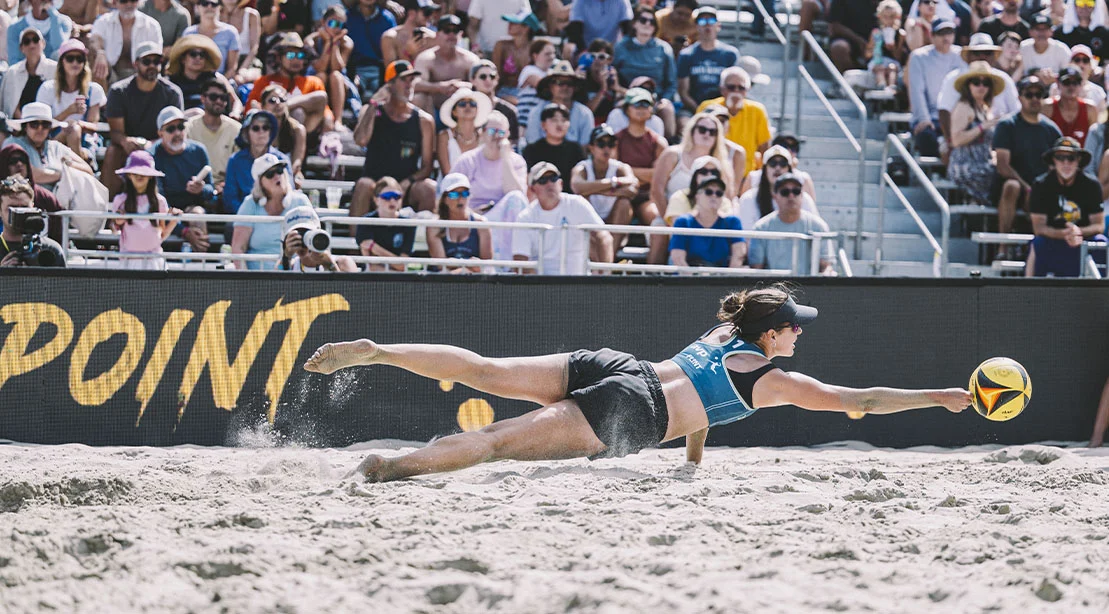
For the vast majority of professional athletes, the measure of a career is distilled into a binary language: wins and losses, championships and failures, podium finishes and empty-handed departures. For seven-time AVP champion Betsi Flint, those metrics remain relevant, but they have been fundamentally supplanted by a more profound benchmark.
Today, when the public address announcer introduces her to the crowd, the title that resonates most deeply isn’t "seven-time champion." It is "mom of two."
"I love when they introduce me as a mom of two," Flint tells Muscle & Fitness. "That holds a lot more weight to me than any other accolade."
Flint’s return to the 2026 AVP League circuit—following the birth of her son, Odin—is more than a sports comeback story. It is a masterclass in the intersection of professional high-performance, biological recovery, and the logistical symphony required to raise a young family while competing at the world’s most elite level.
The Reality of the Postpartum Comeback
The narrative of the "effortless" postpartum athlete is a common trope in sports media, often perpetuated by social media highlights that ignore the arduous, unglamorous reality of physical reconstruction. Flint is determined to dismantle that myth.
Her return to the sand has been a calculated, often grueling process. Following the birth of her daughter, Cora, now five, and her recent return after welcoming Odin, Flint has had to reconcile the athlete she was with the mother she has become. The challenges began long before she stepped back onto the court. Her second pregnancy, in particular, was marked by severe iron deficiency, necessitating medical infusions that left her physically depleted.
"I had no energy," she recalls. "I would sit down and fall asleep. Some doctors told me it was just a normal part of pregnancy, but it didn’t feel normal."
This physiological toll delayed her training, forcing her to abandon the standard timeline of "getting back to 100%." Even after the initial recovery phase, the transition back to competitive volleyball presented a stark reality: her body was not performing at the same velocity or explosive capacity as it had pre-pregnancy.
"I want to do things that I used to do, but I’m not doing them yet," she admits. "I’m not jumping as high, running as fast, or hitting as hard. But that’s okay." By shifting her focus from immediate perfection to incremental, weekly progress, Flint has found a sustainable path to longevity.
A New Support Ecosystem
One of the most significant pivots in Flint’s career has been the expansion of her support team. While she has always benefited from world-class strength and conditioning coaches, the addition of a pelvic floor physical therapist was the "missing piece" in her post-childbirth recovery.
The Role of Pelvic Floor Specialists
Traditional athletic training often overlooks the complex hormonal and structural shifts that accompany pregnancy and breastfeeding. Flint notes that her discomfort—often dismissed as generic fatigue—was actually a systemic response to these changes.
"Finding a pelvic floor physical therapist who understands the nuances of returning to elite sport after having a baby made such a difference," Flint says. This specialist provided more than just rehabilitation exercises; they provided a roadmap for managing joint instability and hormonal shifts, allowing Flint to train with confidence rather than fear of injury.
Mental Health and Adaptability
The psychological strain of this transition cannot be understated. Flint acknowledges that she is not naturally patient, a trait common among elite competitors. Her strength coach has become a crucial buffer, often having to "slow her down" when she attempts to accelerate her training intensity beyond what her body can safely sustain. This discipline—the ability to hold back—has proven to be just as important as the ability to push forward.
Chronology of a Season: Adapting to the AVP League
The 2026 AVP League season has been a test of extreme adaptability. Unlike the traditional tournament structure, the league’s new format requires athletes to navigate varying environments with precision and speed.
- Miami: The initial challenge of suffocating humidity tested the team’s cardiovascular conditioning.
- Las Vegas: Competing on courts built over blacktop in extreme desert heat necessitated a complete overhaul of their warm-up routine. Rather than adhering to the standard 50-minute prep, the team truncated their warm-up to conserve energy for the match itself.
- Long Beach: Returning to more familiar conditions allowed Flint to integrate the lessons learned from the prior two legs of the tour.
"You never try to dwell on what’s going wrong," says Flint. "If we’ve got 30-mile-an-hour winds, let’s go."
This ability to pivot is what defines the current iteration of her career. The AVP League’s shift to a single, high-intensity match per day has allowed for a more consistent performance schedule. For an athlete balancing the demands of a nursing infant and a young child, this predictability is a competitive advantage. It allows her to arrive at the court with her energy reserves prioritized for the match, rather than depleted by the "grind" of multiple tournament rounds.
The Science of Longevity: Nutrition and Daily Discipline
Flint’s longevity is not the result of a single secret, but a rigorous adherence to the "little things." Her day begins between 5:00 and 6:00 a.m., structured around the needs of her children before transitioning into a professional athlete’s schedule.
Nutrition as a Force Multiplier
Flint emphasizes that nutrition is no longer about aesthetics; it is about cognitive and physical fuel. Her partnership with professional meal-prep services has been vital. By outsourcing the decision-making process for her nutrition, she has regained mental bandwidth that would otherwise be lost to the "what’s for dinner" dilemma—time she now spends with her children or in recovery.
Cross-Training and Preventing Overuse
Flint is a vocal critic of early specialization in youth sports. She credits her own success to a multi-sport background (volleyball, basketball, and softball), which she believes prevented the repetitive stress injuries that end many professional careers early. By incorporating varied movement patterns and cross-training, she has preserved her body’s integrity.
Implications: A Shift in the Cultural Narrative
Flint’s journey serves as a powerful case study for the evolution of the female athlete. By refusing to hide the realities of her postpartum journey—from pumping breast milk between matches to admitting to "60-percent days"—she is normalizing a more holistic view of performance.
Redefining Success
When asked what she wants her legacy to be, Flint doesn’t cite her trophy case. "I’d love to be remembered as someone who was a great teammate and brought the best out of her partner," she says. "And someone who had the perseverance to keep going after having kids."
Her perspective offers a roadmap for the next generation of athletes:
- Stop Comparing: Every athlete’s physical journey post-childbirth is unique. Comparison is the thief of progress.
- Work Smarter, Not Harder: Experience allows for a more efficient allocation of energy.
- Resilience is Showing Up: On days where she feels only 60% capable, she commits to giving 100% of that 60%.
Conclusion
Betsi Flint’s 2026 season is a testament to the fact that motherhood is not a career obstacle to be overcome, but an experience that fundamentally upgrades an athlete’s perspective. As she competes on the AVP circuit, she is doing so with a level of intentionality that only comes from balancing the highest stakes of sport with the highest stakes of life.
Whether she is battling wind in Long Beach or chasing her daughter on a bike during a conditioning session, Flint is demonstrating that true athletic greatness is not just about the final score. It is about the capacity to adapt, the wisdom to prioritize, and the courage to show up—fully and authentically—regardless of the circumstances. For Flint, the championship of life is already won, and that reality has made her a more dangerous, more resilient, and more fulfilled competitor than she has ever been.