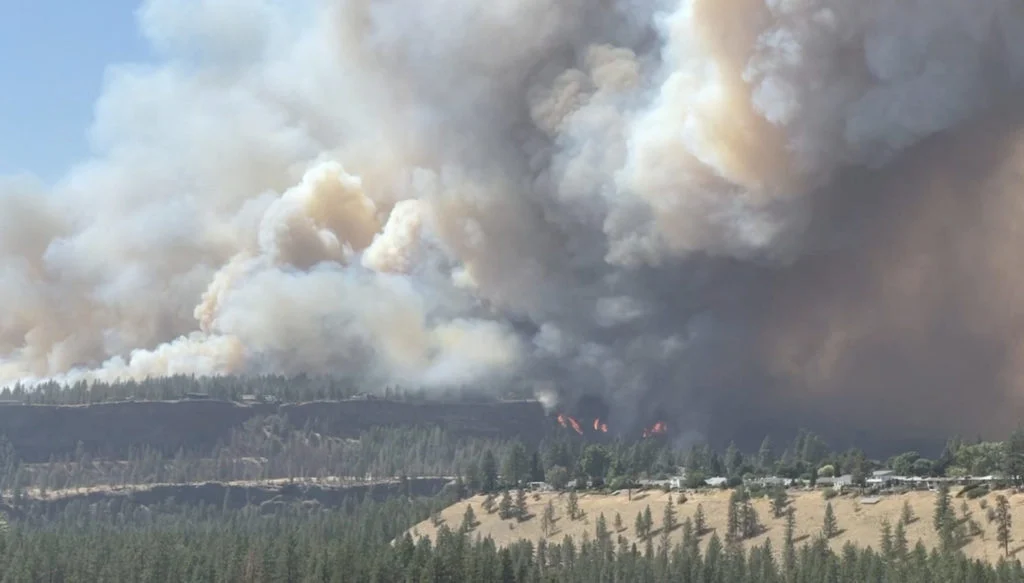
The Pacific Northwest is currently grappling with one of the most harrowing wildfire seasons in recent history. Across Washington state, a confluence of extreme drought, volatile weather, and stretched resources has created a landscape of unprecedented peril. In the Spokane area, the heart of the crisis, thousands of residents have been displaced, hundreds of structures have been reduced to ash, and the specter of arson hangs over a community desperate for answers. As state officials and a massive multi-state task force struggle to contain the blazes, the catastrophe has sparked a national conversation about infrastructure, climate resilience, and the heroism of those on the front lines.
The Spokane Crisis: A Community in Transition
The situation in Spokane—Washington’s second-largest city—has been described by authorities as both "heartbreaking" and "unprecedented." For many, the transition from normalcy to catastrophe occurred in a matter of minutes. Kami Fehlig, a local resident who lost her home to the advancing inferno, recounted the harrowing speed of the evacuation.
"About 30 minutes before it jumped the river, my husband and I were seeing how bad it was," Fehlig shared. "We told the kids, ‘We don’t want to scare you, but we think you should start preparing.’ I grabbed my wedding album, I grabbed the kids’ baby books, and within a few minutes, the power went out. It was, ‘Go now. Go now.’"
Fehlig’s experience is shared by roughly 67,000 others who were forced to flee as the flames encroached upon residential neighborhoods. Currently, approximately 500 displaced individuals are seeking refuge in the Spokane Convention Center, a temporary sanctuary for a community that has seen over 700 buildings destroyed.
Chronology of a Catastrophe
The current crisis did not emerge in a vacuum. Washington has spent the last four years under a persistent emergency drought declaration, creating a landscape primed for combustion. The situation deteriorated rapidly as high winds fanned the flames, pushing fires through residential areas with a speed that outpaced traditional containment methods.
While the fires continue to burn, the focus of law enforcement turned sharply toward the origin of the "Old Trails" fire, which is widely considered the most destructive of the trio currently threatening the region. In a significant development, authorities arrested a 37-year-old suspect, identified as Aaron Farinacci, following a tip from a member of the community. Farinacci, who served time in prison in 2010 for the killing of his father, has denied setting the fire.
The arrest has drawn intense scrutiny, as reports indicate that Farinacci had been contacted by law enforcement in relation to two other fires last year, though he was never charged. As the Spokane County Sheriff’s Office leads the investigation, the legal process will be long, but for the residents of Spokane, the arrest represents a focal point for their collective trauma.
Supporting Data: A Statewide Emergency
The devastation in Spokane is not an isolated event but rather the epicenter of a much larger crisis. According to Washington Commissioner of Public Lands Dave Upthegrove, the state is currently battling 16 major wildfires.
- Total Acreage Burned: Over 500,000 acres have been scorched across the state so far this year.
- Active Fire Load: Approximately 250,000 acres are actively burning at this moment.
- Human Response: A massive coalition of 5,000 responders—hailing from more than a dozen states and as far away as Australia—is currently engaged in the suppression efforts.
- Casualties: Remarkably, there have been no reported deaths or serious injuries, a statistic attributed to the efficiency of local emergency personnel and the swift execution of evacuation protocols.
Commissioner Upthegrove emphasized that the scale of this fire season is historic. "This is one of the worst fire seasons in decades," he stated. "We have burned well over half-a-million acres… and this could go on to become a historic fire season in the Pacific Northwest."
Official Responses and Federal Intervention
The federal government has acknowledged the severity of the situation, with the President authorizing federal disaster relief for the Spokane area. This assistance provides critical, immediate support, allowing the state to access specialized resources such as search-and-rescue teams and the heavy-duty generators required to maintain water supply infrastructure.
However, Commissioner Upthegrove cautioned that this is merely the first phase of a long recovery process. "This will allow the state of Washington to access certain federal resources," he explained. "There will be a lot of work to do to rebuild this community moving forward in the long run. But we’re still fighting these fires right now, working on getting them out."
The administrative response has been matched by the physical labor of the "front-line heroes"—the young firefighters who are currently operating under extreme exhaustion. While the state has seen some relief in weather patterns, with winds dying down, officials remain wary. The confluence of a long-term drought and the El Niño weather pattern creates a volatile environment where the threat of new ignitions remains constant.
Implications for the Future: Infrastructure and Accountability
The fires in Washington arrive against a backdrop of increasing concern regarding the role of utility infrastructure in wildfire ignitions. This concern was underscored by a separate, chilling report out of California today. Officials announced that an 18-month investigation into the 2025 Eaton Fire—which killed 19 people and decimated the town of Altadena—concluded that the blaze was ignited by sparks from a transmission tower owned by Southern California Edison.
The link between aging or out-of-service utility equipment and catastrophic wildfires is a growing point of tension. As climate change increases the frequency of "fire weather," the margin for error for utility companies and state agencies shrinks.
The Path Forward
For the state of Washington, the road ahead involves three distinct phases:
- Suppression: Bringing the current 16 major fires under full containment.
- Accountability: Ensuring that the investigation into the Old Trails fire and others is handled with transparency and that justice is served for the affected communities.
- Resilience: Rebuilding in a way that accounts for a "new normal" of arid, high-wind conditions.
Commissioner Upthegrove remains hopeful, despite the daunting statistics. "Behind each of these fires, there are young firefighters running into the woods who are exhausted, working long hours," he noted. "There are community members coming and pulling together. And we believe we can get through this."
The resilience of the Spokane community has become the defining narrative of the disaster. While the landscape may be scarred, the organized evacuation and the massive influx of mutual aid from across the globe demonstrate a human capacity to respond to environmental threats with solidarity.
However, as the dust settles, Washington will face difficult questions about land management, infrastructure hardening, and the long-term impact of a drying climate. The current fire season is more than just a series of meteorological events; it is a signal that the status quo of fire management in the Pacific Northwest is undergoing a permanent, and often painful, transformation. As the state moves into the next phase of the crisis, the world watches to see how a city like Spokane recovers from the ashes of a summer that will be remembered for decades to come.