








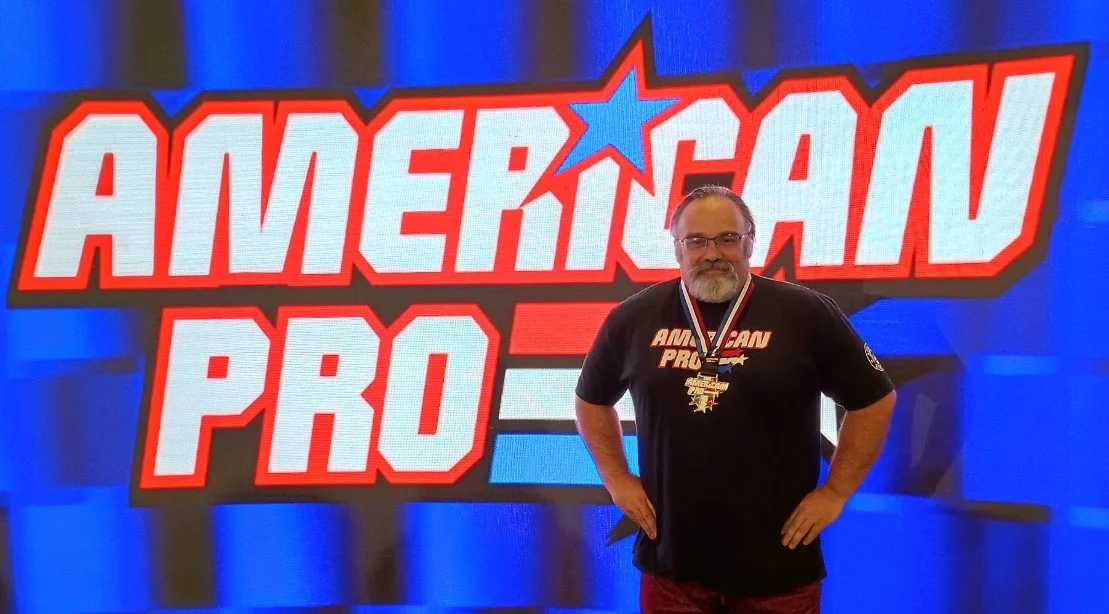
When you are standing backstage at a prestigious powerlifting meet like Powerlifting United’s American Pro at the Henrico Sports and Events Center, the sensory experience is visceral. You smell the sharp, nose-stinging scent of ammonia capsules being cracked. You hear the low-frequency, rhythmic thud of hundreds of pounds of steel hitting rubber flooring—a sound that vibrates through the soles of your shoes. In these moments, you begin to understand a fundamental truth about strength sports: months of meticulous, soul-crushing preparation ultimately distill down to a few fleeting seconds of execution under the harsh glow of the arena lights.
On August 7 and 8, I transitioned from observer to participant. I went from covering one of the most significant powerlifting events of the year to being a cog in its machinery. Day 1 demanded a singlet; Day 2 demanded media credentials. This is not a standard event recap—though those records and results are well-documented elsewhere—but rather an intimate look at the experience from the other side of the platform. The goal was simple: to determine, with absolute certainty, that Theodore Roosevelt’s famous “Man in the Arena” warning was not just a platitude, but a call to action. I wanted to be the man whose face was marred by dust, sweat, and blood, rather than the detached critic analyzing the stumbling blocks of the strong.
The Invisible Variables: When Prep Meets Reality
No meet preparation exists in a vacuum, and no training cycle survives contact with reality unscathed. Athletes often map out a 12-week block with surgical precision, calculating every set, rep, and percentage down to the decimal point. Then, the universe intervenes.
Whether it is a sudden injury, the unexpected loss of a training facility, the grind of professional adversity, or the crushing weight of personal obligations, the competitor’s mandate remains the same: identify the disruption, adapt, and move forward. Every athlete backstage at the American Pro carried an invisible list of variables they could not control.
Take, for instance, Maddy Forberg. Her presence at the American Pro represented a calculated return to her roots after a pivot toward bodybuilding, all while navigating the complexities of post-injury recovery. Forberg’s performance was not just about the numbers; it was a masterclass in psychological resilience. Similarly, the narrative surrounding John Haack—who arrived in pursuit of all-time world records with the eyes of the entire powerlifting world fixed upon his every move—highlights the immense pressure that accompanies elite status. Haack’s ability to treat the platform as a sanctuary rather than a firing squad is what separates the elite from the merely strong.
These stories illustrate a core tenet of the sport: meet prep is not about flawless execution; it is about the capacity to absorb adversity without conceding. Whether you are a world-record holder or a first-time competitor, the iron does not care about your excuses.
The Chronology of Competition: From Warm-Up Room to Platform
The physical labor of a meet is completed weeks before you step into the venue. Once you arrive at the Henrico Sports and Events Center, the battle shifts entirely to the psychological realm.
The Warm-Up Room: The Calm and the Chaos
The warm-up area is a microcosm of human temperament. Some lifters sit motionless, eyes closed, headphones on, effectively cordoning themselves off from the sensory overload of the arena. Others pace with the restless energy of caged animals, while a third group treats every warm-up set with the intensity of a competition attempt. Coaches and handlers act as timekeepers and navigators, constantly monitoring the flight board, calculating rotations, and ensuring their athlete is primed at the exact moment their name is called.
The Arena Lights: The Binary Truth
When the curtain parts and your name echoes through the arena speakers, the backstage cacophony vanishes. The transition from the warm-up area to the platform is jarring. Under the bright lights, the American Pro feels gargantuan. You walk to the bar, three referees sit in silent judgment, and the spotters—the only people cheering for you in that moment—provide the rhythmic encouragement needed to initiate the lift.
Powerlifting is cruelly binary. You are either successful, or you are not. Two out of three white lights indicate a successful attempt. You squat, you bench, you deadlift. You need at least one successful lift in each discipline to post a total. If you miss three attempts on any lift, your day is effectively over—a “bomb out” that renders your training cycle void for the purposes of the leaderboard.
The strategy is a delicate dance. You go conservative on the opener to secure a total. You chase the realistic, optimized goal on your second lift. If the second lift is successful, the third attempt becomes “house money”—a chance to chase a personal record or a lifelong ambition. If you miss, you must reset your mind instantly. Dwelling on a failure in the warm-up area or after a missed attempt is the fastest route to a second failure.
Supporting Data: The Anatomy of a Total
A powerlifting meet is a test of capacity. While the crowd cheers for the massive totals in the heavyweight divisions, the sport is equally defined by the technical consistency required to reach the platform.
The American Pro serves as a benchmark for the sport’s elite, yet the underlying mechanics remain the same for everyone. The data collected from the event underscores that success is not merely about raw strength, but about the ability to manage fatigue, technical proficiency under duress, and the mental fortitude to stick to a plan when the body begins to signal fatigue.
For many, the “total”—the sum of the best squat, bench, and deadlift—is the only metric that matters. However, for those in the trenches, the total represents the culmination of thousands of hours of unseen work. The statistical significance of a lifter’s performance often hides the personal context: an athlete competing while managing a torn labrum, or a masters-aged lifter overcoming a decade of atrophy to step back onto the stage.
Official Responses and the Culture of Strength
The community surrounding powerlifting is perhaps its most unique feature. It is a rare environment where competitors, despite being in direct rivalry, act as each other’s primary support system.
During the American Pro, the camaraderie was palpable. From elite athletes offering advice on weight cuts to veteran masters lifters helping novices navigate the rules of the platform, the atmosphere was one of mutual growth. The sport thrives when the community thrives. As confirmed by numerous attendees, the competition is strictly contained within the boundaries of the platform; once the chalk is wiped off the hands, the competition ends and the brotherhood of the barbell begins.
The Personal Toll: A First-Hand Account
My personal experience at the American Pro was a sobering reminder of the sport’s unpredictability. During the preparation phase, I sustained a hip injury that was, unfortunately, significantly aggravated during my third squat attempt.
The resulting 876-pound total—comprised of a 308-pound squat, 292-pound bench press, and 275-pound deadlift—was, by my own standards, far below what I had projected in my training logs. However, the experience provided an invaluable perspective. In my category, only one other lifter managed to post a total. By completing my lifts, I not only secured an Open category medal but also officially populated the previously empty West Virginia record books for Powerlifting United’s 140-kilogram Raw Masters 45-49 division.
It was a humbling reminder that in this sport, sometimes “showing up” is a victory in its own right. The numbers on the spreadsheet may be modest, but the process of earning them—of navigating the injury, the nerves, and the physical demand—offered a level of personal insight that no amount of reading or observing could ever replicate.
Implications: Why We Lift
Why do we endure the strain, the caloric deficits, the travel, and the physical trauma? Powerlifting is, at its core, a simple sport, but the lessons it imparts are profound. It is not defined by the weight on the bar or the trophy on the shelf; it is defined by the courage to show up when you are outmatched, when you are injured, or when your preparation has been compromised.
The benefits of the sport extend far beyond the gym doors. A focus on structured strength training, when approached with proper attention to recovery and biomechanics, can significantly improve the quality and quantity of one’s life. The strength gained under the bar often translates to the strength required to navigate the challenges of daily life.
As we look at the results of the American Pro—from the world-record performances to the masters lifters pushing through their own physical limitations—we see a common thread. The barbell demands the exact same thing from every person who approaches it: accept the challenge, overcome the force of gravity, and earn the approval of the referees.
In the end, the sport of powerlifting is a metaphor for life. We map out our goals with precision, we account for the variables we can control, and we do our best to adapt to the ones we cannot. We step into the arena, we face our weaknesses, and we strive to perform to the best of our ability. Whether we succeed or stumble, the value lies in the fact that we were there, in the arena, facing the challenge head-on.