









For many adults over the age of 65, the simple act of rising from a chair can feel like a daunting physical hurdle. While society often emphasizes cardiovascular health or balance training, there is a silent epidemic of declining knee strength that directly impacts the quality of life and independence of older adults. Climbing stairs, stepping onto a curb, or simply standing up requires significant quadriceps and hamstring engagement—muscles that, if left undertrained, can lead to sedentary habits and a heightened risk of falls.
Contrary to popular belief, you do not need an expensive gym membership or complex weight machines to combat this decline. In fact, some of the most effective rehabilitation and strengthening techniques can be performed in your own living room using nothing more than a sturdy wall. By utilizing wall-supported exercises, seniors can safely rebuild functional strength, improve joint stability, and regain the confidence to navigate their daily lives with ease.
The Limitations of Machines vs. Functional Movement
In the fitness industry, there is a prevailing reliance on seated gym machines. While these are designed for isolation, they often move the body through a rigid, fixed pathway that rarely mimics the chaotic, multi-planar movements of daily life. When a person sits in a leg-press machine, the machine stabilizes the body, effectively taking the "work" away from the small, crucial stabilizer muscles surrounding the knee.
Functional movement—the patterns we use to squat, lunge, and sit—requires these stabilizers to fire in coordination. Wall exercises bridge this gap. They provide the necessary support to ensure safety while still requiring the user to engage their core, hips, and knees naturally. For the aging population, this approach is superior because it builds "real-world strength" that translates directly into the ability to move through one’s home and community without assistance.
The Mechanics of Knee Health: A Functional Chronology
To understand why knee strength is paramount after 65, we must look at the mechanical demands of aging. The knee is a hinge joint, but it is highly dependent on the "engine room" above and below it: the quadriceps and the hamstrings.
The Role of the Quadriceps
The quadriceps (the front of the thigh) are responsible for knee extension—the action of straightening your leg. When you stand up from a chair, your quads are the primary drivers. Weakness here is the leading cause of "chair-rise difficulty," a key metric used by gerontologists to predict mobility decline.
The Role of the Hamstrings
Often overlooked, the hamstrings (the back of the thigh) act as the "brakes" for the knee. Strong hamstrings protect the kneecap by providing posterior stability. When the hamstrings are weak, the kneecap is often subjected to excessive shear force, leading to chronic discomfort.
The Importance of Eccentric Control
Many seniors focus on the "lift" (concentric movement) but neglect the "lower" (eccentric movement). The ability to sit down slowly into a chair—rather than collapsing into it—is a sign of functional health. Developing eccentric strength is the best way to prevent the jarring impact that leads to cartilage wear and joint pain.
Fundamental Wall-Based Exercises for Restoration
The following four exercises are curated to build strength, balance, and stability. Before beginning, ensure you are wearing supportive footwear and that your wall space is clear of obstructions.
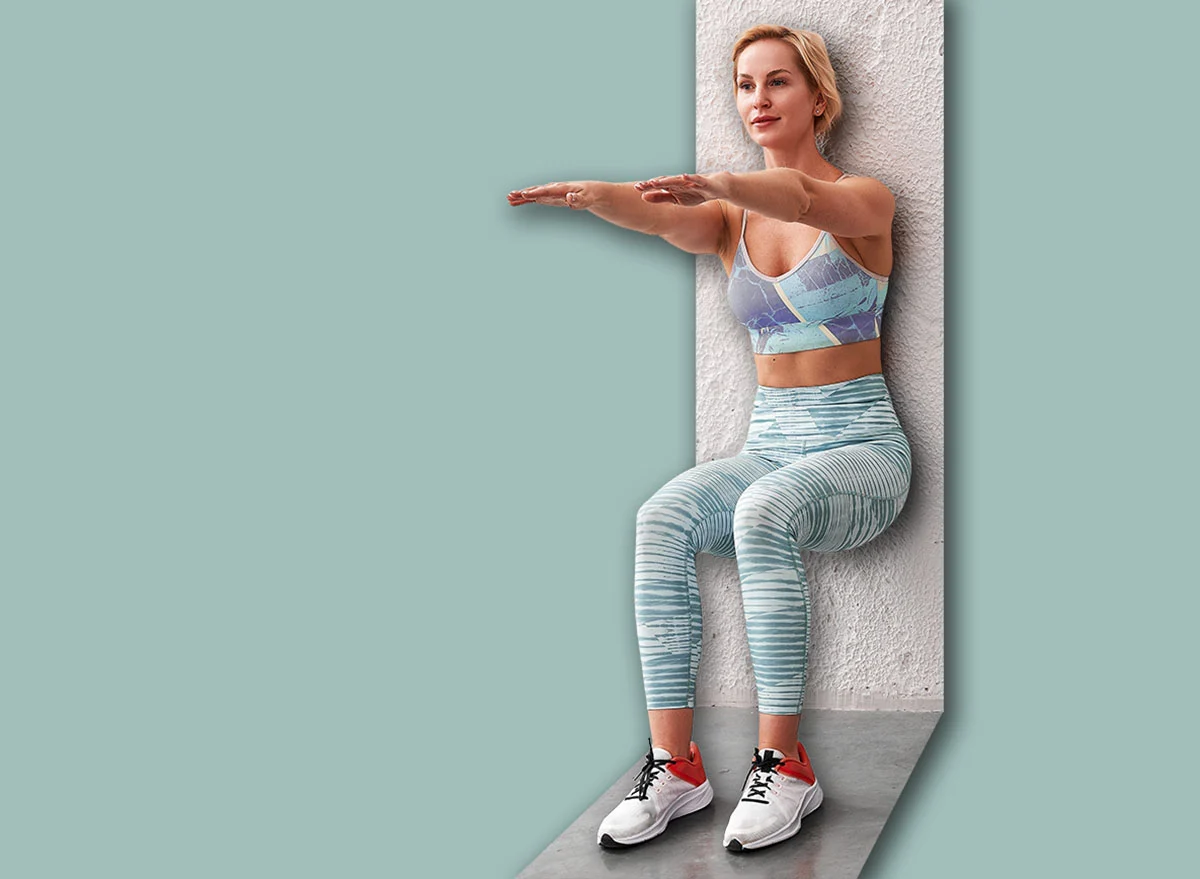
1. The Wall Sit Hold: Building Isometric Endurance
The wall sit is the cornerstone of knee rehabilitation. Because it is an isometric exercise—meaning the joint angle remains static—it is remarkably safe for those with mild joint sensitivities.
- The Technique: Stand with your back flat against the wall, feet shoulder-width apart and roughly 12 to 18 inches away from the base. Slowly slide your back down the wall until your knees are bent to a comfortable degree.
- Progression: If you are a beginner, keep your feet further from the wall and your knees only slightly bent. As your strength improves, walk your feet further out to sink your hips lower.
- The Goal: Hold the position for 20 to 30 seconds. Focus on pushing your heels into the floor, which will force your quadriceps to engage fully.
2. The Wall Squat: Concentric and Eccentric Training
While the wall sit builds endurance, the wall squat builds range of motion. By moving up and down, you train the muscles to handle load through a full arc of movement.
- The Technique: Place your back against the wall, feet slightly ahead of your body. Keeping your back in contact with the wall, slowly lower your hips as if sitting into an invisible chair. Ensure your knees track in line with your toes. Pause at the bottom for one second, then push through your heels to return to a standing position.
- The Goal: Perform 3 sets of 8 to 10 repetitions. Focus on the descent; lowering yourself slowly (taking three seconds to go down) is just as important as the push back up.
3. Wall-Supported Split Squat: Developing Single-Leg Stability
Life is rarely performed with two feet planted firmly on the ground. When you walk, you are essentially performing a series of single-leg squats. The split squat is the gold standard for correcting imbalances between your left and right legs.
- The Technique: Stand a few feet away from the wall. Step one foot back into a lunge position. Use your fingers against the wall for balance. Lower your back knee toward the floor, ensuring your front knee stays stable.
- The Progression: The wall is your "training wheels." Start by placing all five fingers on the wall for maximum stability. Over the course of several weeks, reduce your contact to three fingers, then one, until you can perform the movement with minimal or no assistance.
4. Wall-Supported Standing Hamstring Curl: Protecting the Knee
To balance the work done by the quadriceps, we must strengthen the back of the legs. This exercise targets the hamstrings directly without placing the knee joint under the stress of a full squat.
- The Technique: Stand facing the wall, placing both hands on it for support. Keep your torso upright. Slowly bend one knee, bringing your heel toward your glutes. Squeeze your hamstring at the top of the movement, then lower your foot back to the floor with total control.
- The Progression: Once bodyweight becomes easy, add a light ankle weight or a resistance band. Do not let gravity pull your leg down; the "lowering" phase is where the most significant muscle growth occurs.
Supporting Data and Clinical Implications
Research in geriatric kinesiology consistently shows that targeted resistance training can reverse "sarcopenia"—the age-related loss of muscle mass—even in individuals in their 70s and 80s. A study published in the Journal of Aging and Physical Activity noted that seniors who engaged in functional resistance training twice weekly showed a 25% improvement in their "Timed Up and Go" test scores over a six-month period.
The implications for this are profound. Increased knee strength does more than just make climbing stairs easier; it increases the metabolic rate, improves bone density by putting healthy stress on the skeletal system, and significantly reduces the fear of falling. For many, the transition from feeling "frail" to feeling "capable" begins with the ability to stand up without using one’s hands.
Expert Recommendations for Implementation
As a personal trainer with 15 years of experience, my advice to those over 65 is simple: Consistency over intensity.
- Warm-Up: Always spend five minutes walking in place or doing gentle knee marches before starting your wall exercises.
- Pain Management: There is a difference between "muscle fatigue" (the burning sensation of a muscle working) and "joint pain" (a sharp, stabbing, or grinding sensation in the knee). If you feel sharp joint pain, stop immediately and adjust your range of motion.
- Frequency: Aim for these exercises three times per week. Your muscles need time to recover, especially as we age.
- Hydration and Nutrition: Ensure you are consuming adequate protein. Muscles cannot repair themselves after a workout if you are not providing the amino acids necessary for tissue synthesis.
By integrating these wall-supported moves into your weekly routine, you are not just exercising; you are investing in your future independence. The wall is always there—it is the most reliable partner you have in your journey toward a stronger, more mobile second half of life.