











The U.S. government has officially released the 2025–2030 Dietary Guidelines for Americans (DGAs), a policy document intended to serve as the North Star for the nation’s health, federal nutrition programs, and clinical practice. With a central, ambitious tagline of “eat real food,” the new guidelines appear to take a long-overdue stance against the ultra-processed food landscape that dominates the American diet. However, beneath the surface of this simplified messaging lies a complex, and often contradictory, document that has sparked intense debate among nutrition scientists and public health experts.
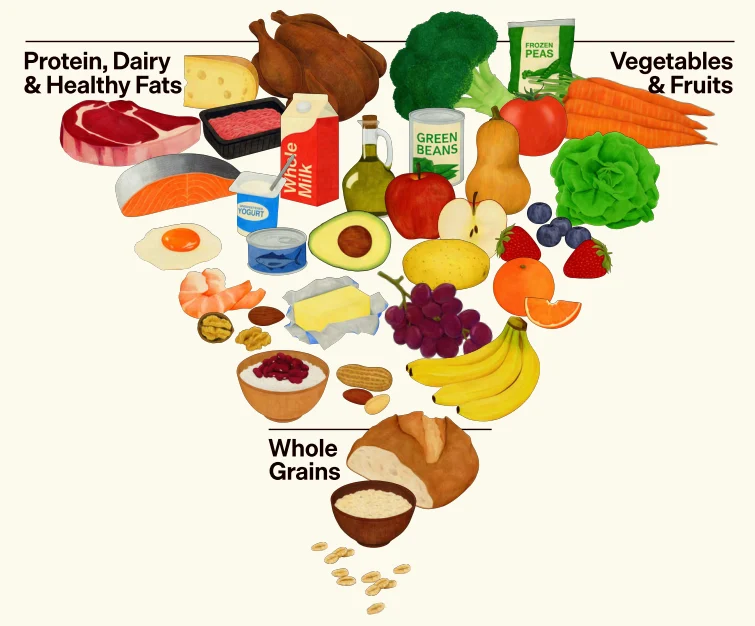
While the Guidelines correctly advocate for a drastic reduction in added sugars and refined grains, the visual centerpiece—a new, inverted “food pyramid”—places a surprising emphasis on red meat, full-fat dairy, and butter. This juxtaposition between the text’s health-conscious prose and the pyramid’s visual cues has left many experts concerned that the government is providing mixed messages that could ultimately undermine cardiovascular health.
The Main Facts: A Shift in Tone and Content
The 2025–2030 DGAs represent a departure from previous editions in their attempt to be more consumer-facing. They are shorter, accompanied by interactive web tools, and feature a redesigned visual graphic. The core recommendations focus on three major pillars:
- Elimination of Added Sugars: The Guidelines take an uncompromising stance, asserting that no amount of added sugar or non-nutritive sweetener is part of a healthy diet.
- The "Highly Processed" Crackdown: For the first time, the DGAs specifically warn against “highly processed” foods, including sugary beverages and refined snack foods.
- Protein Hype: The new standards suggest a significant increase in daily protein intake, shifting the recommended range to 1.2–1.6 grams per kilogram of body weight.
However, the primary point of contention remains the "New Food Pyramid." By placing steak, cheese, and butter in prominent positions, the graphic risks signaling to the public that these foods are foundational, despite the Guidelines’ internal acknowledgement that saturated fat intake should remain capped at 10% of total daily calories.
Chronology: The Road to a Controversial Update
The development of the DGAs is a multi-year, rigorous process typically managed by the U.S. Departments of Agriculture (USDA) and Health and Human Services (HHS). Historically, this process begins with the Dietary Guidelines Advisory Committee (DGAC)—a non-partisan panel of experts tasked with synthesizing the best available nutritional science.
In this cycle, the Committee spent two years reviewing evidence and ultimately produced a comprehensive Scientific Report. However, in a move that has drawn sharp criticism from the scientific community, the current administration effectively sidelined the original Committee’s report. Instead, they commissioned a “supplemental scientific analysis” conducted by a group of individuals selected through a private federal contracting process.
This change in methodology has fueled allegations of a lack of transparency. Deirdre Tobias, an assistant professor at the Harvard T.H. Chan School of Public Health who served on the original 2025–2030 DGAC, noted that the final document deviates significantly from the rigorous, replicable, and unbiased standards established for the federal government. Furthermore, investigative reports have highlighted that some reviewers involved in the supplemental analysis held disclosed financial ties to the beef and dairy industries, raising questions about potential conflicts of interest regarding the pyramid’s prominent inclusion of animal products.
Supporting Data: The Saturated Fat Math
To understand the danger of the current messaging, one must look at the math. A standard 2,000-calorie diet allows for roughly 22 grams of saturated fat per day to stay within the 10% limit.
Consider a typical daily intake suggested by the new DGAs:
- One 8-ounce cup of whole milk: 5 grams of saturated fat.
- ¾ cup of full-fat Greek yogurt: 6 grams of saturated fat.
- 1 ounce of cheddar cheese: 6 grams of saturated fat.
By consuming these three servings of dairy—which are explicitly encouraged in the guidelines—a person has already reached 17 grams of saturated fat. If that individual then uses a single tablespoon of butter (7 grams) or beef tallow (6 grams) to cook their dinner, they have exceeded the daily limit before accounting for the saturated fat naturally occurring in their protein source.
Dr. Frank Hu, chair of the Department of Nutrition at Harvard, emphasizes that while the DGAs do technically retain the 10% cap, the visual "healthy fat" grouping fails to distinguish between plant-based unsaturated fats—like those found in olive oil, soy, and canola—and the saturated fats in animal products. "The mixed messages surrounding saturated-fat-rich foods," Dr. Hu warns, "may lead to confusion and potentially higher intake of saturated fat, which is directly linked to increased LDL cholesterol and cardiovascular risk."
Official Responses and Expert Critique
The official line from the USDA and HHS remains that the new guidelines are designed to be "user-friendly" and "actionable." Proponents of the new pyramid argue that it reflects a more flexible approach to eating. However, the academic community has been vocal in its skepticism.
The lack of guidance on the quality of protein is a recurring theme in expert critiques. While the guidelines encourage a “variety of protein foods,” they fail to prioritize plant-based proteins or fish over processed or red meats. Research consistently shows that the "protein package"—the fiber, fats, and minerals that accompany protein—is just as important as the protein itself. By failing to steer consumers toward high-quality, heart-healthy protein sources, the DGAs miss an opportunity to curb the rising rates of heart disease in the United States.
Furthermore, the Guidelines continue to ignore the environmental and socioeconomic impacts of food production. As global food systems face the pressures of climate change, the omission of sustainability from national dietary policy is viewed by many as a failure to look toward the future of global food security.
Implications for the American Public
The implications of these mixed messages are profound. If the public perceives the "New Food Pyramid" as a mandate to increase their consumption of red meat and dairy, the nation may see a plateau or even an increase in cardiovascular events.
Moreover, the vague advice on alcohol—simply suggesting consumers drink "less"—leaves the average person without a concrete framework for moderation, a stark contrast to the specificity of other parts of the document.
Ultimately, the 2025–2030 DGAs serve as a reminder of the power and danger of visual communication. While the text attempts to move the needle toward "real food," the imagery may be doing the exact opposite. For the average American, the best course of action remains to look past the government’s simplified graphic. Organizations like the Harvard T.H. Chan School of Public Health suggest that if consumers find themselves confused by the official government messaging, they should refer to evidence-based tools like the "Healthy Eating Plate."
The 2025–2030 Guidelines are a clear sign that, despite advancements in nutritional science, the intersection of policy, industry, and health remains fraught with complexity. Whether this edition will successfully improve the health of the nation remains to be seen, but the history of low adherence to previous guidelines suggests that unless the messaging becomes clearer, more consistent, and scientifically grounded, the gap between policy and practice will only continue to widen.
Key Takeaways for Health-Conscious Consumers:
- Prioritize Unsaturated Fats: Choose olive oil, avocados, and nuts over butter and animal fats.
- Read the Labels: "Real food" often means avoiding ultra-processed items regardless of their presence in the pyramid.
- Quality Over Quantity: When choosing protein, focus on fish, legumes, and plant-based sources rather than relying solely on red meat.
- Consult Professionals: Because the DGAs are a broad policy document, they cannot account for individual health needs. Working with a registered dietitian remains the gold standard for creating a sustainable, healthy diet.