











The 2026 midterm elections delivered a definitive, sweeping victory for the Democratic Party, securing control of both the House and the Senate. Yet, as the dust settles on the electoral map, a complex reality has emerged: the national "blue wave" did not translate into a uniform ideological victory when filtered through the granular, state-level ballot measures that governed everything from reproductive rights to medical research funding.
While Democratic candidates rode a tide of national sentiment to victory, voters simultaneously signaled deep, localized anxieties. Across the United States, ballot initiatives revealed a populace that is ideologically fluid—often supporting progressive economic and social candidates while simultaneously backing conservative-leaning restrictions on transgender youth, punitive drug policies, and fiscally cautious social programs.
The Chronology of a Disconnected Mandate
The 2026 cycle was defined by a tension between candidate-based politics and issue-based governance. Throughout October, political analysts noted that while the national discourse focused on federal legislative power, state-level campaigns were quietly pouring millions into initiatives that often cut against the grain of the national Democratic platform.
In early November, as polling stations closed, the dichotomy became stark. In Colorado, voters delivered a resounding victory for the Democratic ticket, returning the governor, the attorney general, and a majority of the state legislature to office. Yet, in the same breath, those same voters approved measures to restrict transgender participation in school athletics and enacted a ban on gender-affirming surgeries for minors.
This pattern repeated across the country. In Missouri, voters protected reproductive rights while simultaneously considering measures tied to the restriction of gender-affirming care. In California, voters moved to authorize a massive $8.4 billion bond for immunology research—a move seen as a direct rebuke to federal funding instability—even as other states moved to implement harsh, law-enforcement-heavy policies regarding the opioid crisis.
Supporting Data: The Disparity Between Perception and Reality
Central to the 2026 debate over transgender rights were ballot measures in Arizona, Colorado, and Washington. Proponents argued these measures were necessary to protect "fairness" in sports and ensure the well-being of minors. However, critics labeled these efforts "ballot candy"—performative legislative acts designed to energize the conservative base without addressing systemic issues.
The statistical reality of these measures stands in sharp contrast to the political volume they generated. According to the Williams Institute at UCLA, approximately 300,000 youth between the ages of 13 and 17 identify as transgender nationally. Of that cohort, only about 40% participate in athletics. Furthermore, data provided by the NCAA in late 2024 indicated that out of more than 500,000 collegiate athletes, fewer than 10 were transgender. More significantly, recent polling and statements from NCAA representatives confirmed that zero transgender athletes currently compete in women’s leagues.
Similarly, the narrative regarding the "inherent physical advantage" of transgender women in sports remains scientifically tenuous. Research, including studies published by the BMJ Group, suggests that current evidence does not support the existence of a definitive, across-the-board physical edge for transgender women in competitive sports. When it comes to medical interventions, the data is equally revealing: top surgery for minors is statistically rare, and bottom surgery on a minor’s genitals is effectively non-existent in clinical practice.
Official Responses and Political Rhetoric
The disconnect between the electoral success of candidates and the passage of restrictive ballot measures has left political strategists and civil rights advocates grappling for answers.
Chase Strangio, who leads the ACLU’s LGBT & HIV Project, was blunt in his assessment on social media. "The voters rejected the anti-trans rhetoric used against candidates while still stripping away our rights at the ballot," Strangio stated. He characterized these ballot measures as "a function of funding more than anything," arguing that the disproportionate spending by advocacy groups should not serve as a mandate for the legislature to enact further restrictions.
On the other side of the aisle, supporters of the measures argued that they were not about hatred, but about establishing clear, protective boundaries for children. The disconnect, they argue, is simply a reflection of a public that views sports and medical care as distinct from the broader political party platforms.
However, the "blue wave" that swept Democrats into power is now creating a logistical bottleneck for these ballot measures. In Colorado, where the measures are statutory rather than constitutional, the governor-elect has indicated that the implementation of the new restrictions will require "a long, hard look." The Denver Post reported that the state legislature may move to amend or delay these measures, setting up a potential constitutional showdown between the will of the voters and the policy goals of the newly elected administration.
Abortion and the Status Quo
Reproductive rights remained a pillar of the 2026 election, with four states putting abortion-related measures on the ballot. The result was largely a preservation of the status quo, indicating that while voters are protective of existing rights, they are not necessarily pushing for expansion in deeply red territories.
Missouri stood out as the most contentious battleground. Two years after voters enshrined reproductive freedom in the state constitution, the legislature attempted to claw back that power by bundling a constitutional ban on gender-affirming care with an abortion restriction. Voters saw through the gambit, rejecting the measure by 56% to 44%.
In Nevada and Virginia, voters moved to further codify abortion access in their state constitutions, ensuring that these states remain islands of reproductive care in a post-Roe landscape where 26 states now maintain some form of protective status for abortion services. Conversely, Idaho remains a bastion of restriction, with voters rejecting efforts to liberalize the state’s existing, near-total abortion ban.
Drug Policy: A Complex Narrative
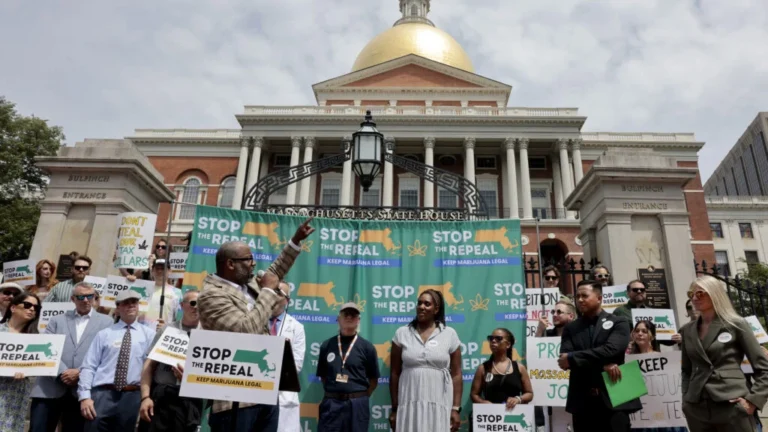
The narrative of a progressive blue wave was further complicated by drug policy. In Massachusetts, an expensive campaign to repeal recreational marijuana legalization failed, with 76% of voters choosing to keep the industry intact. Yet, elsewhere, the trend toward punitive policy was evident.
Arizona and Colorado both passed measures aligning with the Trump administration’s hardline stance on the fentanyl crisis. Arizona voters designated drug cartels as terrorist organizations, and Colorado voters approved increased criminal penalties for the possession and sale of fentanyl. These results highlight a fundamental shift in voter anxiety: while there is a growing comfort with recreational cannabis, there is a parallel, rising fear regarding the illicit synthetic drug market, which voters appear willing to address through traditional "tough-on-crime" measures.
The California Research Bond: Science vs. Earmarks
The approval of Proposition 38 in California, authorizing $8.4 billion in bonds for immunology research, represents one of the most significant health policy shifts of the cycle. Driven by a desire to insulate the state from the volatility of federal science funding—which has been plagued by grant cancellations and administrative delays—the measure was framed as a protective shield for California’s innovation economy.
However, the passage of Prop 38 has sparked intense scrutiny. The "oddly specific" criteria for the distribution of $4.2 billion in funds appear to tailor the grant directly to the California Institute for Immunology & Immunotherapy (CIII), an institution co-founded by billionaire philanthropist Gary Michelson. Michelson personally contributed over $40 million to the "Yes on 38" campaign, while his co-founder added another $5 million.
The lack of institutional maturity at CIII—which reported having zero employees in 2024—has led to questions about whether the measure is a genuine public health investment or a vehicle for private influence. Despite these concerns, the measure received broad support, including endorsements from Governor Gavin Newsom and both major political parties, suggesting that in the current economic climate, the promise of scientific progress outweighed concerns over legislative earmarks.
Implications for the Future
The 2026 midterms demonstrate that the American electorate is far from monolithic. The "blue wave" was not a blank check for a singular ideological agenda; rather, it was a tactical vote against the status quo in Washington, paired with a series of distinct, often contradictory local mandates.
As the new Congress prepares to take office, the implications are clear: the politics of the next two years will be defined by the friction between federal-level Democratic control and a state-level political landscape that remains deeply suspicious of broad social change. Whether it is the battle over the implementation of transgender restrictions in Colorado or the management of massive research bonds in California, the next chapter of American policy will be played out not just in the halls of Congress, but in the state houses and courtrooms where the true, messy work of governing is now concentrated.