








Reviewed by Brian St. Pierre, MS, RD
In 2017, when semaglutide (Ozempic) first began its ascent toward mass-market ubiquity, a palpable anxiety rippled through the health and fitness industry. Coaches across the globe were forced to grapple with a provocative, existential question: "Is this drug going to steal my job?"
For years, that threat remained largely theoretical. Prescription rates were modest, and the medication felt like a niche medical intervention rather than a societal shift. Today, the landscape has fundamentally transformed. By 2026, over one in ten U.S. adults are actively taking a GLP-1 medication. For the modern coach, these drugs are no longer a distant concern—they are a daily reality.
As the stigma surrounding obesity treatment has eroded, so too has the defensive posture of the fitness community. Many coaches have moved away from viewing these medications as a "band-aid" or a shortcut, choosing instead to embrace them as a clinical tool that, when paired with professional coaching, can create a powerful synergy for long-term health.
The Shift: From "GLP-1 Users" to "The Supported Client"
The most significant evolution in the fitness industry is a change in target demographics. If you view your market as "people on GLP-1s," you are setting yourself up for frustration. Many individuals using these medications have no desire for lifestyle coaching, and attempting to force guidance onto those who are not ready is, at best, a wasted effort.
Instead, the modern coach must pivot to the "GLP-1 support world." As Kate Solovieva, Precision Nutrition’s Director of Community, aptly puts it: "As a coach, you’re not in the GLP-1 world; you’re in the GLP-1 support world."
By focusing on the subgroup of users who are "ready, willing, and able" to engage in behavior change, coaches can move from a state of competitive anxiety to a position of professional necessity. The goal is not to replace the medication, but to provide the structural foundation—nutrition, resistance training, and psychological resilience—that allows the medication to work safely and effectively.
Understanding the Seven Profiles of the GLP-1 Journey
Readiness for coaching is rarely a static state. A client who feels empowered today may feel overwhelmed tomorrow. To navigate this, coaches must adopt a dynamic approach, identifying where their client currently sits on their journey.
1. The Honeymooner (Low Readiness)
These clients are currently riding the "magic" of their initial doses. They see the scale dropping, have minimal side effects, and see no reason to change their sedentary habits.
- The Coaching Move: Avoid the "righting reflex." Do not lecture them on muscle loss or the dangers of inactivity. Instead, validate their success, offer a warm congratulations, and plant a seed for the future. Make it clear your door is open when they are ready to layer on deeper health strategies.
2. The Ambivalent Candidate (Low-to-Moderate Readiness)
These individuals are paralyzed by the decision to start medication. They struggle with the societal stigma of weight-loss drugs and the fear of personal failure.

- The Coaching Move: Recognize that the decision to medicate is a clinical one, not a coaching one. Use tools like the "4 Crazy Questions" to help them explore the risks of both action and inaction. Often, their hesitation stems from a fear that they are "cheating." A coach’s role is to reframe the medication as a tool for health, not a sign of moral weakness.
3. The Ready-to-Quitter (Moderate Readiness)
These clients are suffering from significant side effects—nausea, vomiting, and fatigue—and are considering stopping treatment entirely.
- The Coaching Move: Normalize their experience. Educate them on the common nature of these side effects and encourage them to communicate with their doctor about potential dosage adjustments. Suggest small, frequent meals as an experiment to manage nausea, always framing it as an investigation rather than a prescription.
4. The Muscle-Loss Risk (Moderate Readiness)
The scale is dropping, but the body composition is shifting in a dangerous direction. These clients are often sedentary and have chronically low protein intake.
- The Coaching Move: Bring awareness to the invisible. Encourage a DEXA scan to provide objective data. If they are losing muscle, the numbers will often provide the motivation that words cannot. Emphasize protein at every meal and introduce low-threshold, sustainable resistance training.
5. The Under-Fueler (Moderate-to-High Readiness)
The medication has suppressed their appetite so effectively that they are barely eating, leading to hair loss, fatigue, and plummeting energy.
- The Coaching Move: Screen for disordered eating history. If red flags exist, refer to a specialist immediately. For others, the priority is establishing an "eating schedule." They must treat food as a necessary fuel source, eating every 3–4 hours regardless of appetite.
6. The Graduate (High Readiness)
These clients are weaning off the medication and are acutely aware of the risk of weight regain.
- The Coaching Move: This is the most critical time for habit reinforcement. The medication was the training wheels; now they must ride on their own. Focus on consistency. Research shows that those who integrate healthy habits while on the drug are four times more likely to maintain their results once they discontinue use.
7. The Priced-Out (High Readiness)
External factors, such as insurance changes or job loss, have forced these clients to stop their medication. They often feel a mix of anger, shame, and fear.
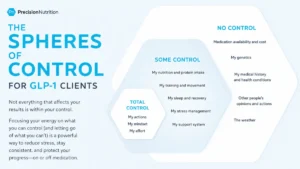
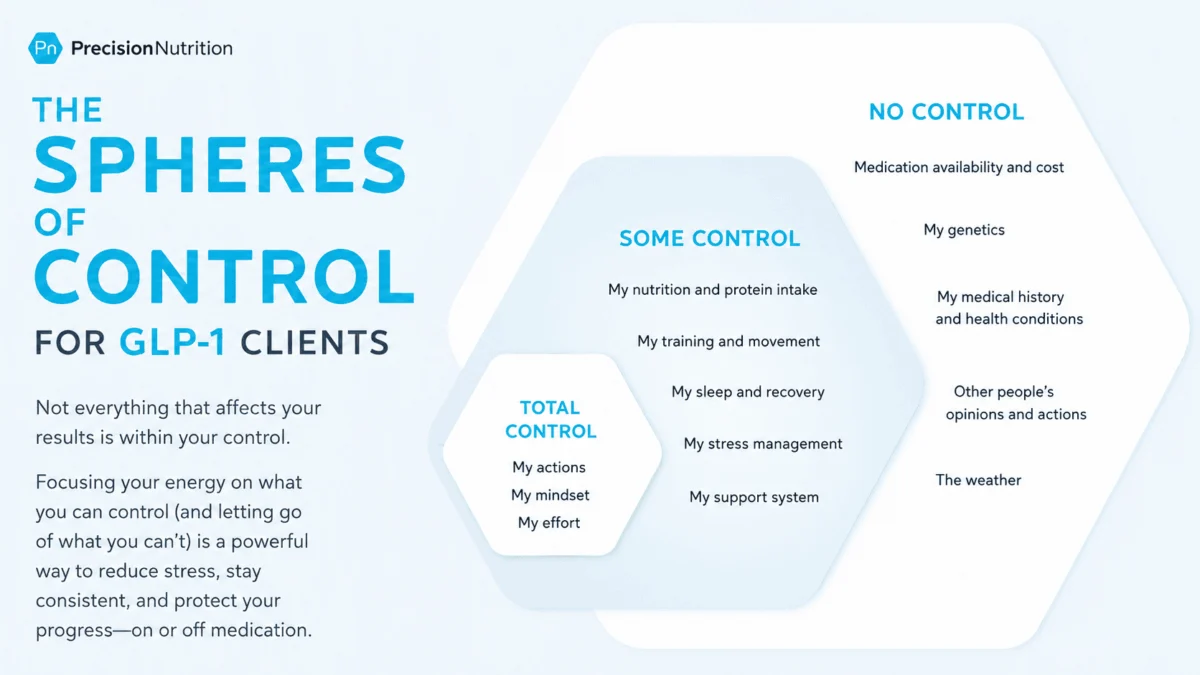
- The Coaching Move: Reframe this as a systemic failure, not a personal one. Utilize the "Spheres of Control" exercise to redirect their energy from the things they cannot change (cost/access) to the things they can (movement, sleep, protein intake).
The Crucial Role of Lifestyle Habits
The central challenge in the GLP-1 era is that the medication manages the what (weight loss), but it does not manage the how (the quality of that loss). Without intervention, up to 40 percent of weight lost on GLP-1s can be lean muscle mass.
The "promise" that a coach can offer is not weight-loss permanence, but rather the construction of "neural ruts"—deep, sustainable habit pathways that persist even when the chemical aid is removed. As Coach Toni Bauer notes, the clients who maintain their results are the ones who adopt the identity of a "new person"—someone who trains for strength and eats for recovery, regardless of whether they are on medication or not.
Implications for the Fitness Industry
The integration of GLP-1 medications into the health and wellness space signals a broader shift toward "integrated care." Coaches who remain stuck in the old paradigm of "eat less, move more" without acknowledging the complexities of hormonal and pharmacological interventions will likely find themselves obsolete.
Conversely, the coaches who thrive will be those who:
- Understand the Science: They grasp the metabolic and physiological nuances of GLP-1s.
- Master the Soft Skills: They utilize Motivational Interviewing and trauma-informed coaching to meet clients where they are.
- Prioritize Function over Aesthetics: They focus on building the physical capacity—strength, mobility, and metabolic health—that ensures a client doesn’t just lose weight, but gains a healthier, more resilient life.
As we look toward the future, the message for fitness professionals is clear: The medication is here to stay. The question is not whether it will replace the coach, but whether the coach will evolve to support the new needs of the client. By providing the structural support that the drug cannot, the coach becomes the most important asset in a client’s long-term health journey.
References
- For further reading and evidence-based strategies, please consult the full documentation and study citations provided in the original research papers on GLP-1 outcomes and behavioral habit formation.