






In an era increasingly dominated by clinical, detached healthcare, the ancient Indian tradition of Ayurveda offers a profound counter-narrative: the healing power of intentional, conscious touch. Ayurvedic massage is not merely a spa indulgence; it is a sophisticated, time-tested therapeutic modality designed to harmonize the body, mind, and spirit. Rooted in the Vedic tradition, this practice functions as a cornerstone of both palliative (Shamana) and purificatory (Shodhana) therapies, aiming to guide the human organism back to a state of equilibrium.
Historical Foundations and Ancient Wisdom
The methodologies of Ayurvedic massage are not recent inventions but are documented in the brhat trayi—the "Great Three" texts of Ayurveda authored by the sages Caraka, Sushruta, and Vagbhata. Supplemented by later foundational texts such as the Bhavaprakasha and Yogaratnakara, these teachings provide a comprehensive framework for health maintenance.
Historically, these massage protocols were far more than luxury treatments. They were utilized for athletic recovery, supporting the physical demands placed upon ancient warriors, and serving as essential components of postpartum care. Furthermore, these techniques were employed for virilization and systemic detoxification. The lineage of this knowledge has been preserved for millennia, suggesting that the ancients possessed a granular understanding of the human physiological response to tactile stimulation.
The Tri-Dosha Framework: The Five Elements in Motion
To understand the mechanics of Ayurvedic massage, one must first grasp the Ayurvedic view of the universe. All matter is considered a composition of five great elements (Pancha Mahabhuta): space, air, fire, water, and earth. When these elements manifest within the human physiology, they organize into three functional biological energies known as Doshas:
- Vata: The combination of space and air. It governs movement, nervous system function, and communication.
- Pitta: The combination of fire and water. It regulates metabolism, digestion, and body temperature.
- Kapha: The combination of water and earth. It provides structure, lubrication, and stability to the body.
Ayurvedic treatment is fundamentally based on the principle of "like increases like," and conversely, "opposites balance." Therefore, a practitioner evaluates the patient’s Vikruti (current state of imbalance) and Prakruti (original constitution) to select massage strokes, oils, and herbs that introduce the missing "opposite" qualities to the patient’s system.
Individualized Care: A Tailored Approach
Unlike modern "one-size-fits-all" massage therapy, Ayurvedic bodywork is strictly individualized. A practitioner’s primary objective is to evaluate the state of the Agni (digestive fire) and the presence of Ama (metabolic toxins).
The Selection of Oils and Herbs
The choice of medium is critical. Because oil acts as a delivery vehicle for the medicinal properties of herbs, the base oil itself must be chosen with intention:
- Vata imbalances require heavy, warming, and grounding oils, such as sesame oil.
- Pitta conditions necessitate cooling, soothing oils like coconut or sunflower.
- Kapha states require lighter, stimulating, and heating oils, such as mustard oil.
If a patient presents with high levels of Ama—which is sticky, heavy, and cold—oil massage may actually be contraindicated, as it could aggravate the condition. In such cases, the practitioner may opt for Udvartana, a dry massage using specialized herbal powders that stimulate lymphatic flow and break down stagnant toxins.
Special Considerations for Vata and the Mind
According to the Samkhya school of philosophy, the air element is inextricably linked to the sense of touch (Sparshendriya). Because Vata is composed of air and space, individuals with Vata imbalances—or those suffering from mental fatigue, anxiety, or nervous system dysregulation—derive exceptional relief from consistent, grounding touch.
Furthermore, the skin (Tvak) is considered the largest organ of the body, governed by Bhrajaka Pitta. This sub-dosha is responsible for the complexion and luster of the skin. Regular application of medicinal oils does more than improve surface-level skin quality; through systemic absorption, these substances nourish the deeper tissues (dhatus), including muscles, nerves, and organs. It is a process of feeding the body through the skin, effectively nourishing the "digestive fire" of the outer tissues.
Core Categories of Massage Therapy
Abhyanga: The Practice of Oleation
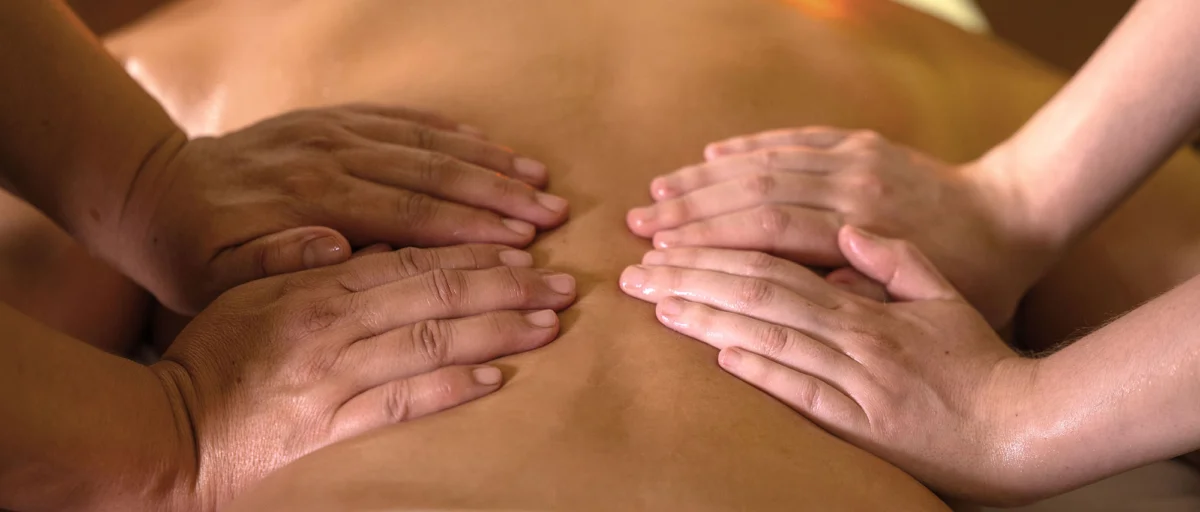
Abhyanga is the most widely recognized form of Ayurvedic bodywork. It involves the rhythmic application of herbalized oils. Whether performed as a self-massage or by a professional practitioner (in some cases, two practitioners working in tandem for a four-handed session), the goal is Snehan. In Sanskrit, Snehan translates to both "oil" and "love." The practice is viewed as a physical manifestation of compassion, designed to harmonize the cells of the body. In the context of Panchakarma (the intensive cleansing program of Ayurveda), Abhyanga is the vital step that loosens accumulated toxins, preparing them for elimination.
Massage with Powders and Pastes
Beyond oil-based treatments, specialized techniques exist for different physiological needs:
- Udvartana: Dry, warm herbal powder massage used to invigorate and detoxify.
- Udsadana: The use of dry herbs for cosmetic and beautification purposes.
- Udgarshana: Massage using herbal pastes (herbs combined with water or oil), specifically targeting chronic skin conditions.
Strokes and Directionality
The direction of the stroke is a deliberate clinical choice. Anuloma (away from the heart) is generally used to calm the mind and ground Vata, while Pratiloma (toward the heart) is often employed to stimulate lymphatic flow and address circulatory issues or varicose veins. Practitioners utilize a diverse toolkit of techniques, including:
- Garshana/Mardana: Friction-based massage.
- Peedana: Deep kneading.
- Udvesthana: Twisting or wringing motions.
- Praharana: Percussion.
- Sandhi Calana: Focused joint mobilization.
Marma Therapy: The Energetic Gateway
Perhaps the most intriguing aspect of Ayurvedic massage is Marma therapy. Marmani are specific anatomical junctions where muscles, veins, ligaments, bones, and joints meet. These are not merely physical points; they are energetic intersections that correspond to internal organs, glands, and the flow of Prana (life force energy).
While modern audiences may compare Marma to Chinese acupuncture, they are distinct. Marma points are often larger and more complex, and the stimulation methods are typically manual, utilizing the practitioner’s hands rather than needles. By activating these points, a practitioner can "awaken the body’s inner pharmacy," helping the patient heal on physical, mental, and emotional levels simultaneously.
Implications for Modern Health
The resurgence of interest in Ayurvedic massage is not merely a trend; it is a response to a modern health crisis characterized by chronic stress and systemic inflammation. The implications of this ancient knowledge are profound:
- Preventative Healthcare: Regular Abhyanga can act as a preventative shield, bolstering the immune system and maintaining doshic balance before illness takes root.
- Psychosomatic Healing: By treating the skin and the nervous system through touch, Ayurveda addresses the root of many stress-related conditions that are often overlooked by conventional medicine.
- Holistic Integration: Ayurvedic massage demonstrates that healthcare does not have to be invasive to be effective. The gentle, nourishing nature of the practice encourages the body to heal itself rather than forcing a chemical or mechanical intervention.
Conclusion: The Path Forward
Ayurvedic massage remains a vital, evolving field. As practitioners like Beatrice Voss and others continue to bridge the gap between ancient lineage and modern application, the benefits of these therapies are becoming increasingly accessible. Whether seeking relief from chronic pain, desiring a more balanced mental state, or simply looking to support the body’s natural detoxification processes, the "healing touch" of Ayurveda provides a holistic pathway to vitality. By integrating the five elements and the wisdom of the doshas into our daily lives, we can harness the ancient knowledge of the sages to improve our modern health outcomes.
For those interested in the deeper nuances of these therapies, continuing education in fields such as Marma therapy offers a way to master the subtle, life-changing potentials of this traditional science.