





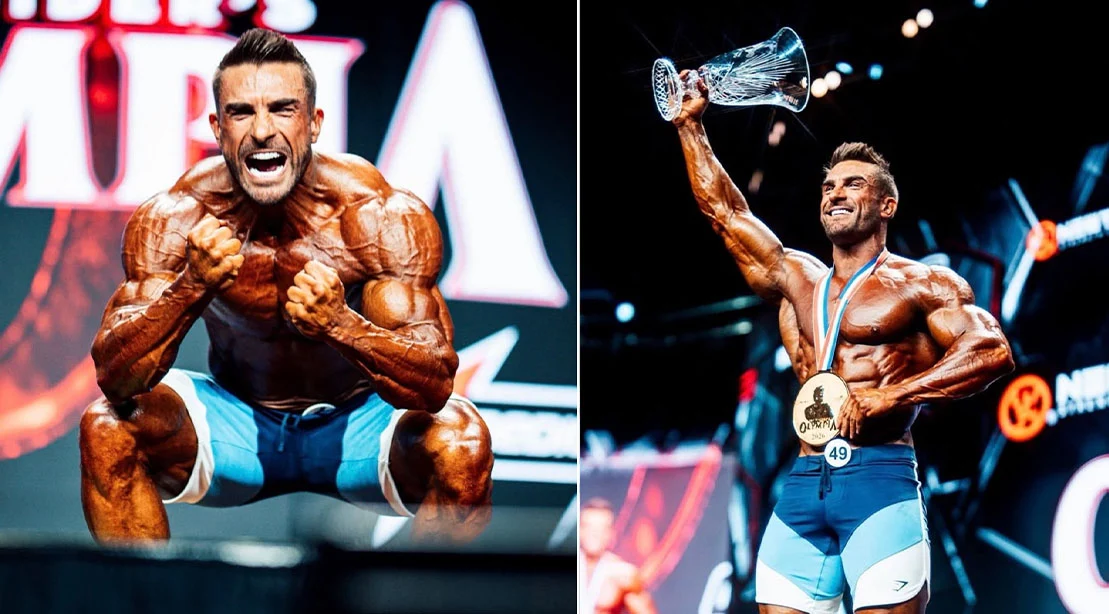
In the high-stakes world of professional bodybuilding, the Olympia stage is the ultimate proving ground—a place where perfection is expected and marginal errors are punished. On September 26, 2026, British icon Ryan Terry cemented his place in the annals of sporting history by capturing his fourth consecutive Men’s Physique Olympia title. By doing so, he equaled the legendary record of Jeremy Buendia, effectively declaring himself one of the greatest to ever grace the category.
However, the victory was far from the triumphant, seamless walkover it appeared to be under the bright lights of the Orleans Arena. Less than 24 hours after his historic win, a visibly emotional Terry peeled back the curtain at the Olympia Winner’s Seminar in Las Vegas to reveal a harrowing reality: he had arrived in Sin City not at 100%, but while battling a debilitating, career-threatening spinal injury that had nearly forced him into an early retirement from the competition.
The Anatomy of a Crisis: A Path to the Brink
The 2026 Olympia preparation cycle had initially been touted by Terry as his most disciplined and mentally focused to date. The RT Fit Gym owner had publicly emphasized the importance of mindfulness, stress management, and a positive psychological environment. But seven weeks out from the biggest stage in the world, the narrative shifted from athletic optimization to medical survival.
During a routine training session, Terry suffered a herniated C5 disc in his neck. The injury, which sent shockwaves through his nervous system, did more than cause localized pain; it triggered a trapped median nerve, resulting in chronic sensory issues that plagued him throughout the final stages of his prep.
"We can talk about it now," Terry told the audience at the Palms in Las Vegas, his voice heavy with the weight of the ordeal. "This has been the hardest prep I’ve ever gone through. There were times I was sat with my wife, in the kitchen, in tears, thinking I’m not going to make the stage. It’s the first prep that I genuinely didn’t think I was going to make it."
A Chronology of Resilience
The timeline of Terry’s 2026 campaign is a study in perseverance. For an athlete whose livelihood depends on the symmetrical, high-definition aesthetic of his physique, a neck injury is particularly catastrophic. The C5 disc herniation threatened not only his ability to lift the heavy loads required for hypertrophy but also his ability to pose—the final, vital component of an Olympia win.
The Seven-Week Countdown
- Weeks 7–5: The initial shock of the injury. Terry attempted to push through the pain, but the neurological symptoms—pins and needles in his fingers and radiating discomfort—began to compromise his training intensity.
- Weeks 4–2: The pivot. Recognizing that traditional lifting was no longer viable, Terry’s team shifted toward a radical, multidisciplinary recovery protocol. The goal shifted from "peak intensity" to "damage control."
- Peak Week: The final stretch. Even as he stepped onto the plane to Las Vegas, the severity of the trapped nerve remained a constant, painful reminder of the risk he was taking. He was essentially competing on nerves and grit, with lingering numbness in his extremities that required extreme focus to hide during mandatory poses.
Multidisciplinary Recovery: The Science Behind the Comeback
Terry’s ability to step on stage, let alone win, was not a miracle; it was the result of a sophisticated, aggressive medical support system. During the seminar, Terry credited his survival to a trifecta of modern physical therapy and restorative medicine.
Central to his recovery was the use of MBST (Molecular Biophysical Stimulation Therapy). This cutting-edge technology, which utilizes magnetic resonance to stimulate cellular repair and accelerate the recovery of bone and cartilage, played a critical role in stabilizing his neck. Alongside this, he utilized a grueling regimen of acupuncture and intensive chiropractic adjustments to manage the inflammation surrounding the C5 disc.
Perhaps most importantly, Terry highlighted the role of his best friend, a professional physical therapist who worked tirelessly to ensure the champion could function. "I just want to say a quick thank you to everybody, to my team, supporting me and helping me get here today," Terry stated. This support structure allowed him to mask the ongoing sensory issues—specifically the persistent pins and needles in his fingers—long enough to perform at the highest level.
The Weight of History: Terry vs. Buendia
The victory on September 26, 2026, carried an extra layer of significance: the equaling of Jeremy Buendia’s four-title record. Buendia, a titan of the Men’s Physique category, has long stood as the benchmark for excellence. For Terry, who famously took nine attempts before securing his first Olympia title in 2023, matching Buendia’s record was the fulfillment of a lifelong ambition.
The relationship between the two men remains one of profound mutual respect. Speaking on the podium and later at the seminar, Terry addressed the emotional complexity of the moment. "Massive, massive respect to Jeremy," Terry said. "That must have been a hard thing to watch. For me to match his record… he was the first to congratulate me, and he genuinely meant it. That meant a lot to me. What a fantastic champion he is."
Buendia’s gracious reaction serves as a testament to the culture of the Men’s Physique division, where the drive to be the best is balanced by a shared understanding of the sacrifice required to reach the pinnacle.
Implications for the Future
The aftermath of the 2026 Olympia has left the bodybuilding community in awe of Terry’s tenacity. However, the revelation of the injury raises questions about the long-term sustainability of such high-level competition.
1. The Physical Toll of Elite Bodybuilding
Terry’s injury is a sobering reminder that even the most "aesthetic" categories in bodybuilding carry significant orthopedic risks. The pursuit of the "perfect" physique often pushes the human frame to its absolute mechanical limit. His success highlights the necessity for bodybuilders to treat their careers as a professional medical operation, integrating sports science, physiotherapy, and recovery technology into their daily lives.
2. The Mental Game
Terry’s ability to remain calm while dealing with a career-ending injury demonstrates the growing importance of mental health in professional sports. His "positive mindset" was not just a platitude; it was a tactical necessity that prevented him from collapsing under the pressure of his own physical limitations.
3. The 2027 Outlook
Despite the severity of his injury, Terry has already confirmed his intention to return for the 2027 Olympia. His goal is no longer just to equal records, but to set a new standard by becoming the most decorated Men’s Physique athlete in history. With the injury now acknowledged and a recovery plan in place, the path forward is clearer, though no less grueling.
Conclusion: The Making of an Icon
Ryan Terry’s 2026 Olympia victory will be remembered not just for the trophy he lifted, but for the obstacles he overcame to reach it. In an era where social media often presents a polished, filtered version of athletic success, Terry’s transparency regarding his C5 disc injury provides a rare, grounded look at the reality of the sport.
He stands today not only as a four-time Olympia champion but as a testament to the power of the human spirit. For the fans who look to him as an inspiration, his story serves as a reminder that greatness is rarely found in the absence of pain, but rather in the courage to perform in spite of it. As he turns his sights toward 2027, the world watches with bated breath, knowing that if Ryan Terry could conquer the Olympia stage with a trapped nerve and a herniated disc, there is truly no limit to what he might achieve next.