










In high-stakes industries—where a split-second decision can be the difference between operational success and catastrophic failure—fatigue has long been the "invisible hazard." For decades, organizations in sectors like aviation, mining, and healthcare have relied on subjective measures to gauge worker readiness: self-reporting, supervisor intuition, and rigid, one-size-fits-all scheduling.
NeuroUX is looking to disrupt this status quo with the launch of its new Fatigue Monitoring Platform. By shifting the paradigm from guesswork to objective, data-driven science, the company aims to turn fatigue management into a standard, automated component of safety operations.
The High Cost of Human Exhaustion
The Occupational Safety and Health Administration (OSHA) has long identified worker fatigue as a primary driver of industrial accidents. When alertness wanes, the cognitive cost is immense; reaction times slow, decision-making becomes impulsive, and situational awareness evaporates.
The historical toll of fatigue is etched into the annals of industrial history. From the 2005 BP oil refinery explosion in Texas City and the 2009 Colgan Air crash to the tragic 1986 space shuttle Challenger disaster and the nuclear meltdowns at Chernobyl and Three Mile Island, the common thread is often human error induced by sleep deprivation or circadian disruption.
Despite these lessons, many modern corporations still manage fatigue through policies that ignore individual biology. "Fatigue affects even the most experienced workers," says Anunay Raj, co-founder of NeuroUX. "When companies can measure it, they can manage it."
The Science of the Gold Standard: PVT
At the heart of the NeuroUX platform lies the Psychomotor Vigilance Test (PVT). For decades, the PVT has been recognized by sleep researchers as the "gold standard" for measuring neurobehavioral impairment.
Unlike memory or logic tests, which can be improved through practice or sheer willpower, the PVT measures sustained attention and reaction speed. It is uniquely sensitive to the biological signatures of sleep loss and circadian misalignment. Because the test is resistant to "learning effects"—meaning performance does not artificially improve through repetition—it is the ideal instrument for the daily, high-frequency monitoring required in industrial settings.
By digitizing this rigorous clinical tool, NeuroUX has made it accessible for the modern, mobile workforce. The platform integrates seamlessly into the daily workflow, allowing workers to complete a brief alertness check on a smartphone or tablet before beginning a shift.
Personal Baselines: Moving Beyond the "Average" Worker
One of the most significant innovations in the NeuroUX platform is its transition away from generic safety thresholds. In many existing systems, an "alertness threshold" is set at an arbitrary level that applies to every employee, regardless of their age, chronotype, or sleep history.
NeuroUX takes a personalized approach. The platform benchmarks each individual worker against their own historical baseline. By establishing what "normal" looks like for a specific individual, the system can detect subtle deviations that might indicate critical levels of impairment.
This hyper-personalized data is a game-changer for safety managers. If a worker shows a 15% drop from their personal baseline, the system flags the risk immediately. This eliminates the "toughing it out" culture that frequently leads workers to underreport their fatigue levels to avoid disciplinary action or loss of income.
How the Platform Works: A Step-by-Step Integration
The implementation of the NeuroUX platform is designed to be low-friction for both the employee and the supervisor.
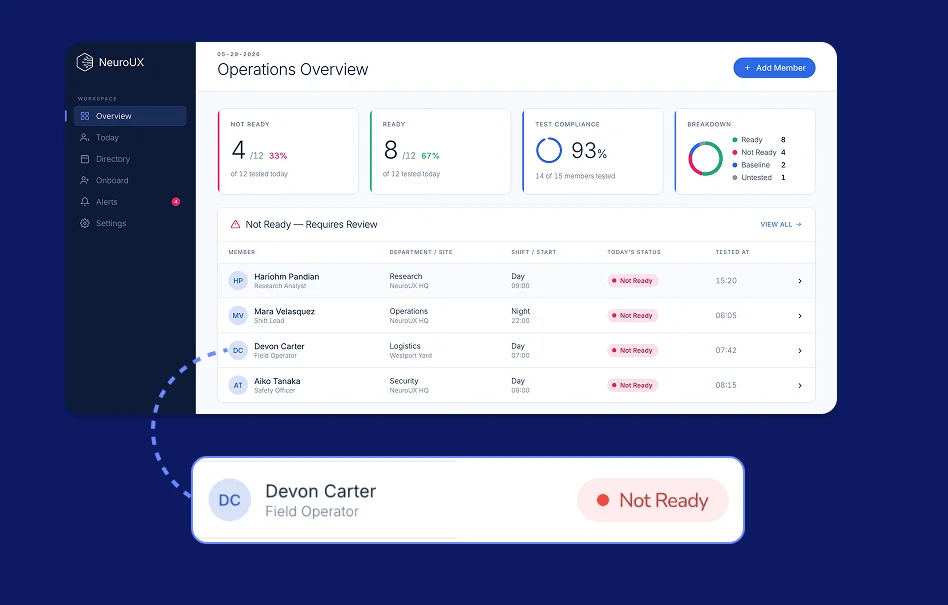
- The Pre-Shift Check: Before entering a high-risk environment, a worker spends just a few minutes on their mobile device completing the PVT-based alertness test.
- Data Processing: The platform immediately calculates the worker’s current neuro-cognitive state, comparing it against their personal historical performance.
- Real-Time Reporting: Within seconds, the system provides a clear "fit-for-duty" signal.
- Operational Action: Supervisors receive this information through their preferred management channel, allowing for immediate reassignment or intervention if a worker is flagged as high-risk.
Broad Implications: From the Flight Deck to the ER
The utility of the NeuroUX platform extends far beyond the traditional industrial floor. The technology has already been stress-tested in various high-pressure environments, including research studies involving flight crews, night-shift medical personnel, and professional athletes.
In healthcare, where "post-call" burnout is a known systemic issue, the ability to objectively verify whether a surgeon or resident is mentally fit to operate could significantly reduce the incidence of preventable medical errors. Similarly, for professional athletes, the technology offers a way to monitor recovery and optimize performance without overtraining.
Challenging the "Self-Reporting" Culture
For decades, the standard for determining if a worker is "fit for duty" has been, "Are you tired?" This question is notoriously unreliable. Humans have a documented tendency to overestimate their own alertness levels, especially when they are sleep-deprived. This phenomenon, known as the "subjective-objective discrepancy," means that an exhausted worker may feel perfectly capable of operating heavy machinery when, in reality, their cognitive functions are significantly impaired.
By replacing self-reporting with objective data, NeuroUX is effectively removing the emotional and social pressure from the safety check. The worker is no longer "admitting" to being tired; they are simply providing a data point that dictates their suitability for the current task.
The Future of Operational Safety
As the global workforce faces increasing pressure for efficiency, the risk of burnout and fatigue is only rising. Organizations that continue to rely on manual, subjective assessment methods are leaving themselves vulnerable to catastrophic risk.
NeuroUX’s platform suggests a future where safety is proactive rather than reactive. By integrating fatigue monitoring into the daily rhythm of work, companies can create a culture where physical and mental readiness is treated with the same level of importance as equipment maintenance and safety training.
Summary of Benefits
- Objectivity: Removes supervisor bias and employee self-deception from the safety equation.
- Personalization: Accounts for the reality that every individual has different baseline capabilities.
- Speed: Provides actionable results in minutes, preventing delays in operational workflows.
- Scalability: Operates on existing mobile infrastructure, making it feasible for global, remote, and decentralized teams.
Conclusion: The Path Forward
The launch of the NeuroUX Fatigue Monitoring Platform marks a pivotal moment in occupational health and safety. By bridging the gap between rigorous sleep science and everyday industrial operations, NeuroUX is providing the tools necessary to protect workers from the silent, mounting danger of fatigue.
As the data continues to demonstrate, human error is often a symptom of underlying biological reality. With the advent of mobile, AI-supported alertness testing, the era of guessing whether a worker is "fit for duty" is drawing to a close. In its place, we are entering an era of measurable, manageable, and highly optimized human performance.
For industries looking to modernize their safety protocols, the message is clear: when the stakes are high, objective data is the only reliable safeguard against the unpredictable nature of human fatigue. By adopting platforms like those offered by NeuroUX, companies are not just checking a box; they are actively investing in the well-being of their most valuable asset—their people—while ensuring the resilience and reliability of their operations.