







For years, the gold standard for fitness enthusiasts, bodybuilders, and the health-conscious has been clear: if you want to change your body, you must track your intake. Whether through meticulous macro counting or calorie logging, the data-driven approach promised control. But for Dr. Gabrielle Fundaro, a PhD in Human Nutrition, a veteran coach, and a competitive powerlifter, the data eventually stopped providing the answers she needed.
Despite her professional credentials and over a decade of experience, Dr. Fundaro reached a breaking point. She was physically "on track" but mentally exhausted. The rigid reliance on external metrics—apps, scales, and percentages—had eroded her ability to trust her own biological signals. Her journey toward a new methodology, known as "RPE-Eating," represents a significant shift in the nutrition industry, moving away from algorithmic control toward interoceptive awareness.
The Chronology of a Nutritional Burnout
Dr. Fundaro’s experience is not unique; it is a common trajectory for many who spend years in the world of high-performance athletics. Initially, macro tracking served as a vital educational tool. It provided the structure necessary to fuel her powerlifting training and maintain the physique required for competition. It was a period of "data-driven success."
However, as the years passed, the utility of the method began to wane. The cognitive load required to perfectly balance macronutrients for every meal became a source of anxiety rather than liberation. The turning point came when she realized she could no longer walk into a restaurant and enjoy a meal without mentally calculating its impact on her daily totals. She was "on track," but she was no longer present.
The fear of stopping was palpable. Like many athletes, she harbored deep-seated anxieties: If I stop tracking, will I lose my muscle mass? Will I inevitably overeat and gain body fat? As a nutrition expert, does my inability to intuitively eat invalidate my professional standing? These questions kept her tethered to her tracker long after it had ceased to be a positive influence on her life.
The Emergence of RPE-Eating
While struggling with her own eating habits, Dr. Fundaro was simultaneously evolving her training philosophy in the gym. She began using the Rate of Perceived Exertion (RPE) scale, a system commonly used in powerlifting to gauge effort based on how a lift feels rather than just a percentage of a one-rep max. She noticed that when she allowed her training to be guided by how she felt—adjusting volume and intensity based on recovery and fatigue—she became stronger and less injury-prone.
The epiphany was immediate: if RPE could optimize performance in the squat rack, why couldn’t it optimize health at the dinner table?
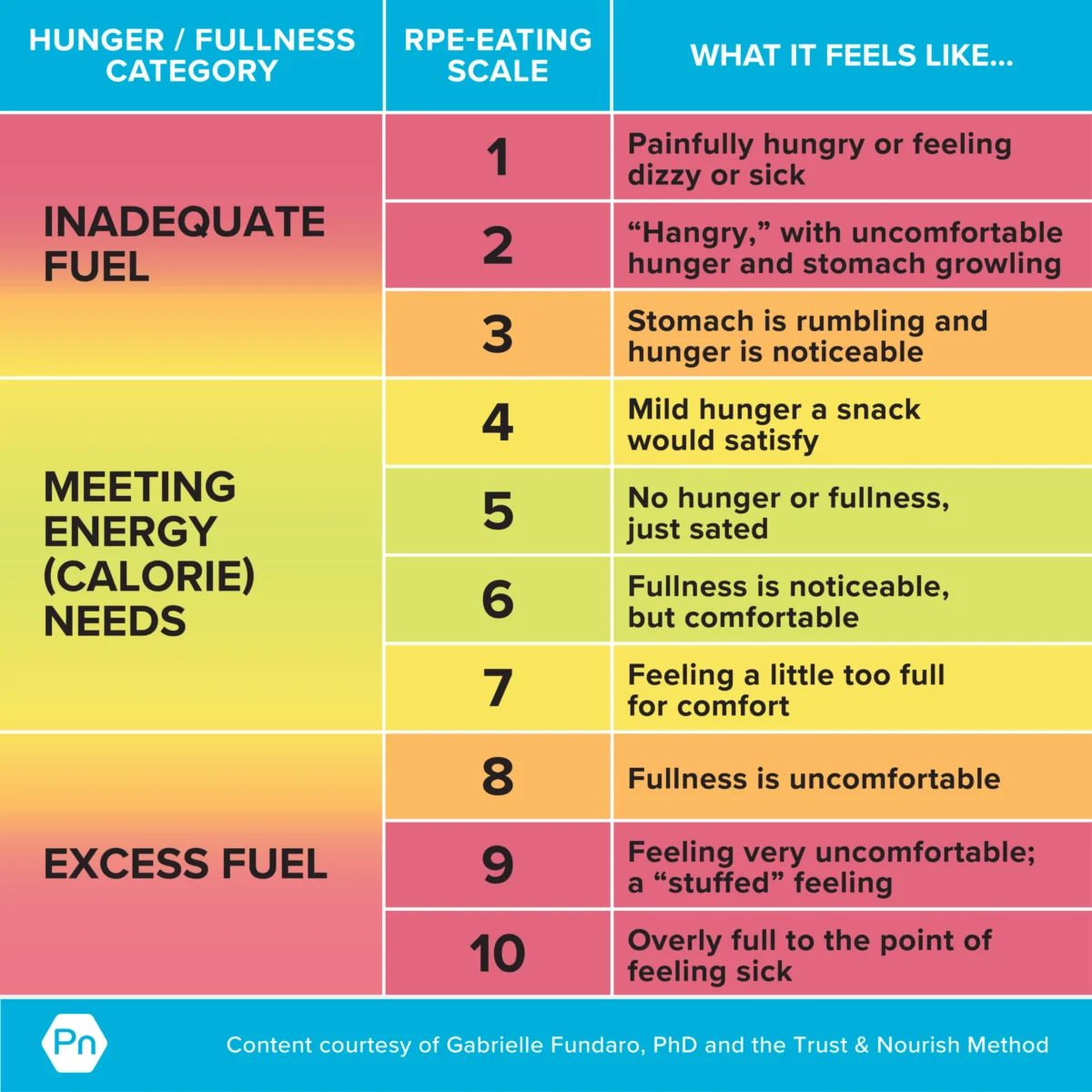
She adapted the 0–10 scale—originally developed by Gunnar Borg in the 1960s—to create a framework for eating. The goal was not to replace one set of rules with another, but to provide a "bridge" for people who felt lost without the rigid structure of a tracking app.
Supporting Data: Why Interoceptive Awareness Matters
The scientific basis for RPE-Eating lies in interoceptive awareness—the ability to perceive the physiological condition of the body. Research has consistently shown that individuals who are highly attuned to their internal hunger and satiety cues are better equipped to maintain long-term weight stability and psychological well-being.
Conversely, chronic external tracking can act as a "noisy neighbor" that drowns out these internal cues. When we outsource our hunger signals to an app, we lose the practice of listening to the body’s natural feedback loops. Dr. Fundaro’s framework encourages a recalibration of these sensors. By documenting hunger levels before, during, and after meals, practitioners begin to "download" a more accurate understanding of what their body requires, effectively updating their internal software.
Official Perspectives: The Coaching Stance
Dr. Fundaro’s approach is not framed as a "cure-all" or a "diet," but as a professional tool for developing self-trust. From a coaching perspective, the transition is treated with the same caution as a return-to-play protocol after an injury.

"I am not anti-weight modification," Dr. Fundaro notes, clarifying her stance for those who still have physique goals. "I am pro-safe weight modification." She draws a parallel to contact sports: there are inherent risks, but those risks can be mitigated through education, mindfulness, and, most importantly, the removal of the stressors that lead to disordered eating patterns.
For coaches, this means teaching clients that the RPE-Eating scale is flexible. It does not demand perfection. In fact, it explicitly accounts for "non-hunger triggers"—the emotional, social, and psychological factors that lead us to eat when we aren’t physically hungry. By teaching clients to "notice and name" these triggers—such as stress, fatigue, or boredom—coaches can help them find non-food coping mechanisms, which is a far more sustainable long-term solution than simply restricting calories.
Implications for the Future of Nutrition
The move toward RPE-Eating carries profound implications for the nutrition industry, which has been dominated for decades by the "calorie-in, calorie-out" paradigm.
The Shift from "Optimal" to "Sustainable"
The most significant implication is the redefinition of "success." In the world of tracking, success is defined by hitting a target. In the world of RPE-Eating, success is defined by the absence of fear. If a client can go out for dinner, eat intuitively, and not feel a sense of moral failing or panic the next morning, that is considered a clinical success, regardless of the macronutrient profile of the meal.
A Tool for "Off-Ramping"
For those who have been trapped in the cycle of yoyo-dieting, RPE-Eating acts as an "off-ramp." It allows individuals to gradually reduce their reliance on apps while still maintaining a sense of structure. This is particularly valuable for those who have a history of eating disorders or who are involved in weight-class sports where the pressure to track is extreme.
The Role of Satisfaction
Dr. Fundaro’s framework also introduces the concept of "satisfaction" alongside "satiety." A meal that provides only physical satiety but lacks pleasure—perhaps because a favorite food is "banned"—often leads to a "pendulum effect," where the person eventually overeats that restricted food. By acknowledging that humans eat for community, tradition, and pleasure, RPE-Eating creates a more holistic, and therefore more sustainable, approach to nourishment.
Practical Implementation: How to Begin
For those looking to adopt this approach, the process is iterative. It begins with clear goal setting: acknowledging that the goal is not "optimal" body fat percentage, but rather increased autonomy.
- Identify Hunger Cues: Before eating, rate your hunger on a scale of 1–10. Is it a physiological need (hunger) or an emotional craving (appetite)?
- Practice Presence: Minimize distractions. Focus on the sensory experience of the meal.
- Mid-Meal Check-in: Pause halfway through. Re-evaluate your hunger level. This "reset" helps bridge the gap between initial hunger and the point of comfortable fullness.
- Reflect on Triggers: If you find yourself eating mindlessly, use the "Notice and Name" technique to identify the emotional trigger.
- Build a Repertoire: Develop a list of non-food coping strategies—walking, breathing, or social interaction—to address the underlying needs that trigger emotional eating.
Conclusion: Reclaiming the Internal Compass
RPE-Eating is not for everyone. For those who are not ready to let go of the control provided by tracking, or for those who require precise intake for high-level athletic performance, traditional methods still have their place.
However, for the vast majority of the population, the current reliance on external tracking has become a barrier to genuine health. By fostering interoceptive awareness, Dr. Fundaro is helping people transition from "users" of an app to "experts" on their own bodies.
"The goal," as Dr. Fundaro concludes, "is to know that you are nourishing yourself—and you don’t need a food tracker to do that." In a world obsessed with data, the most revolutionary act may be learning, once again, how to listen to ourselves.