For many fitness enthusiasts and high-performance athletes, the ritual is as familiar as the morning coffee: opening a tracking app, logging every gram of chicken, every ounce of rice, and every pinch of protein powder. For Dr. Gabrielle Fundaro, a respected voice in human nutrition with over a decade of coaching experience and a decorated history in powerlifting, this ritual was once a cornerstone of her identity.
Yet, despite her academic credentials and success in the gym, Dr. Fundaro eventually reached a breaking point. She discovered a paradox that plagues many in the wellness industry: the more she tracked, the more disconnected she felt from the very body she was trying to optimize. Her realization—that macro-tracking had become a cage rather than a compass—has led to the development of a novel, evidence-based approach to nutrition known as "RPE-Eating."
The Genesis of a Paradigm Shift
The journey toward RPE-Eating was not a sudden decision but a gradual realization. Dr. Fundaro spent years meticulously balancing her macronutrients to maintain a specific physique and performance level. On paper, it was flawless. In practice, it was exhausting.
The turning point came when she realized the psychological toll of external dependency. She found herself unable to enjoy a meal at a restaurant without mentally deconstructing the macronutrient profile of every bite. She was trapped by the "what-ifs": What if I don’t eat enough protein and lose my hard-earned muscle? What if I overeat and gain body fat? What if I, an expert in nutrition, am fundamentally incapable of fueling myself without an app?
Her search for an alternative led her to a familiar concept in the weight room: Rate of Perceived Exertion (RPE). Having successfully utilized RPE to regulate her training intensity and optimize recovery, she began to wonder if the same logic could be applied to the dinner table. If an athlete could trust their body to gauge the intensity of a squat, why couldn’t they trust their body to gauge the needs of their metabolism?
What is RPE-Eating?
Developed by Gunnar Borg in the 1960s, the RPE scale was originally a clinical tool for assessing physical effort. It allowed individuals to quantify subjective exertion on a scale—often 0 to 10. In the fitness world, this scale transformed how people train, moving away from rigid, "one-size-fits-all" prescriptions toward a model of autoregulation.
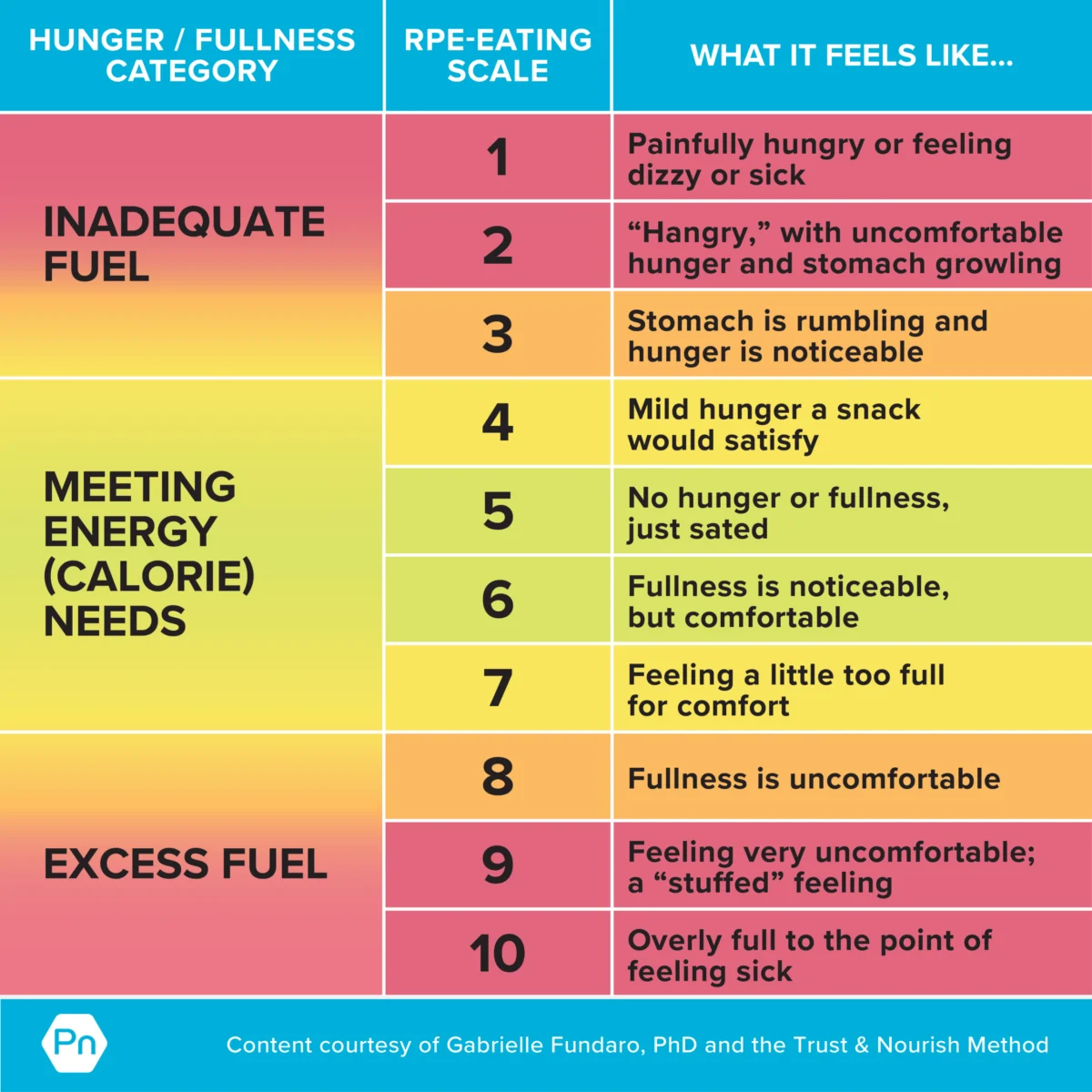
Dr. Fundaro adapted this framework to create the "RPE-Eating Scale," a 10-point system that helps individuals categorize their internal hunger and fullness signals.
- 1–3 (Inadequate Fuel): Characterized by physical symptoms like lightheadedness, shakiness, or an empty, painful hunger.
- 4–7 (Adequate Fuel): The "sweet spot" where hunger is satiated, energy levels are stable, and the body feels comfortable and nourished.
- 8–10 (Excess Fuel): Ranges from feeling "stuffed" to the point of discomfort, sickness, or an inability to move comfortably.
The objective is not to hit a perfect number every time, but to develop the skill of "interoceptive awareness"—the ability to sense what is happening inside your own body without relying on digital feedback.
The Chronology of Implementation
Transitioning away from a long-term tracking habit is not instantaneous. Dr. Fundaro suggests a structured, four-step process for those looking to regain their autonomy.
Step 1: Defining the Goal
The first step is a psychological reset. RPE-Eating is not a "weight-loss hack." It is a tool for building self-trust. For individuals who have spent years chasing a specific physique, shifting the goalpost to "nutritional competence" can be uncomfortable. However, it is a necessary evolution for long-term health.
Step 2: The Art of Tuning In
Practice begins by distinguishing between hunger (a physical need for energy) and appetite (a psychological desire for pleasure). Dr. Fundaro encourages practitioners to record their hunger levels before and during meals. By checking in halfway through a meal, one can observe how the body shifts from "hungry" to "satiated." This "downloading" of the sensation of fullness helps the brain re-map its internal satiety signals.

Step 3: Navigating Non-Hunger Triggers
Human beings rarely eat in a vacuum. We eat when we are stressed, bored, or celebrating. Dr. Fundaro advocates for the "Notice and Name" technique. When an urge to eat strikes, pause to identify the emotion driving it. Is it anxiety? Is it fatigue? By acknowledging the trigger, one can decide if food is the appropriate solution or if a different coping mechanism—like a walk or a deep breath—is required.
Step 4: Balancing Satiety and Satisfaction
A critical, often overlooked component is satisfaction. One can meet all nutritional requirements (satiety) but feel emotionally unsatisfied, leading to a binge-restrict cycle. RPE-Eating encourages the inclusion of foods that bring genuine pleasure, effectively removing the "forbidden" status of certain items and reducing the likelihood of compensatory overeating.
Supporting Data and the Science of Autoregulation
Critics often dismiss intuitive methods as "feelings over facts." However, the scientific literature on autoregulation in sports performance provides a robust defense of the RPE model. Studies on velocity-based training and RPE-based resistance training have shown that athletes who use internal feedback are often more consistent and less prone to burnout than those following rigid, pre-programmed percentages.
Interoceptive awareness is a measurable skill. Just as a powerlifter learns to recognize when a lift is becoming dangerous based on bar speed, an eater learns to recognize when their hunger is subsiding based on stomach signals and energy levels. While tracking glucose or calories provides data, those tools do not teach the user how to read their own biology. RPE-Eating serves as a bridge, allowing the individual to eventually operate without the "crutch" of the tracker.
Implications for the Fitness Industry
The implications of Dr. Fundaro’s work are profound for the coaching industry. Many fitness professionals have witnessed the "pendulum effect": clients who track macros with extreme precision eventually crash, resulting in disordered eating patterns or total abandonment of health goals.
RPE-Eating offers a "safety net." For those who are currently tracking but want to transition to a more sustainable lifestyle, this method acts as a bridge. It provides the structure that people crave without the rigidity that destroys long-term adherence. It also addresses the hidden compulsion of "finishing the plate," a habit that relies on external optics rather than internal physical needs.
Who is This For?
Dr. Fundaro is clear that this is not a universal solution. It is particularly valuable for:
- Burned-out Trackers: Those who feel shackled to their fitness apps.
- The Control-Seekers: Individuals whose anxiety spikes the moment they stop tracking.
- At-Risk Populations: Those with a history of yo-yo dieting or high body dissatisfaction who may find the hyper-focus of tracking to be a trigger for disordered behavior.
However, she cautions that this is not a replacement for professional intervention. For those suffering from clinical eating disorders, working with a licensed therapist or registered dietitian remains the gold standard. RPE-Eating is a tool for behavioral change, not a medical treatment for pathology.
A Future Beyond the App
The goal of RPE-Eating is ultimately to render itself unnecessary. Once a person has successfully cultivated the skill of listening to their body, they no longer need a scale, a calculator, or a chart. They have internalized the data.
In an industry obsessed with the next "optimal" diet or the latest tracking technology, Dr. Fundaro’s approach is refreshing in its simplicity. It acknowledges that human beings are not machines to be calibrated, but complex organisms capable of learning, adapting, and trusting themselves.
As Dr. Fundaro concludes, the true measure of a successful nutrition strategy is not how many grams of protein you consumed, but whether you can navigate your life, your plate, and your hunger with confidence, peace, and—most importantly—the ability to listen to the body you live in.