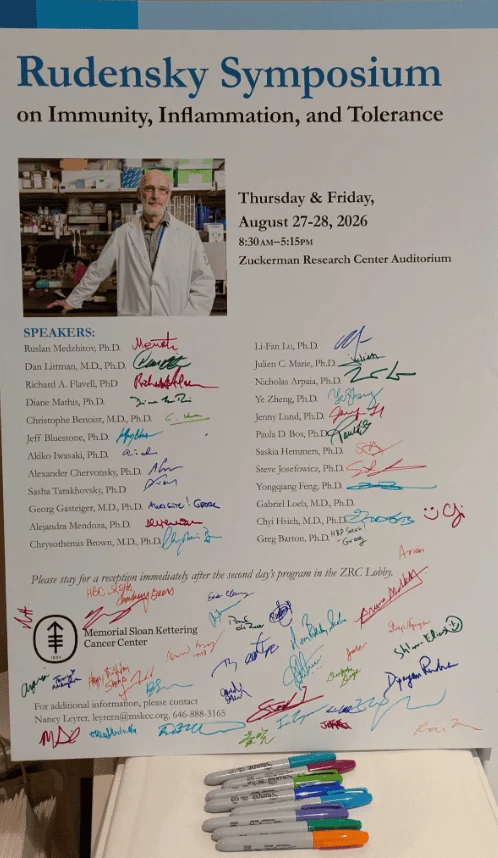
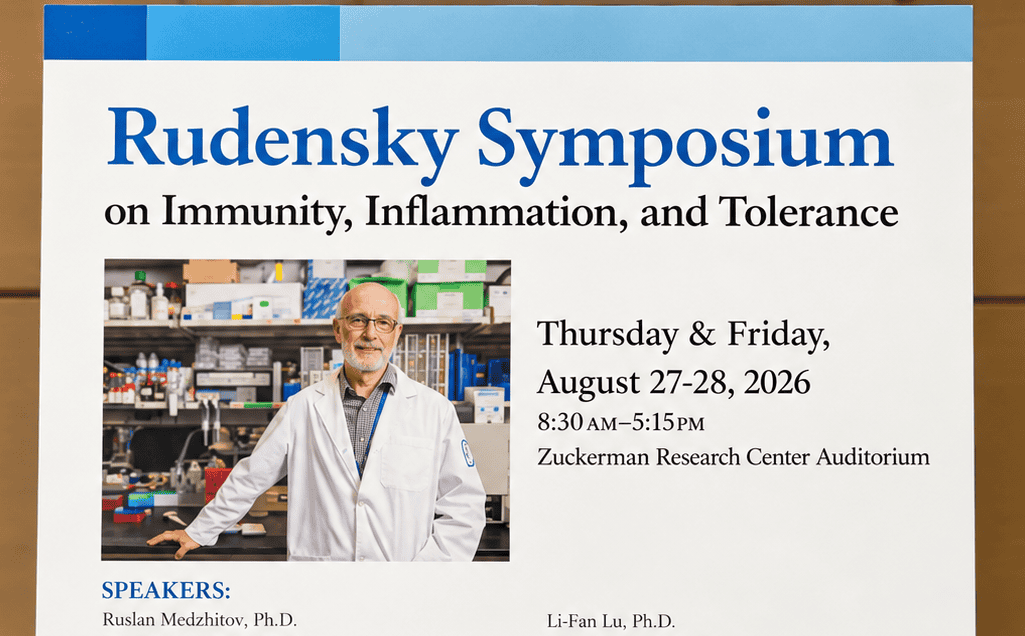
On August 27–28, 2026, the scientific community gathered not merely for a conference, but for a celebration of a life’s work in the service of immunology. The Rudensky Symposium on Immunity, Inflammation, and Tolerance served as both a high-level academic summit and a heartfelt tribute to Alexander “Sasha” Rudensky, PhD, of the Memorial Sloan Kettering Cancer Center (MSKCC), on the occasion of his 70th birthday.
The symposium was a testament to the "ripple effect" of scientific leadership. It brought together a multigenerational cohort of former trainees, lifelong collaborators, and peers, weaving together cutting-edge presentations on immune regulation with personal anecdotes that underscored the human element of rigorous scientific inquiry. For the Cancer Research Institute (CRI), which has supported Dr. Rudensky’s work for over two decades, the event was a vivid illustration of how long-term investment in basic science pays dividends in the fight against cancer.
The Foundation of a Scientific Legacy
For over 20 years, the CRI has been a consistent partner in Dr. Rudensky’s laboratory, funding more than a dozen CRI fellows who have gone on to shape their own independent research programs. This partnership reached a pinnacle in 2015 when Dr. Rudensky was awarded the CRI William B. Coley Award—one of the most prestigious honors in immunology—for his pioneering identification and characterization of regulatory T cells (Tregs).
Tregs are the "peacekeepers" of the immune system. They act as a critical brake, preventing the immune system from attacking the body’s own healthy tissues. However, in the context of oncology, these cells can become a liability; tumors often hijack this suppressive mechanism to shield themselves from destruction by the immune system. The symposium was organized around the dual nature of these cells—how they maintain balance in health and how they facilitate evasion in disease.
Chronology of Inquiry: From Tissue Repair to Tumor Surveillance
The symposium’s agenda was meticulously curated to reflect the evolution of immunological thought, tracing a path from basic cellular biology to complex systemic interactions.
The Maintenance Crew: Immunity in Healthy Tissues
The opening sessions focused on a paradigm shift in how we view immune cells: they are not just soldiers, but janitors and architects of tissue homeostasis.
CRI scientist and 2003 Coley Awardee Dr. Ruslan Medzhitov opened the proceedings by detailing the role of macrophages in "housekeeping." His research indicates that stressed cells recruit macrophages to clear out damaged protein "garbage," suggesting that the immune system is fundamentally wired to ensure the longevity of tissues, even in the absence of pathogens.
This theme of tissue maintenance was expanded upon by 2024 Coley Award recipients Dr. Diane Mathis and Dr. Christophe Benoist. Dr. Mathis discussed how specific populations of Tregs are essential for controlling inflammation in injured muscle, effectively guiding the repair process and preventing the formation of debilitating scar tissue. Complementing this, Dr. Benoist demonstrated that the identity and functional profile of a Treg are dictated by the specific molecular targets they recognize, adding a layer of precision to our understanding of immune restraint.
Early Warning Systems: Cancer Before the Tumor
A critical section of the symposium was dedicated to the "pre-cancerous" state—a frontier that is rapidly becoming a focal point of immunotherapy research.
Dr. Richard A. Flavell, a 2012 Coley Awardee, presented compelling preclinical work regarding early cancer immunosurveillance. By studying intestinal stem cells harboring the BRAF mutation, Dr. Flavell’s team observed that the immune system actively monitors and eliminates mutant cells before they can form a macroscopic tumor. The research highlighted that when these mutant cells lose the ability to communicate with T cells, they gain a competitive advantage, allowing them to populate intestinal niches.
Similarly, Dr. Julien C. Marie explored the inflammatory origins of malignancy. By disrupting the TGF-β signaling pathway, his lab pushed Th17 immune cells into a state of chronic inflammation that induced DNA damage and, eventually, oncogenesis. Crucially, the restoration of these signals was shown to reverse the inflammatory state, suggesting that the "harmful" programs of immune cells retain a degree of plasticity that could be therapeutically exploited.
The Wider Ecosystem: Microbiomes and Microenvironments
As the symposium moved into the second day, the focus shifted from individual cells to the complex neighborhoods in which tumors reside.
Dr. Dan Littman, a 2016 Coley Awardee and CRI Scientific Advisory Council member, presented data on the gut-immune-cancer axis. His research has been instrumental in establishing that the composition of the gut microbiome can dictate the efficacy of checkpoint immunotherapy. The implications are profound: an immune response that begins in the gut can influence the systemic ability of a patient to respond to cancer treatments elsewhere in the body.
The physical architecture of the tumor was addressed by Dr. Paula D. Bos, who examined how Tregs remodel the extracellular matrix. Her work showed that Tregs influence macrophages to alter the structural "scaffolding" of breast tumors, creating collagen highways that facilitate cancer cell escape and metastasis. By selectively modulating these pathways, her team was able to reduce metastatic burden, providing a potential roadmap for therapeutic intervention that avoids the systemic risks of blanket Treg depletion.
Dr. Nicholas Arpaia concluded this thematic block by discussing the "immunosuppressive neighborhoods" tumors build for themselves. By identifying specific fibroblast populations that recruit Tregs to the lung, his group is developing strategies to intercept these recruitment signals. This work, notably developed in collaboration with CRI Lloyd J. Old STAR Dr. Tal Danino, utilizes engineered bacteria to deliver targeted therapies precisely within the tumor microenvironment, minimizing off-target toxicity.
Implications for Future Cancer Therapy
The overarching message of the Rudensky Symposium was clear: the wall between "basic immunology" and "clinical oncology" has effectively crumbled. The mechanisms that regulate tissue repair, manage the microbiome, and maintain immune tolerance are the very same mechanisms that dictate whether a cancer is ignored, contained, or eliminated.
The implications for clinical practice are twofold:
- Prevention and Early Intervention: By understanding the immunosurveillance of mutant cells, clinicians may one day be able to identify and "prime" the immune system to clear pre-malignant cells before they become invasive.
- Precision Immunomodulation: Moving away from broad-spectrum immunotherapy toward targeted, context-dependent interventions—such as modulating macrophage behavior or disrupting specific fibroblast-Treg interactions—offers a path to higher efficacy with fewer side effects.
A Legacy Built on Mentorship
While the scientific data was rigorous, the symposium’s spirit remained rooted in the human relationships fostered by Dr. Rudensky. The "Rudensky Lab Family," as attendees identified themselves, emphasized that the breakthroughs of the last few decades were not the result of solitary genius, but of a culture that prioritized intellectual honesty, rigorous debate, and the freedom to chase "unfashionable" questions.
"Progress is not just a series of papers," noted one attendee during the closing remarks. "It is a transfer of intuition and rigor from one generation to the next."
As the CRI continues to support the next generation of researchers, the Rudensky Symposium stands as a case study for success. By funding the "people" as much as the "projects," institutions like the CRI ensure that the foundational questions of immunology remain at the forefront of the war on cancer.
The event concluded with a sign-off on a commemorative poster board—a simple gesture that belied the monumental impact of the career it celebrated. For the scientific community, the symposium was a reminder that while the complexities of the immune system are vast, the clarity of a well-mentored, collaborative approach is the surest path to discovery. As we look toward the next decade, the research shared in these two days serves as a beacon, guiding the way toward more effective, less toxic, and potentially preventative cancer therapies.