In a calculated move that signals a broader national ambition, California Governor Gavin Newsom has embarked on a series of high-stakes campaign stops across the American South. This tactical shift represents more than just a standard outreach effort; it is a fundamental critique of the Democratic Party’s recent electoral strategy. Newsom, often viewed as a leading voice for the progressive wing of the party, argues that Democrats have dangerously "taken their eyes off the ball" regarding state-level races, effectively ceding ground to Republican legislatures that have aggressively redrawn congressional maps to cement their power.
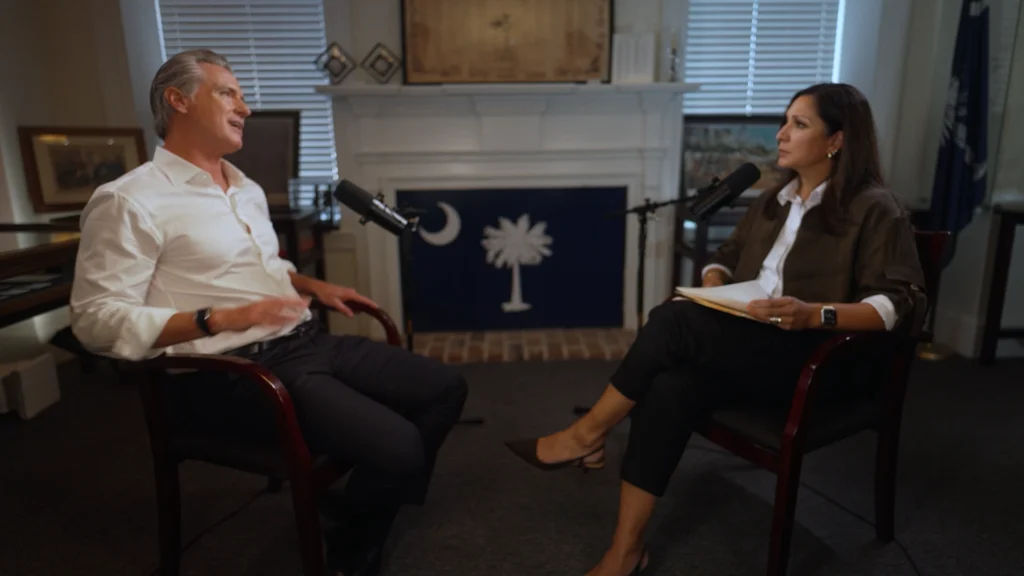
In a recent appearance on the PBS News program "Settle In," recorded against the backdrop of a visit to South Carolina, Newsom sat down with host Amna Nawaz. The conversation provided a rare, unvarnished look at the Governor’s perspective on the party’s "rural problem," the necessity of aggressive state-level organizing, and the swirling, inevitable questions surrounding his potential path toward a 2028 presidential bid.
The Strategic Shift: Addressing the "Rural Gap"
For years, political analysts have pointed to the widening chasm between urban centers—where Democratic support is concentrated—and rural regions, which have become increasingly entrenched Republican strongholds. Newsom’s recent Southern tour is an attempt to reverse this trend.
During his interview, Newsom emphasized that the Democratic brand has suffered in rural America due to a lack of physical presence and a failure to articulate a vision that resonates with working-class voters outside of major metropolitan hubs. "We’ve stopped showing up," Newsom remarked. "If you aren’t in the room, if you aren’t in the community, you aren’t part of the conversation. And when you aren’t part of the conversation, someone else is defining you."
Newsom’s strategy centers on the idea that Democrats must engage in "guerilla-style" politics in deep-red states. This involves not only funding high-profile federal races but also investing in local legislative seats, school boards, and county-level offices that cumulatively dictate the outcomes of congressional redistricting.
Chronology of a Campaign Evolution
To understand Newsom’s current trajectory, one must look at the timeline of his political evolution over the last several years:
- 2021: Surviving the Recall. Newsom’s decisive victory in California’s gubernatorial recall election cemented his status as a national party leader, giving him the political capital to pivot toward national issues.
- 2022: The "Red State" Tour. Throughout his reelection campaign, Newsom began running ads in states like Florida and Texas, challenging Republican governors on policies regarding reproductive rights and education. This signaled an intent to engage in the "culture wars" on a national stage.
- 2023: The Launch of the "Campaign for Democracy." Newsom launched a political action committee focused on supporting Democratic candidates in red states. This established the infrastructure for his current Southern outreach.
- 2024: The Southern Pivot. Recognizing that Republican-led redistricting efforts have effectively neutralized Democratic voting power in several swing districts, Newsom began a deliberate, multi-state tour—including South Carolina, Alabama, and Georgia—to mobilize grassroots organizers.
- Present Day: The "Settle In" interview serves as a synthesis of these efforts, positioning Newsom not just as a state governor, but as a party strategist with a national vision.
Supporting Data: The Cost of Complacency
The urgency behind Newsom’s rhetoric is backed by stark electoral data. Over the past decade, Republican-controlled state legislatures have leveraged the census-driven redistricting process to create "safe" seats that insulate their incumbents from the shifting demographics of their states.
According to data from the Brennan Center for Justice, Republican-led redistricting in states like North Carolina, Texas, and Georgia has effectively limited the Democratic Party’s ability to regain control of the House of Representatives, even in years where Democratic candidates win the national popular vote by significant margins.
Furthermore, voter turnout data in rural counties across the South suggests a "depressive effect" on Democratic participation. In counties where there is no competitive state-level Democratic candidate, turnout among minority voters and younger voters—the bedrock of the party—drops significantly. Newsom’s thesis is that by fielding candidates in these "ignored" districts, the party can boost turnout for top-of-the-ticket races, potentially flipping key seats in the Electoral College.
Official Responses and Political Reaction
Newsom’s activism has received a mixed reception. Within the Democratic Party, he is praised by many for his energy and willingness to challenge the status quo. "Gavin is doing what we’ve needed for a decade," said one national party strategist who requested anonymity. "He’s taking the fight to them, rather than waiting for the fight to come to us."
Conversely, some traditionalists within the party express caution. There is a fear that Newsom’s aggressive, high-profile style might alienate moderate voters in suburban areas who are already wary of national polarization. Republican leaders have been quick to capitalize on this, frequently painting Newsom as an "out-of-touch coastal elite" attempting to impose California values on Southern states.
"Governor Newsom’s presence here is a gift to the Republican Party," said a representative for a Southern Republican committee. "He represents everything that rural Southerners reject. His attempts to lecture us on how to run our states only serve to unite our base."
Implications for 2028: The Path Forward
The "Settle In" interview inevitably turned toward the future. While Newsom has publicly stated he is focused on his current term in Sacramento and helping the party in the immediate election cycle, his actions suggest he is building a national resume.
The "National Governor" Model
Newsom’s strategy mirrors that of other successful presidential candidates who used their governorships as a platform for national ideological leadership. By focusing on issues like climate change, reproductive rights, and economic inequality, he is creating a template for how a modern Democratic leader can operate in a polarized environment.
The Rural-Urban Bridge
If Newsom is to mount a credible bid for the White House in 2028, he must prove that his brand of progressivism can travel beyond the Sierra Nevada mountains. His current work in the South is effectively a "stress test" for his message. If he can demonstrate even modest gains in rural turnout, it would provide him with a powerful narrative to counter the perception that he is too "liberal" for the broader American electorate.
The Challenge of the Primary
Should he run, Newsom would likely face a crowded field of candidates. His challenge will be to balance his progressive credentials—which are necessary to win a Democratic primary—with the more pragmatic, "big tent" approach he is currently testing in the South.
Conclusion: A High-Stakes Gamble
Gavin Newsom’s foray into the American South is a calculated, high-stakes gamble. By shifting his focus to state-level infrastructure and rural outreach, he is attempting to solve one of the Democratic Party’s most enduring problems. Whether this strategy will bear fruit in upcoming election cycles remains to be seen, but the intent is clear: Newsom is repositioning himself as the chief architect of a new Democratic strategy.
As the political landscape continues to shift, the California Governor’s move signals that the next presidential race will not just be fought in the traditional swing states, but in the legislative chambers and rural town halls of the South. For Newsom, the 2028 election is not just a future possibility; it is a project that begins today, one state at a time.
PBS News is supported by public viewers and institutional funders. For more information on our support and funding, please visit pbs.org/newshour/about/funders.