





Two weeks ago, the scientific community mourned the passing of Craig Venter, a titan of 20th-century biology. To the public, Venter was the quintessential maverick—a self-styled rebel who donned a leather jacket, challenged the rigid hierarchies of institutional science, and famously raced the U.S. government to decode the blueprint of human life.
Following his death, obituaries painted a romanticized, cinematic picture of this era. The New York Times described Venter’s “whole-genome shotgun” method as a revolutionary shortcut that forced the publicly funded Human Genome Project (HGP) to acknowledge his company, Celera, as an equal in a photo-finish race. It is a compelling, clean, and satisfying narrative.
However, it is also a narrative that elides the most critical components of the story. As a former archivist and communications specialist at the National Human Genome Research Institute (NHGRI), I spent years immersed in the primary documents—the memos, the back-channel negotiations, and the internal friction—that defined this era. The truth is not a story of two isolated runners on a track, but a complex, symbiotic, and often fraught dance between public infrastructure and private ambition.
The Genesis: A $3 Billion Apollo Mission
To understand the significance of the genome race, one must first understand the scope of the HGP. Launched in 1990, the project was a 13-year, $3 billion taxpayer-funded initiative. Its goal was never merely to sequence the three billion base pairs of the human genome; it was to build the scientific, ethical, and technological infrastructure of the genomic age.
This required the development of new sequencing technologies, the establishment of standardized global data formats, and a forward-thinking, federally funded program to address the Ethical, Legal, and Social Implications (ELSI) of the research. It was, in the words of those who lived it, a project of Apollo-landing ambition. The sequence was the headline, but the creation of an open-access scientific ecosystem was the true achievement.
Chronology: The Race and the Reality
- 1990: The Human Genome Project officially launches, led by the NIH and the Department of Energy.
- 1997: The Bermuda Principles are established, mandating that all genomic data be released into the public domain within 24 hours of generation. This creates a foundational philosophical divide between public science and proprietary models.
- 1998: Craig Venter leaves the NIH to form Celera Genomics. He announces a plan to sequence the human genome faster and cheaper using his whole-genome shotgun method, intending to license the data to pharmaceutical companies.
- 1999–2000: The "race" intensifies. Internal archives reveal that while the public saw a rivalry, the scientific reality was a delicate, high-stakes negotiation.
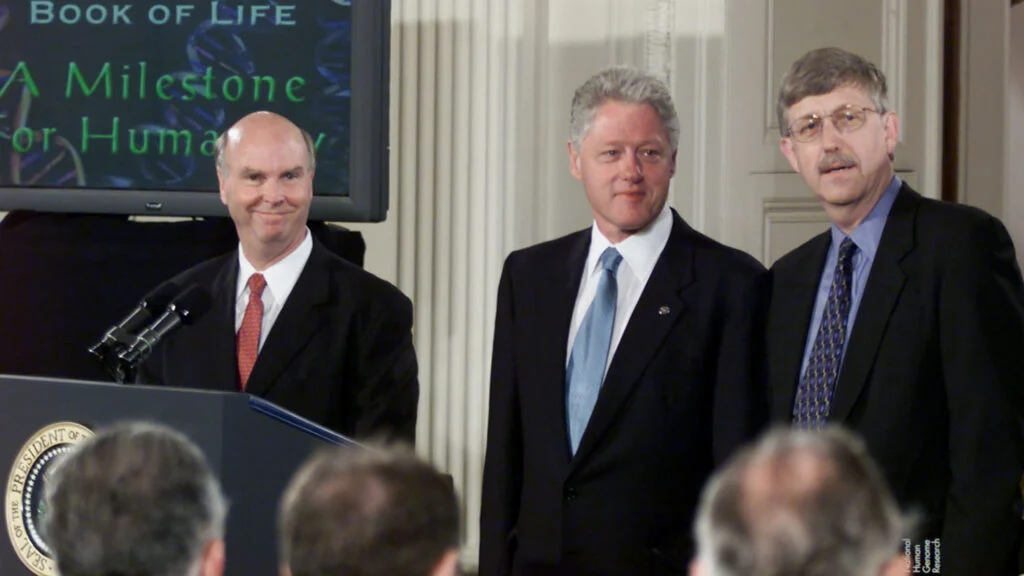
- June 26, 2000: President Bill Clinton hosts a ceremony at the White House, announcing a "draw" between the HGP and Celera.
- April 1, 2025: A date now known in academic circles as the "April Fools’ Day Massacre," marking the catastrophic layoffs and dissolution of key NHGRI archival and communications units.
Supporting Data: The Symbiosis of Public and Private
The standard narrative suggests that Venter’s Celera was a lone wolf, operating in a vacuum of private innovation. Data preserved in the NHGRI archives reveals a different reality: Celera was inextricably linked to the publicly funded effort it sought to outpace.
The "whole-genome shotgun" method, while brilliant, produced significant gaps in the sequence. To close these gaps, Celera relied heavily on the very data the HGP was releasing for free. The public consortium provided the essential "scaffolding"—the map upon which Celera’s faster, but less precise, sequencing could be assembled.
This was not a case of two independent firms competing; it was a case of one entity building the road while another drove a faster car along it. The public project, driven by the Bermuda Principles, ensured that knowledge remained a common good. Celera, conversely, aimed to patent portions of the genome, a move that would have restricted medical research for years to come. These were not just different business strategies; they were fundamentally different visions of what scientific knowledge is for.
Diplomatic Engineering: The White House "Draw"
The White House ceremony in 2000 is often remembered as a spontaneous moment of reconciliation. Internal memos, however, suggest that the event was a masterclass in choreographed diplomacy. Every word spoken by the stakeholders was negotiated months in advance.
Crucially, the terminology was carefully curated. The term "cooperation" was embraced, while "collaboration" was strictly avoided. The distinction was vital: "Cooperation" implied that two independent entities had decided to acknowledge each other’s presence for the sake of political optics, whereas "collaboration" suggested a shared effort, which would have required explaining the messy reality of their interdependence to the public.
This messaging campaign was remarkably successful. The media narrative became one of a "fair fight" between a government monolith and a brilliant private innovator, effectively obscuring the fact that the private entity was feeding on the public infrastructure it claimed to be replacing.
Implications for Modern Science Policy
The sanitization of this history has profound consequences today. In the current political climate, there is a growing trend toward stripping the NIH of its funding and authority. Proponents of this shift often point to the Genome Project as evidence that the private sector is more efficient and capable of delivering results than the federal government.
This argument is fundamentally flawed. If we view the success of the Human Genome Project as a triumph of private-sector agility, we ignore the prerequisite: a massive, 13-year public investment that provided the tools, the standards, and the data that made Celera’s work possible in the first place.
As we witness the "unwinding" of institutions like the NHGRI, we are losing more than just personnel; we are losing the institutional memory required to hold these truths. The archival records that documented these negotiations are now at risk of being buried or discarded. Without these records, the myth of the "lone genius" becomes the only version of history that survives, further justifying the dismantling of the very public institutions that enable groundbreaking science.
Conclusion: Completing the Portrait
Craig Venter was, without question, a consequential and brilliant scientist. His drive, his ego, and his innovative spirit undoubtedly accelerated the pace of genomic discovery. But honoring his legacy does not require us to flatten the truth.
A portrait is defined by its frame. When we frame Venter as a solitary figure fighting the "slow-moving bureaucracy," we lose the most important part of the story: that his achievement was made possible by the principled, collaborative, and taxpayer-funded work of thousands of scientists who believed that human biology should not be behind a paywall.
As we move forward into an era where federal science is under direct assault, we must reclaim this history. The story of the genome isn’t just about how fast we can run; it’s about what we are running toward, and who is allowed to share in the results. If we forget that the public sector built the road, we may soon find ourselves with no path forward at all.