For years, Dr. Gabrielle Fundaro was the gold standard of nutritional discipline. With a PhD in Human Nutrition, a successful career as a high-level nutrition coach, and the physical fortitude of a competitive powerlifter, she lived by the data. Every gram of protein, every carbohydrate, and every fat molecule was meticulously logged into an app.
Yet, beneath the veneer of the "perfectly fueled" athlete, a quiet crisis was brewing. Despite her deep academic expertise, Dr. Fundaro felt an increasing sense of alienation from her own body. The very system she used to maintain her physique had become a psychological tether, leaving her unable to enjoy a simple meal without first consulting a digital ledger.
Today, Dr. Fundaro is leading a paradigm shift in how we approach nourishment. By adapting the Rate of Perceived Exertion (RPE) scale—a staple in strength training—to the dinner table, she is providing a blueprint for thousands to reclaim their intuition, abandon the rigidity of macro-tracking, and find peace in the act of eating.
The Chronology of a Nutritional Burnout
The journey away from data-driven eating did not happen overnight. For over a decade, Dr. Fundaro utilized macro-counting as a primary coaching tool. It was effective, logical, and empirically sound—until the human element intervened.
The Stagnation of Rigidity
As a powerlifter, Dr. Fundaro spent years training under the premise that if you track the input, you control the output. However, she eventually found herself trapped in a cycle of "analysis paralysis." Dining out became an exercise in stress rather than enjoyment; picking a meal off a menu required mental gymnastics to guess the caloric load.
The Realization
The turning point came when Dr. Fundaro realized that her reliance on external metrics was eroding her ability to interpret internal signals. She was trapped in a cycle of fear: If I stop tracking, will I lose my muscle? Will I gain body fat? Am I still an expert if I don’t know my exact daily protein intake?
The "Aha!" Moment
While training in the gym, Dr. Fundaro began utilizing RPE—a subjective scale where an athlete gauges the intensity of a set based on how much "left in the tank" they have. She noticed that she was getting stronger and recovering faster by listening to her body’s daily feedback rather than forcing a rigid weight on the bar. It was the catalyst for a radical question: If I can trust my body to tell me how much to lift, why can’t I trust it to tell me how much to eat?
The Science of RPE-Eating: A New Framework
The RPE-Eating scale is not about "eating by feelings" in a dismissive sense; it is a structured exercise in interoceptive awareness. Interoception is the nervous system’s ability to sense the internal state of the body, such as hunger, fullness, and thirst.
The Scale Defined
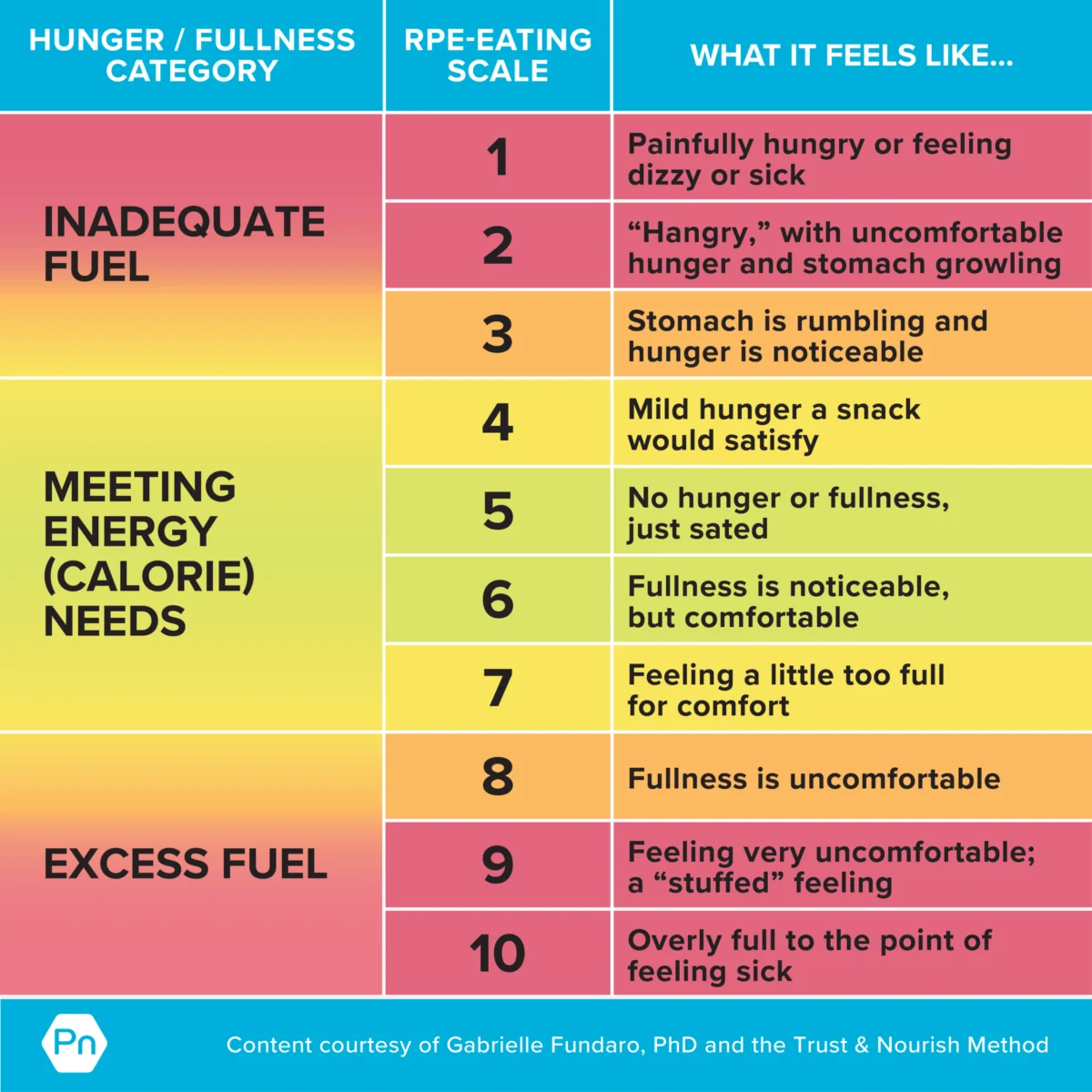
Dr. Fundaro’s adapted scale utilizes a 1–10 range to categorize biological states:
- 1–3 (Inadequate Fuel): Ranging from "painfully hungry" to "hangry" and uncomfortable.
- 4–7 (Adequate Fuel): The sweet spot. This ranges from "mild hunger satisfied" to "noticeable but comfortable fullness."
- 8–10 (Excess Fuel): Ranging from "a little too full" to "physically sick/stuffed."
Moving Beyond Calories
While calorie counting focuses on the quantity of energy, RPE-Eating focuses on the quality of the experience and the body’s current physiological requirement. By learning to check in with oneself before, during, and after a meal, an individual moves from being a "calculator" to being a "communicator" with their own biology.
Supporting Data and Psychological Implications
The implications of this shift are profound, particularly for those with a history of disordered eating or chronic yo-yo dieting.
The "Safety Net" of Subjectivity
Critics often argue that removing tracking leads to weight gain. However, Dr. Fundaro points out that traditional tracking often creates a "pendulum effect." People restrict calories to hit a target, which eventually leads to a psychological and physical crash—resulting in bingeing. RPE-Eating removes the binary "pass/fail" nature of a diet, which in turn reduces the emotional volatility that triggers bingeing.

Interoceptive Awareness vs. External Metrics
Research suggests that individuals who rely heavily on external apps to dictate their hunger cues often lose the ability to identify true physical hunger. By practicing "Notice and Name"—a technique where one identifies the emotional state (stress, boredom, anxiety) before eating—the individual begins to differentiate between hunger (a biological need for energy) and appetite (the emotional or sensory desire for food).
Practical Application: A Guide for the Skeptic
For those accustomed to the precision of a food scale, the transition to RPE-Eating requires practice. Dr. Fundaro outlines a four-step process for implementation:
- Define Your Goal: Determine if you are seeking a weight-neutral relationship with food or intentional weight change.
- The Pre-Meal Audit: Before eating, identify your hunger on the 1–10 scale.
- Mindful Consumption: Eat without distractions. Check in halfway through to see where you are on the scale.
- The "Download": Once finished, identify the physical sensation of satiety. "Download" that feeling so you can recognize it again later.
Addressing Non-Hunger Triggers
A core component of this method is the acknowledgement that we are not robots. Life is stressful. When a "non-hunger trigger"—such as a stressful email or a bad day—drives the desire to eat, the RPE method encourages an investigation of the trigger rather than a moral judgment of the behavior.
Implications for Coaches and Athletes
The shift toward RPE-Eating has significant implications for the coaching industry.
The "Off-Ramp" Model
Dr. Fundaro advocates for using RPE-Eating as an "off-ramp." Just as a novice lifter needs a program to learn movement patterns, a client may need macro-tracking to learn about portion sizes and macronutrient density. However, the ultimate goal of a good coach should be to help the client "graduate" from the tool.
Weight Modification: A Cautious Approach
While Dr. Fundaro remains open to intentional weight change, she treats it with the seriousness of a contact sport.
- For Weight Gain: Individuals generally aim to hover in the 7–8 range.
- For Weight Loss: Individuals aim to maintain a 4–5 range, ensuring they are satisfied but not over-fueled.
Crucially, she warns against using this method for extreme aesthetic goals, such as bodybuilding competitions, where the margins for error are razor-thin. "That would be like using physiotherapy to prepare for a powerlifting competition," she notes. It is simply the wrong tool for that specific, high-stress job.
The Verdict: Autonomy Over Accuracy
Ultimately, the RPE-Eating framework is about the restoration of human autonomy. While a nutrition app provides data, it cannot account for the stress of a deadline, the joy of a family meal, or the fluctuating hormonal signals of the human body.
Dr. Fundaro’s own transition serves as the strongest endorsement for this method. By trading the digital spreadsheet for an internal compass, she has not only maintained her physique but has also regained her ability to sit down at a table and simply eat.
As she tells her clients, "The goal is to know that you are nourishing yourself—and you don’t need a food tracker to do that." In a world obsessed with metrics, finding the freedom to trust one’s own body might be the most "optimal" outcome of all.
Disclaimer: RPE-Eating is a tool for developing self-awareness and is not a substitute for medical intervention. Those with a history of eating disorders or complex metabolic conditions should consult with a healthcare professional or a registered dietitian before altering their nutritional approach.