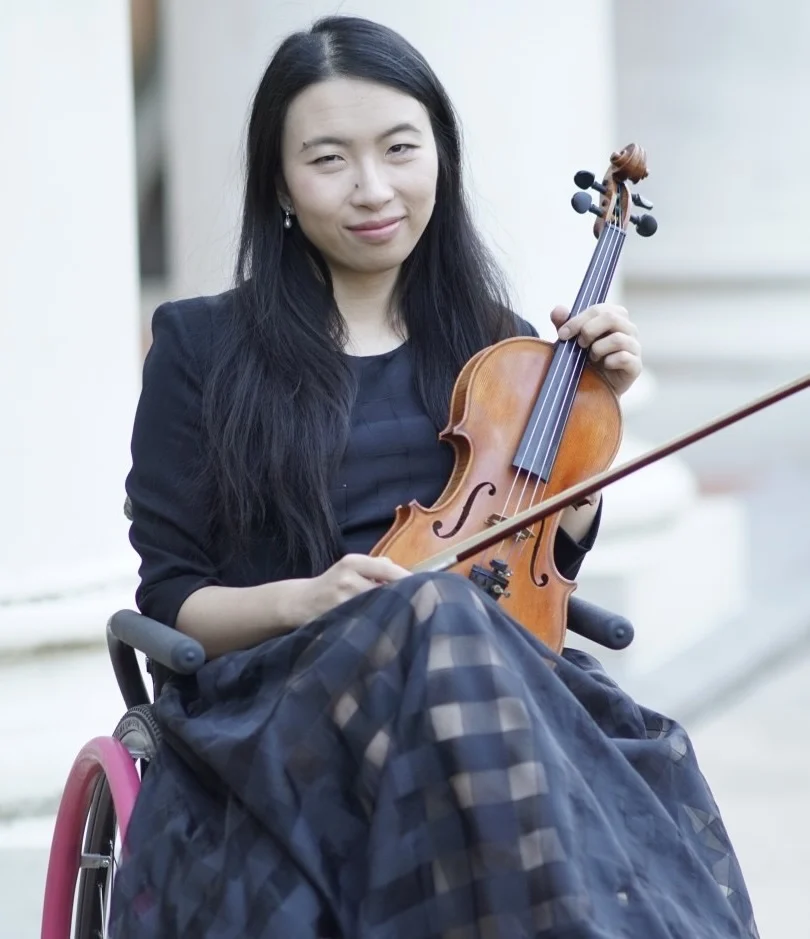
In the world of professional music, the violin is often seen as an extension of the soul—a conduit for expression that requires precise, fluid coordination. For Amy Wang-Hiller, a classically trained violinist, that connection remains as profound as ever, even as the nature of her performance has been irrevocably altered by a series of complex neuro-connective tissue disorders.
Wang-Hiller, who now navigates life with quadriplegia, hypermobile Ehlers-Danlos syndrome (hEDS), and a suite of related conditions, has transitioned from the concert stage to a different kind of performance: the rigorous, often grueling advocacy for patients who, like her, exist in the "blind spots" of modern medicine. As the founder of the InclusiVibe Foundation and host of The Hidden Diagnoses Impact podcast, she is redefining what it means to live with a disability, challenging systemic biases, and proving that the human spirit—and the capacity for artistry—is not defined by physical capacity alone.
A Life Measured in Measures: The Early Years
Born in China, Amy Wang-Hiller’s relationship with the violin began at the tender age of three and a half. It was not a choice made out of early-childhood ambition, but rather a practical endeavor suggested by her parents.
"At first, it really wasn’t my choice," Wang-Hiller recalls. "Violin was practical because it was something my parents could carry around easily."
The transformation from a reluctant student to a dedicated artist occurred in the quiet, observant moments of childhood recitals. Watching older, more experienced students command the stage sparked a fire in her. "I remember thinking, ‘Oh my God, they’re so good.’ I wanted to play like them."
This early discipline fostered a deep-seated commitment. Even during bouts of childhood illness, marked by high fevers and physical discomfort, the violin remained her constant. The habit of practice became a ritual, a bridge between her current abilities and the professional standard she sought to achieve. This foundation would prove vital, not just for her musical career, but for the resilience she would later require to navigate an increasingly fragmented health landscape.
Chronology of a Diagnostic Odyssey
The narrative of Wang-Hiller’s health is not one of a single traumatic event, but rather a slow, cascading accumulation of symptoms that were long dismissed by the medical establishment.
- Childhood (The Silent Years): Frequent bouts of tonsillitis, chronic fevers, vision disturbances, and unexplained jaw and stomach pain plagued her early years. These symptoms were treated in isolation, with no clinician looking for the connective tissue thread that tied them together.
- 2012–2015 (The Turning Points): Following a move to the United States, Wang-Hiller was involved in a car accident in 2012, followed by a significant fall in 2015. These events served as the catalysts for a sharp decline in her stability. She began experiencing vertigo, balance deficits, and difficulty eating—symptoms she could only describe as "weird," as they fell outside the vocabulary of traditional clinical diagnostics.
- 2020 (The Acceleration): A severe neck hyperextension injury shattered the fragile equilibrium of her body. Within two years, the progression was rapid and alarming: severe POTS (Postural Orthostatic Tachycardia Syndrome), dystonia, fainting, and temporary paralysis.
- 2022–Present (Diagnosis and Disability): As specialists finally began to connect the dots, a series of complex, systemic diagnoses emerged: hypermobile Ehlers-Danlos syndrome, occult tethered cord, and craniocervical instability (CCI). These findings revealed a severe upper cervical ligament injury, effectively explaining the neurological collapse she had been enduring.
Understanding the Spectrum of Paralysis
A recurring theme in Wang-Hiller’s advocacy is the public—and clinical—misconception of quadriplegia. While the term is frequently associated with total immobility, the reality is a nuanced spectrum.
Wang-Hiller is classified as having AIS B (sensory incomplete) quadriplegia. "When people hear the word quadriplegia, they often imagine someone who cannot move or feel anything at all," she explains. "In practical terms, I have some sensation and very limited movement, but not enough for independent function."
She uses the metaphor of being "encased in cement" to describe her lived experience. The brain sends the signal to move, but the damaged segments of the spinal cord act as a firewall, blocking the message from reaching the limbs. This creates a dangerous paradox: because she can exhibit small, controlled movements, onlookers—and sometimes medical professionals—frequently underestimate the severity of her condition, assuming she has more functional capacity than she actually possesses.
The Cost of Misdiagnosis: Psychological Labeling
Perhaps the most damaging aspect of Wang-Hiller’s journey has been the repeated misattribution of her physical symptoms to psychological or functional causes. The "functional" label, often used in neurology when no structural cause is immediately apparent, became a weaponized diagnosis that delayed life-saving intervention.
In 2022, her relationship with a neurologist reached a breaking point when she was referred to a Functional Neurological Disorder (FND) clinic. Her ability to play the violin was cited as "evidence" of inconsistency, despite her objectively declining physical health.
"The psychological and functional labels didn’t just affect my medical care; they changed the way I saw myself," Wang-Hiller reflects. "Years of gaslighting and psychiatric misattributions made me question my own symptoms. That’s one of the greatest harms of misdiagnosis."
The systemic nature of this issue is compounded by the medical record itself. Once a patient is labeled with a "functional" diagnosis, that tag often follows them into every future consultation, biasing new doctors before they have even conducted a physical examination. For Wang-Hiller, it took the objective reality of needing a ventilator to finally shift the medical perspective from "functional" to "structural."
Cultural Disparities in Rare Disease
Wang-Hiller is a vocal proponent for greater diversity in how connective tissue disorders are researched and discussed. As a Chinese-born patient, she has observed that clinical presentation, and the medical community’s interpretation of that presentation, can be heavily influenced by ethnic and cultural bias.
"When people only encounter one picture of EDS, patients from different ethnic backgrounds tend to be overlooked or diagnosed much later," she notes. Her advocacy aims to challenge these outdated assumptions, ensuring that the "face" of EDS represents the global population, not just a narrow demographic. By sharing her own story, she hopes to encourage other Asian patients—and those from all marginalized backgrounds—to speak out, ensuring their unique clinical manifestations are documented and understood.
The Birth of the InclusiVibe Foundation
The culmination of Wang-Hiller’s experience—both the trauma of her medical journey and her enduring love for music—is the InclusiVibe Foundation. Recognizing that her struggles with fragmented, siloed care were shared by thousands of other patients, she set out to build a bridge between the patient experience and the clinical/research world.
InclusiVibe functions as a community-led nexus. It does not focus on a single diagnosis; instead, it addresses the common denominator: the systemic failure to care for patients with complex, multi-systemic neuro-connective conditions. Through storytelling, artistic expression, and advocacy, the foundation aims to force a paradigm shift in how healthcare systems handle chronic, invisible, and complex disability.
Implications: Fortune and Misfortune
Looking toward the future, Wang-Hiller remains a pragmatist about the nature of suffering. Her adherence to the Chinese philosophy that "fortune and misfortune are interdependent" provides a framework for her life that is neither toxic positivity nor defeatism.
"It doesn’t mean suffering is good or that everything happens for a reason," she says. "It means we often can’t see the whole story while we’re living it."
Her journey has been one of immense loss—of her physical independence, of her previous life as a performer—but it has also yielded a new, vital purpose. She has become a voice for the voiceless, an educator for the next generation of musicians, and a beacon for those lost in the maze of medical bureaucracy.
For those currently in the "middle of a difficult chapter," her message is one of radical patience. Healing is not always synonymous with a return to the pre-illness state; sometimes, it is the quiet, persistent act of finding meaning, connection, and joy in a life that looks radically different from the one originally planned.
Amy Wang-Hiller’s work serves as a reminder that advocacy is not just about changing policies; it is about changing the culture of care. Whether through the strings of a violin or the reach of her foundation, she continues to perform—not for an audience of critics, but for a community in desperate need of being heard.