By Karina Sturm | January 2026
Netflix’s latest Harlan Coben adaptation, Run Away, is being heralded as a high-stakes, pulse-pounding thriller. The narrative follows Simon Greene, a father unraveling the dark, dangerous mysteries surrounding his daughter, Paige. Yet, for thousands of viewers within the disability community, the most profound revelation in the series isn’t a plot twist or a cliffhanger—it is the quiet, matter-of-fact inclusion of a character who challenges the binary understanding of mobility.
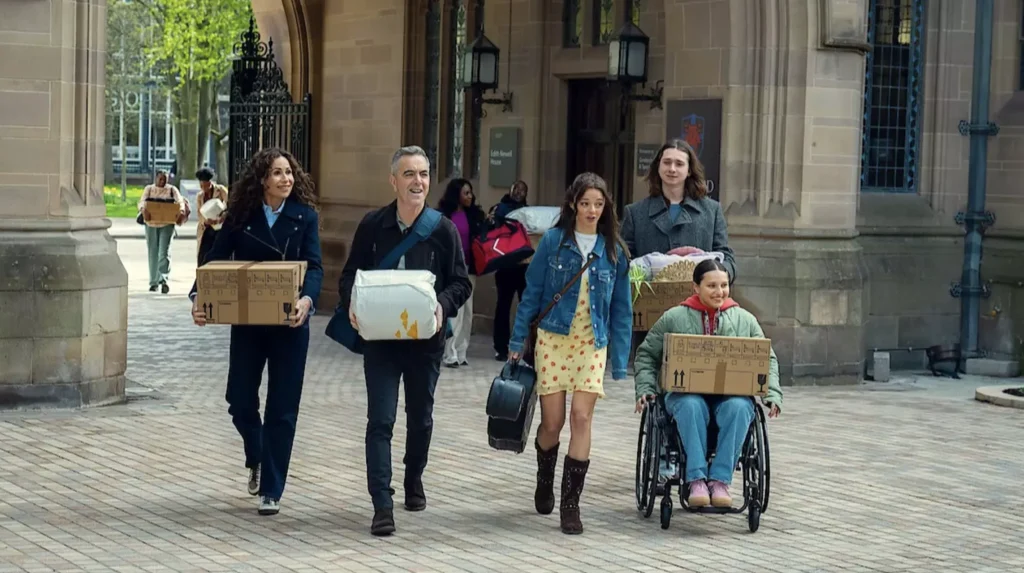
Anya Greene, the youngest daughter of the family, is played by Ellie Henry. Throughout the series, Anya is seen using a wheelchair in some scenes, while walking or standing unaided in others. In a medium that often demands medical justification for any deviation from the "standard" human experience, Run Away makes a radical choice: it offers no explanation. This creative decision has sparked a firestorm of online discourse, inadvertently exposing the deep-seated misconceptions the public holds regarding ambulatory wheelchair users and the nature of dynamic disabilities.
The Anatomy of a Misunderstanding: Why Ambulatory Users Confuse Audiences
The public reaction to Anya’s fluctuating mobility has been a masterclass in the necessity of better representation. When the show premiered, social media forums and comment sections were flooded with confusion. Viewers questioned whether the production team had committed a "continuity error," failing to keep track of when a character should or should not be using their mobility aid.
This reaction is painfully familiar to those living with Ehlers-Danlos syndrome (EDS), POTS, Multiple Sclerosis, and a host of other conditions that are dynamic in nature. In the public imagination, disability is often tethered to a rigid, binary archetype: the "wheelchair user" is a person who is paralyzed and cannot move their legs at all. Anything outside of this narrow box is met with suspicion.
When an ambulatory wheelchair user stands up to reach an item on a high shelf or steps out of their chair to navigate a tight space, they are frequently met with accusations of "faking" or being "cured." This societal friction is why the representation in Run Away is so vital. By refusing to provide a "medical explanation" for Anya’s mobility, the show forces the audience to confront their own biases. The fact that the audience views her use of a chair as a "mistake" rather than a reality of her lived experience highlights just how invisible the spectrum of disability remains in mainstream media.
Chronology of an Authentic Casting Choice
The success of Anya’s portrayal is not merely a win for scriptwriting; it is a testament to the importance of authentic casting. The story behind the role began like many others, but took an unexpected turn that shifted the production’s trajectory.
Initially, the character of Anya was not written as a disabled person. However, during the casting process, the production team identified Ellie Henry as the best fit for the role. Henry, who lives with Ehlers-Danlos syndrome (EDS) and is an ambulatory wheelchair user in real life, brought her own lived experience to the audition room.
Rather than forcing Henry to hide her disability or confining her to a role that required her to suppress her mobility needs, the production team made a groundbreaking decision: they adjusted the character to match the actor. This is a rare, systemic reversal of the industry standard. Traditionally, the entertainment industry operates on a model of exclusion: disabled actors are often only considered for roles explicitly written around their disability, or they are ignored entirely. By allowing a character who was not originally written as disabled to embody the realities of a disabled actor, Run Away proved that disability does not need to be a "plot point" to be present.
Supporting Data: The Reality of Dynamic Disabilities
To understand why this representation matters, one must first understand the reality of dynamic disabilities. According to health organizations and advocacy groups, many chronic illnesses and genetic conditions fluctuate in severity on a daily, or even hourly, basis.
For many living with EDS—a group of connective tissue disorders—the body’s ability to function is often dependent on factors like energy levels, pain thresholds, autonomic nervous system stability, and inflammation. A patient might wake up on a "good day" capable of walking short distances with the support of orthotics, while a "flare-up" might render them unable to bear weight without the significant stability provided by a wheelchair.
- Prevalence: It is estimated that a significant portion of the millions of people who use wheelchairs worldwide are ambulatory.
- The "Invisible" Tax: These individuals often face a "social tax" where they must constantly prove their need for assistance, facing harassment in parking lots or skepticism from peers if they do not appear "disabled enough" at all times.
- Media Erasure: A 2023 study on representation found that less than 2% of television characters have a disability, and of those, only a fraction are portrayed by actors who actually live with those disabilities, let alone those with dynamic, non-apparent conditions.
By presenting a character whose mobility aid is merely a tool rather than a medical mystery, Run Away aligns with the actual, lived experience of millions, providing a mirror that the media has long refused to hold up.
Official Responses and Creative Intent
Ellie Henry has been vocal about her role, noting in interviews with RadioTimes.com that she anticipated the online confusion. Recognizing that the audience might not understand the nuances of ambulatory wheelchair use, she raised the issue with the production team during the early stages of filming.
Together, they reached a deliberate conclusion: they would not provide a dialogue-heavy explanation for her chair. Henry advocated for the choice to treat her disability as a "natural fact." In the world of the show, Anya is a fully realized human being—a daughter, a sister, and a person with a complex life. Her disability is a part of her, but it is not the only thing about her.
This is a significant departure from the "Inspiration Porn" or "Tragedy Narrative" tropes that often plague disabled characters. Typically, if a character is disabled on screen, the story must revolve around the "overcoming" of that disability, or the narrative must stop for a medical lecture to explain the condition to the non-disabled viewer. Run Away avoids this trap, choosing instead to normalize the presence of a mobility aid as a standard piece of a person’s daily existence.
Implications for the Future of Representation
The impact of this choice extends far beyond the screen. For the EDS community, seeing a major production on a platform as large as Netflix validate the existence of ambulatory wheelchair use is a powerful, if small, victory.
However, it is crucial to remain objective about what this does and does not solve. Anya is not the lead character; her narrative arc is secondary to the central mystery of the show. She is a supporting player in a much larger story. While this might be seen by some as a limitation, for many viewers, it is exactly the kind of representation they have been craving.
Representation does not always have to be the "issue-of-the-week" story. Sometimes, the most radical thing a show can do is simply exist with a disabled person at the table who isn’t there to teach the audience a lesson about how to be a "better person."
A Call for Continued Change
The backlash from the public regarding the "continuity error" is not a failure of the show; it is a failure of the culture. It highlights a massive "representation gap" in our collective consciousness. When we stop viewing the use of a wheelchair as a sign of permanent, total immobility, we begin to see the vast, diverse reality of the human experience.
By leaving the ambulatory nature of the character unexplained, Run Away has done more to raise awareness than a ten-minute monologue ever could. It has sparked a conversation. It has forced the public to look at their own misconceptions. And most importantly, it has provided a blueprint for future productions: hire disabled talent, trust their lived experience, and allow characters to exist in their own truth without needing to perform their disability for the comfort of a non-disabled audience.
In the end, Run Away teaches us that the only real "continuity error" is the one we hold in our minds—the belief that disability is a static, one-dimensional experience. As we move forward, the hope is that this is not an anomaly, but the beginning of a shift toward a more nuanced, inclusive, and accurate portrayal of the human body in all its complexity.