









For decades, the medical community’s primary battle against cancer has been reactive—detecting a tumor, staging its progression, and deploying aggressive therapies to eradicate it. However, a seismic shift is underway in oncology. For the first time, the Cancer Research Institute (CRI) has designated "primary and secondary cancer prevention and interception" as the core theme for its prestigious CLIP (Clinical Laboratory Integration Program) applications. This initiative signals a strategic pivot: seeking multi-investigator teams to bridge the gap between basic mechanistic discovery and clinical application, effectively turning the immune system into a preemptive shield against the disease.
The Paradigm Shift: Redefining Cancer as a Process, Not an Event
Cancer does not emerge in a vacuum; it is the culmination of a long, often silent, biological evolution. Long before a tumor becomes visible on a PET scan or MRI, cells undergo a cascade of genetic mutations, altering the microenvironment of the surrounding tissue. For instance, pancreatic cancer can take over a decade to develop from its earliest genetic precursors.
For most of the history of oncology, this "pre-diagnostic" window was a dark space—difficult to visualize and even harder to treat. Today, that is changing. Advances in genomic sequencing, early detection technologies, immune monitoring, and precancer mapping are pulling this window into the light.
Much like the management of heart disease—where physicians monitor cholesterol and blood pressure for years to prevent a myocardial infarction—oncologists are beginning to view cancer through a lens of risk management. By identifying biological precursors, doctors may soon be able to intervene long before a malignancy becomes invasive, potentially sparing patients the morbidity of advanced disease.
The Three Windows of Intervention
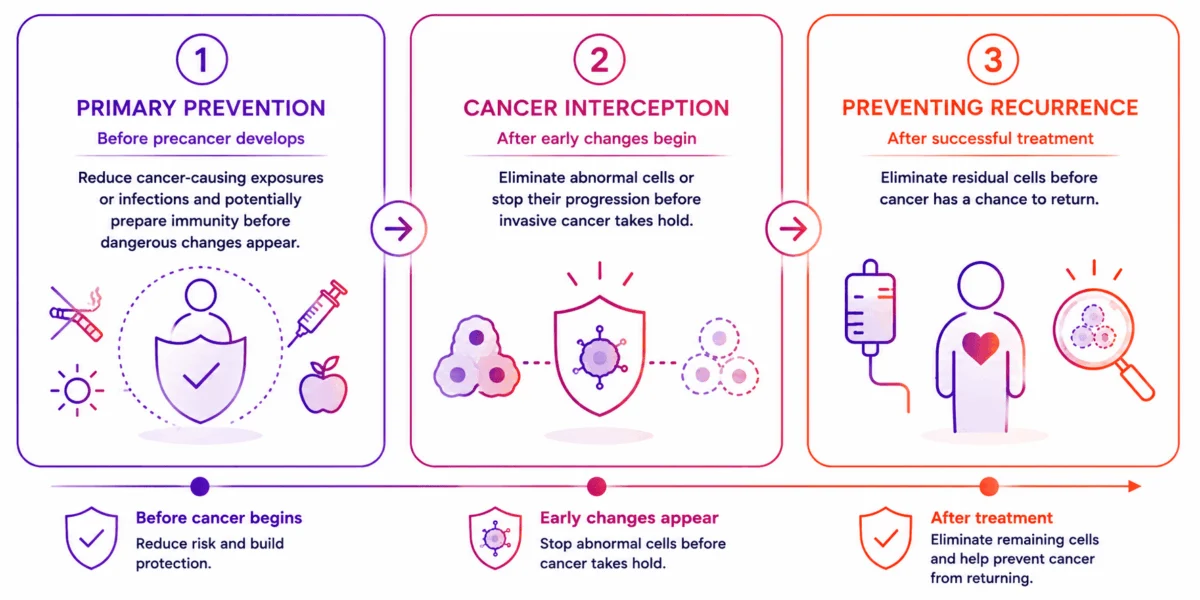
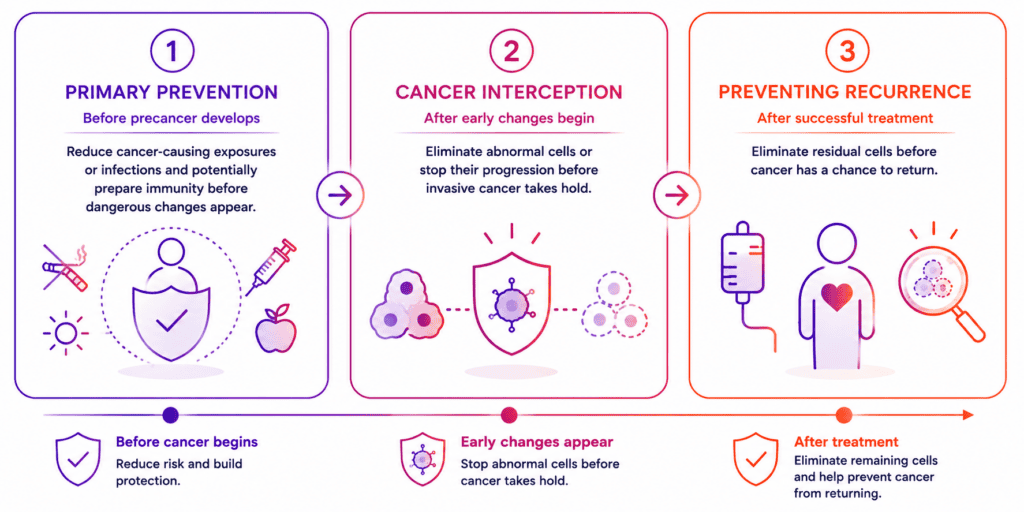
To structure this new era of clinical research, experts have identified three distinct "windows" of opportunity where immune-based interventions could alter the course of the disease:

- Primary Prevention: This is the preemptive strike. It occurs before precancerous changes manifest, focusing on reducing carcinogen exposure or priming the immune system to recognize and neutralize potential threats before they take hold.
- Cancer Interception: This occurs after initial dangerous genetic changes appear but before the disease reaches an invasive stage. The goal here is to eradicate these rogue cells or halt their progression entirely.
- Preventing Recurrence: This focus targets the "microscopic" disease that remains after initial treatment, aiming to train the immune system to hunt down and eliminate residual cells before they can cause a relapse.
In all three scenarios, the immune system holds a strategic advantage. Because the number of abnormal cells is limited or microscopic, the immune system is less likely to be overwhelmed by the immunosuppressive microenvironment that typically characterizes advanced tumors.
Chronology: From Vaccines to Genomic Interception
The concept of "immune prevention" is not entirely new; it has already been proven successful through the lens of infectious disease.
- 1999: The Cancer Research Institute began supporting the work of Dr. Ian H. Frazer. His pioneering research on virus-like particles eventually laid the technological foundation for Gardasil®, the vaccine that prevents HPV infections—a primary cause of cervical, anal, and throat cancers.
- The Modern Era: Success stories like the HPV vaccine and the hepatitis B vaccine have saved millions of lives, proving that the immune system can be trained to prevent cancer before it starts.
- 2026 Milestone: A significant advancement in the recurrence window arrived in August 2026, when Merck and Moderna announced that a personalized mRNA vaccine, used in conjunction with pembrolizumab, significantly reduced the risk of melanoma returning after surgery in a Phase III trial. This serves as a "proof of concept" that immune-based interventions are effective when the tumor burden is minimal.
Supporting Data and Clinical Signals
The journey toward universal cancer interception is paved with both breakthroughs and difficult lessons.
The MUC1 Vaccine Case Study
A vaccine targeting the MUC1 protein—often altered on precancerous colon growths—showed a nuanced reality. While only 25% of participants developed a robust immune response, those who did showed a 38-percentage-point reduction in recurrence compared to the placebo group. Crucially, the non-responders exhibited high levels of immunosuppressive cells before the vaccine was administered. This data suggests that the "baseline immune state" of the patient is a critical variable that must be addressed before an intervention can be successful.
The Nivolumab Trial
A trial involving nivolumab for high-risk mouth lesions demonstrated that while the drug successfully shrank lesions in one-third of participants, it also caused severe immune-related side effects in one-fifth. This serves as a stark reminder: when treating a patient who has not yet developed cancer, the threshold for safety is significantly higher than in palliative or stage-IV settings.
The Promise of KRAS and Lynch Syndrome
Recent studies on pancreatic cancer and Lynch syndrome have provided reasons for optimism. A vaccine targeting common KRAS mutations (found in 90% of pancreatic cancers) generated a lasting immune response in 90% of high-risk participants. Similarly, a vaccine targeting the 209 shared mutations found in Lynch syndrome patients successfully triggered an immune response in every participant. These trials prove that we have the tools to elicit a targeted immune response; the next phase of research will determine whether these responses can stop the progression of cancer itself.
Official Stance: The CRI’s Strategic Vision
The Cancer Research Institute’s decision to focus its CLIP grants on prevention and interception is a direct response to these clinical signals. According to the institute’s leadership, the primary challenge of the coming decade is not just finding new molecules, but mastering the timing of the immune system.
CRI emphasizes that the current field is hampered by five specific, interconnected challenges:
- Defining the "Pre-Cancer" Signature: Identifying the exact biomarkers that distinguish harmless tissue from dangerous precancer.
- Human-Reflective Modeling: Developing laboratory models that accurately mimic the slow progression of human precancerous cells.
- The Immunosuppressive Barrier: Overcoming the body’s natural tendency to shield early-stage mutations from immune detection.
- Safety and Quality of Life: Ensuring that interventions for healthy or high-risk individuals do not introduce toxicities that outweigh the potential benefits.
- Translational Continuity: Ensuring that mechanistic discoveries in the lab are rapidly transitioned into clinical trials.
Implications for the Future of Oncology
The transition toward cancer interception has profound implications for global health. If successful, it would represent the most significant shift in oncology since the advent of chemotherapy.
Shifting the Economic and Human Burden
By focusing on interception, healthcare systems can move away from the "cut, burn, and poison" paradigm that currently dominates cancer care. Treating precancer is inherently less resource-intensive than treating metastatic disease, which requires long-term hospitalizations, intensive care, and complex surgical interventions.
Precision Prevention
The future of cancer prevention will likely be personalized. Much like the mRNA melanoma vaccine, future interventions will likely be tailored to a patient’s specific genetic risk profile, such as those with hereditary conditions like BRCA mutations or Lynch syndrome.
The Role of Team Science
The CRI’s requirement for "multi-investigator teams" acknowledges that no single laboratory can solve this puzzle. Interception requires a marriage between immunologists, who understand how to prime the immune system; cancer biologists, who understand the mutation pathways of specific cancers; and clinical trialists, who can navigate the ethical and safety hurdles of testing drugs on individuals who are not yet "sick."
As we look toward the next decade, the "window before cancer" stands as the most promising frontier in medicine. While the road ahead is complex, the goal is clear: to stop cancer before it ever takes hold, moving us from an era of fighting for survival to an era of ensuring it.