






ALTADENA, CA — In a landmark move to address the intersecting challenges of digital safety, artificial intelligence, and youth mental health, Active Minds, the nation’s premier nonprofit for youth mental health advocacy, has announced a significant national expansion of its programming. Supported by a $5 million grant from Google.org, Google’s philanthropic arm, the initiative aims to equip 100,000 youth and young adults with the tools necessary to navigate an increasingly complex digital landscape.
The announcement, made on June 12, 2026, marks a pivotal moment in the movement to prioritize mental health within the education system. By targeting 154 high schools across the United States, the program seeks to catalyze a student-led movement that bridges the gap between digital innovation and emotional wellbeing.
Main Facts: A Strategic Investment in the Future of Mental Health
The core of this partnership is a $5 million commitment from Google.org designed to scale Active Minds’ evidence-informed programming. This funding is specifically earmarked for the expansion of digital wellbeing initiatives, with a primary focus on high school students—a demographic increasingly exposed to the pressures of social media, generative AI, and digital connectivity.
The "100,000 by 2028" Goal
The initiative is a cornerstone of Active Minds’ broader strategic plan to mobilize 100,000 youth and young adults by 2028. This goal is not merely a numerical target but a mission to create a "critical mass" of mental health advocates who can influence culture at the local, state, and national levels. The expansion focuses on three pillars:
- Mental Health Literacy: Educating students on identifying signs of distress in themselves and their peers.
- Digital Safety Skills: Navigating the ethical and psychological implications of AI and social algorithms.
- Peer Support Networks: Building robust, localized systems where students support one another, reducing the reliance on overburdened professional clinical systems alone.
Targeting Under-Resourced Communities
A significant portion of the funding will be channeled through the Active Minds Program Fund. This fund is designed to eliminate financial barriers for schools that lack the budget to implement comprehensive mental health programs. The expansion specifically targets:
- Communities of color.
- Rural school districts.
- Under-resourced urban schools.
- Youth-serving community organizations.
By focusing on these areas, Active Minds and Google.org aim to ensure that the "digital divide" does not translate into a "wellness divide."
Chronology: From Local Tragedy to National Action
The timeline of this initiative is rooted in both the rapid evolution of technology and specific local events that highlighted the need for community resilience.
2024–2025: The Rise of AI and Digital Pressures
As generative AI became integrated into the educational fabric, students faced new stressors, from academic integrity concerns to the rise of sophisticated deepfakes and algorithmic isolation. During this period, Active Minds began developing its "Responsible Mental Health Video Creation" and "Being Young in the Age of AI" resources to provide a framework for digital agency.
Late 2025: The Eaton Fire Catalyst
In late 2025, the devastating Eaton Fire swept through parts of California, including the Altadena and Pasadena areas. The fire destroyed homes and displaced families, leaving the local youth population dealing with significant trauma. This environmental disaster served as a stark reminder that digital stressors do not exist in a vacuum; they compound with real-world crises.
June 12, 2026: The National Launch in Altadena
The official launch of the expanded partnership took place in Altadena, chosen specifically for its proximity to the communities impacted by the Eaton Fire. The event was not a traditional press conference but an interactive workshop.
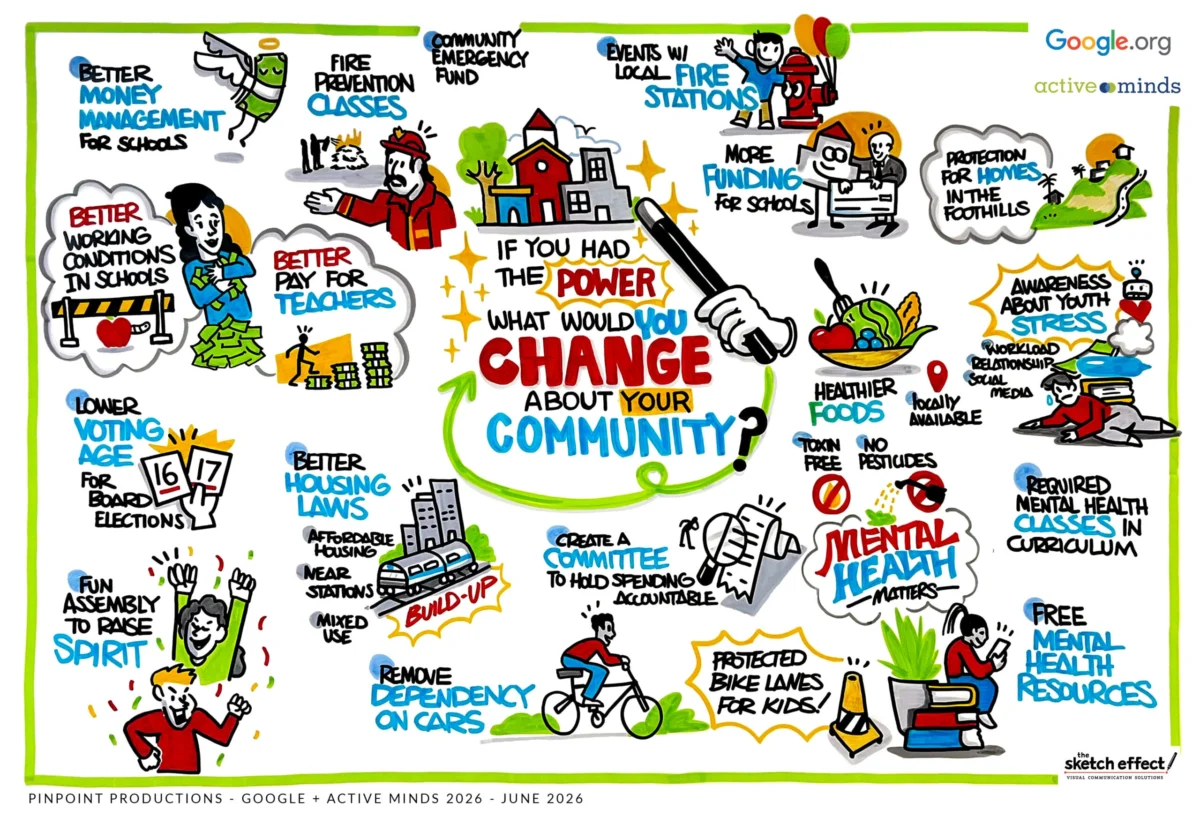
- Morning Session: High school students from the Pasadena Unified School District (PUSD) participated in a "Co-Creation" workshop. They were asked: "If you had the power, what would you change about your community?"
- The Live Mural: As students brainstormed, a local artist translated their ideas—ranging from fire safety and housing to healthier school food and mental health access—into a massive, colorful live mural.
- Afternoon Panel: The mural served as the backdrop for a panel discussion featuring industry leaders, educators, and students. The discussion focused on how to adapt national mental health curricula to meet the specific, localized needs of a community in recovery.
Supporting Data: Quantifying the Impact
The scale of this initiative is supported by data highlighting the urgency of the youth mental health crisis and the effectiveness of peer-led interventions.
The Mental Health Crisis in Numbers
Recent studies indicate that nearly 1 in 3 high school students has experienced poor mental health, with rates significantly higher among marginalized groups. Furthermore, the average teenager spends upwards of seven hours a day on digital platforms, making the digital environment a primary determinant of their psychological state.
Program Reach and Efficacy
The $5 million grant will facilitate:
- 154 High Schools: Direct implementation of Active Minds chapters and programming.
- 100,000 Advocates: The target number of students trained in mental health advocacy by 2028.
- Evidence-Informed Curricula: The program utilizes peer-to-peer models which research shows can be more effective than adult-led interventions in reducing the stigma associated with seeking help.
The Active Minds Program Fund
In its pilot phase, the Program Fund saw a 40% increase in student engagement in schools where financial barriers were removed. With the Google.org injection, the fund is expected to support hundreds of new "mental health experiences"—from assemblies to peer-led workshops—over the next three years.

Official Responses: Voices of Leadership
The partnership has garnered support from the highest levels of advocacy, government, and the tech industry.
Alison Malmon, Founder and Executive Director of Active Minds, emphasized the necessity of meeting students where they are.
"Youth and young adults are navigating an increasingly complex world where mental health, technology, and connection are deeply intertwined. This support from Google.org allows us to significantly expand our work, ensuring that more young people have access to the stories, resources, and peer connections that help them feel seen and supported."
Assemblymember John Harabedian (D-Pasadena) highlighted the intersection of community resilience and digital literacy.
"The youth of Pasadena Unified School District have shown immense resilience in the wake of last year’s devastating Eaton Fire, but we cannot overlook the profound, compounding pressures they face navigating both community recovery and a complex digital world. This empowers them to play an active, vital role in building community resilience. I am proud to see the future leaders of California at the forefront of this movement."
Dr. Megan Jones Bell, Senior Director of Clinical at Google, framed the initiative as a proactive measure for the tech giant.
"At Google, we believe that child safety and digital wellbeing warrant unique, proactive protections. By supporting Active Minds to put youth at the center of this movement, we are championing student-led leadership that shifts the paradigm toward proactive empowerment and long-term resilience."
Implications: A New Paradigm for Digital Safety
The expansion of the Active Minds and Google.org partnership carries profound implications for the future of education, corporate responsibility, and youth advocacy.
Shifting from Protection to Empowerment
Historically, "digital safety" has focused on restrictive measures—blocking websites and limiting screen time. This initiative signals a shift toward empowerment. By teaching youth to "co-create" solutions and advocate for their own wellbeing, the program treats students as stakeholders rather than passive consumers of technology. This is particularly crucial in the age of AI, where the ability to critically evaluate digital content is a fundamental life skill.
The Blueprint for Localized Resilience
The Altadena launch demonstrated that national programs are most effective when they are "localized." By integrating the trauma of the Eaton Fire into the mental health curriculum, Active Minds has created a reproducible blueprint. Other communities—whether facing economic downturns, natural disasters, or social unrest—can use this model to tailor mental health support to their specific stressors.
Corporate Philanthropy as a Catalyst
Google.org’s involvement suggests a growing recognition among tech companies that they have a social responsibility to mitigate the potential negative externalities of their products. By funding independent nonprofits like Active Minds, Google is supporting a "checks and balances" system where youth voices can inform the very policies and products that shape their lives.
Long-Term Societal Benefits
The ultimate implication of equipping 100,000 young advocates is the long-term transformation of societal attitudes toward mental health. As these students enter the workforce and become policymakers, the "mental health literacy" they gained in high school will likely lead to more compassionate workplaces, better-informed public health policies, and a culture that values wellbeing as much as productivity.
As the program rolls out across 154 schools, the eyes of the nation will be on these young leaders. They are no longer just the "future"—they are the active architects of a safer, healthier, and more connected digital world.
For editorial use, high-resolution images of the Altadena launch event, featuring the student-led mural and workshop activities, are available through the Active Minds press office.