











In high-stakes industrial environments, the difference between a successful shift and a catastrophic accident often hinges on a single, intangible factor: human alertness. For decades, industries ranging from aviation and deep-sea mining to healthcare and long-haul transportation have relied on a flawed safety mechanism—the subjective assessment of fatigue. When a worker says they are “fine” or a supervisor makes a visual judgment call, the potential for human error remains dangerously high.
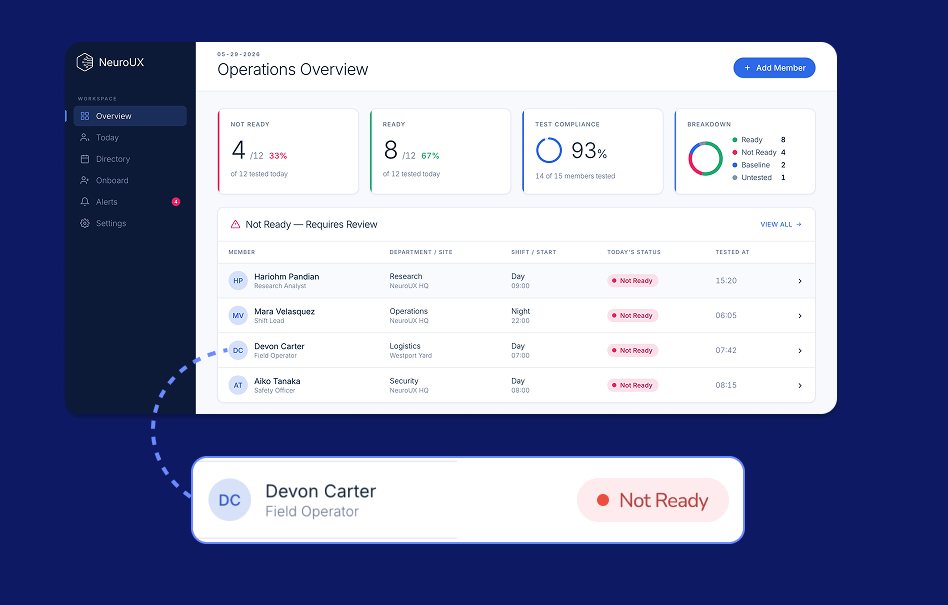
NeuroUX is looking to close this gap. With the recent launch of its Fatigue Monitoring Platform, the company is moving beyond the outdated reliance on self-reporting and "gut feelings." By deploying a mobile-first solution that benchmarks cognitive performance against an individual’s personal baseline, NeuroUX is providing safety-critical teams with an objective, data-driven "fit-for-duty" signal.
The High Cost of Human Error: A History of Fatigue-Related Disasters
The Occupational Safety and Health Administration (OSHA) has long identified worker fatigue as a silent killer in industrial settings. When alertness wanes due to sleep deprivation or circadian misalignment, the consequences are rarely minor.
The historical record serves as a somber testament to the danger of ignoring fatigue. In 2005, the BP oil refinery explosion in Texas City—a tragedy that claimed 15 lives and injured over 180 people—was later linked to the fatigue of workers operating on extended shifts. Similarly, the 2009 crash of Colgan Air Flight 3407 in New York, which resulted in 50 fatalities, was exacerbated by pilot fatigue.
These incidents are not anomalies; they are patterns. From the catastrophic failure of the Space Shuttle Challenger to the nuclear meltdowns at Chernobyl and Three Mile Island, fatigue-induced cognitive impairment has been a recurring factor. Despite these lessons, the primary method for gauging readiness remains antiquated. Most organizations continue to rely on manual check-ins, employee honesty, or supervisor observation—all of which are prone to bias, masking, and the natural human tendency to overestimate one’s own performance.
The Science of Readiness: Leveraging the Psychomotor Vigilance Test
At the core of the NeuroUX platform is the Psychomotor Vigilance Test (PVT). While the name may sound clinical, the concept is rooted in decades of peer-reviewed sleep research, where it is universally recognized as the gold standard for measuring behavioral alertness.
The PVT is uniquely effective because it measures reaction time and the ability to sustain attention—two faculties that deteriorate rapidly under the pressure of sleep loss or circadian disruption. Unlike other tests that might be impacted by a participant’s prior knowledge or "learning effects," the PVT is resistant to practice. This makes it an ideal tool for repeated, daily usage in operational environments.
NeuroUX has digitized this gold standard, transforming a laboratory instrument into a mobile-first tool. By delivering the PVT through a smartphone or tablet interface, the platform allows workers to complete a brief alertness check in a matter of minutes before stepping onto a job site, climbing into a cockpit, or entering an operating theater.
Personalization Over Standardization
One of the most significant innovations in the NeuroUX platform is the shift from generic thresholds to individualized baselines. Traditional fatigue management programs often use a "one-size-fits-all" metric—a standard reaction time threshold that every employee must meet. However, human biology is not uniform; what constitutes a "normal" reaction time for one worker may be abnormal for another.
NeuroUX acknowledges this biological individuality. The platform continuously monitors and builds a "personal baseline" for every worker. By comparing current test results against the worker’s own historical data, the system identifies deviations that indicate impairment. This ensures that the platform is sensitive enough to catch genuine fatigue while reducing the "false alarms" that occur when forcing diverse workforces to meet a single, static benchmark.
Official Perspectives: Why Measurement Matters
"Our goal is to minimize fatigue-related incidents by giving companies a data-driven way to assess whether workers are alert, ready, and able to perform safety-sensitive tasks," says Anunay Raj, co-founder of NeuroUX.
According to Raj, the cultural shift toward objective measurement is the next frontier of industrial safety. "Fatigue affects even the most experienced workers," Raj notes. "It is not a reflection of work ethic or professional dedication; it is a physiological reality. When companies can measure it, they can manage it. Once you have the data, you can optimize shift scheduling, implement restorative breaks, and ensure that the right people are in the right roles at the right time."
The platform’s integration into existing workflows is designed to be seamless. Once a worker completes their check, the results are processed instantly. If a worker falls outside their personal baseline, supervisors receive an immediate, clear notification via their preferred communication channel. This allows for proactive intervention—such as reassigning a task or mandating a rest break—before a high-risk activity begins.
Real-World Applications and Implications
The utility of NeuroUX’s technology extends well beyond the heavy industrial sector. Its versatility has already been proven in diverse and demanding fields:
- Aviation and Transportation: Flight crews and long-haul drivers face irregular schedules that wreak havoc on circadian rhythms. The platform provides a way to verify alertness prior to takeoff or departure.
- Healthcare: Medical professionals, particularly surgeons and residents working long, erratic shifts, are notoriously susceptible to fatigue. Clinical use with sleep disorder patients has already demonstrated the platform’s efficacy.
- Professional Sports: Elite athletes require peak cognitive performance to compete safely and effectively. NeuroUX has been utilized to track recovery and readiness among professional teams.
- Night Shift Operations: In energy and manufacturing, the "graveyard shift" presents the highest risk of error. Objective monitoring helps bridge the gap during the hours when the human body is naturally programmed to sleep.
Future Implications: The End of "Self-Reporting"
The launch of this platform marks a turning point in occupational health and safety. As labor laws and safety regulations tighten, companies are increasingly looking for ways to protect their assets—both human and mechanical—while minimizing liability.
The transition from subjective, questionnaire-based reporting to objective, biometric-style assessment is significant. It moves the conversation around fatigue away from the realm of "compliance" and into the realm of "performance optimization." It transforms safety from a reactive pursuit—where we analyze why something went wrong—into a proactive process where we ensure that every worker is physically and mentally prepared for the task at hand.
Furthermore, by making the process fast and consistent, NeuroUX lowers the barrier to entry for large-scale adoption. When a safety check takes less time than a cup of coffee, it becomes part of the culture rather than an administrative burden.
Conclusion: A New Standard for Duty
As industries continue to automate and optimize, the human element remains the most unpredictable variable. NeuroUX is providing the tools to stabilize that variable. By moving away from guesswork and toward a data-backed understanding of human alertness, the company is helping industries build a future where fatigue-related disasters are no longer seen as "part of the job," but as preventable events.
In the coming years, as this technology becomes standard across the mining, aviation, and healthcare sectors, the expectation for "fit-for-duty" status will likely rise. The days of relying on an employee’s word are numbered; in their place, a new era of evidence-based safety is emerging. Through the combination of rigorous science and mobile accessibility, NeuroUX is ensuring that when the whistle blows and the work begins, the workforce is truly, objectively ready.