










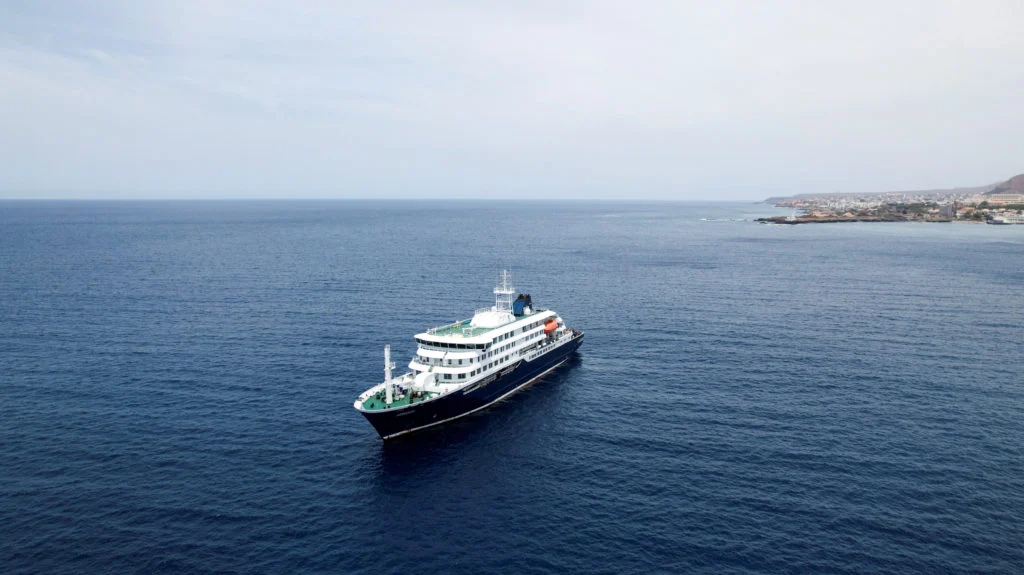
MADRID — Global health authorities are currently locked in a sophisticated, multi-continental containment operation as the Dutch-flagged cruise vessel MV Hondius approaches the Canary Islands. The ship, which has become the epicenter of a rare and lethal hantavirus outbreak, is slated to dock in Tenerife this Sunday under a state of high-security isolation.
With three confirmed fatalities and a growing list of suspected cases scattered across the globe, the situation has prompted a rare, coordinated repatriation effort involving multiple national governments. As the vessel makes its final approach to Spanish waters, public health officials are working feverishly to quell rising anxieties, drawing a firm line between this localized crisis and the broader pandemic fears that have gripped the world in recent years.
Main Facts: The Crisis at Sea
The MV Hondius is currently carrying over 140 passengers and crew members toward the port of Tenerife. The vessel is at the heart of an investigation into an outbreak of the Andes strain of hantavirus. Unlike common respiratory illnesses, hantavirus is primarily transmitted to humans through contact with rodent excreta. However, the specific strain involved in this outbreak has alarmed researchers due to rare, documented instances of human-to-human transmission.
While the World Health Organization (WHO) has maintained that the risk to the general public remains "absolutely low," the logistics of the situation are complex. Virginia Barcones, Spain’s head of emergency services, confirmed that the ship will be greeted by a heavily cordoned-off environment. "They will arrive at a completely isolated, cordoned-off area," Barcones stated. "The people of the Canary Islands… can rest assured that there will be absolutely no possibility of contact at any time."
The operation is designed as a "sterile transit." Passengers will be moved directly from the ship to the airport via guarded, bio-secure vehicles, bypassing the local population entirely before boarding repatriation flights organized by their respective governments.
Chronology of the Outbreak
The timeline of the MV Hondius crisis reveals a series of missed opportunities and the rapid, silent movement of a pathogen across borders.
- Early April: The MV Hondius conducts its routine maritime expeditions in the South Atlantic. During this period, the first passenger succumbs to an undiagnosed illness.
- April 24: Despite the death of a passenger nearly two weeks prior, over two dozen passengers from 12 different nations disembark the ship at various ports without undergoing formal contact tracing or health screenings.
- April 25: A flight from St. Helena to Johannesburg transports several individuals who had recently disembarked the MV Hondius. Simultaneously, a Dutch woman, whose husband had died on the cruise, falls ill on a flight from Johannesburg to Amsterdam. She is removed from the flight in South Africa, where she subsequently passes away.
- May 2: Health authorities officially confirm the presence of hantavirus among the cruise ship population, triggering a global alert.
- May 5 (Present): The vessel enters its final approach to Tenerife as international governments scramble to organize medical evacuations for their citizens.
Supporting Data and Medical Context
The medical community is currently monitoring the situation with extreme caution. The primary concern lies in the nature of the Andes virus. While typical hantaviruses—common in North America—are rarely transmissible between humans, the Andes strain is the only member of the hantavirus family known to possess this capability.
Symptoms and Transmission
Symptoms of hantavirus typically manifest between one and eight weeks after exposure. Early signs often mimic influenza, including fever, muscle aches, and fatigue, which can rapidly progress to severe respiratory distress.
The KLM Flight Incident
One of the most significant points of concern for health officials was a flight attendant who fell ill after working on the flight from Johannesburg to Amsterdam. The potential for the virus to spread in a confined aircraft cabin created a brief period of intense scrutiny. However, Christian Lindmeier, a WHO spokesperson, confirmed on Friday that the flight attendant tested negative for the virus. "This is not a new COVID," Lindmeier emphasized, noting that the negative result should help alleviate global panic.
Official Responses and Repatriation Efforts
The geopolitical response to the MV Hondius has been one of swift, organized action. Recognizing the urgency of the situation, the United States and the United Kingdom have taken the lead in coordinating the extraction of their nationals.
United States and United Kingdom
The U.S. government has committed to sending a dedicated aircraft to the Canary Islands to retrieve its 17 citizens. Similarly, the British government is chartering a private flight to evacuate nearly two dozen U.K. nationals. Both countries have mandated that their citizens undergo rigorous medical screening and mandatory quarantine upon return to their home soil.
The Tristan da Cunha Case
The U.K. Health Security Agency (UKHSA) has identified a third suspected case on Tristan da Cunha, a remote British overseas territory. The individual is currently under medical observation, though their condition remains undisclosed. This development underscores the challenges of contact tracing in isolated corners of the globe, where medical infrastructure is limited.
The Role of Oceanwide Expeditions
The ship’s operator, Oceanwide Expeditions, has maintained that there are currently no individuals on board displaying symptoms of the virus. However, the company has faced criticism regarding the timing of the disembarkations on April 24. Dutch officials are working closely with the operator to establish a full manifest of the individuals who left the ship before the quarantine was initiated.
Implications: A Global Health Lesson
The MV Hondius incident serves as a stark reminder of the vulnerabilities inherent in modern global travel. Even in an era of advanced medical surveillance, the intersection of remote expedition travel and emerging zoonotic diseases presents a logistical nightmare for public health officials.
The Challenge of Contact Tracing
The difficulty of tracking down passengers who dispersed across four continents highlights the limitations of current international health regulations. In the absence of a unified global tracking system, authorities are forced to rely on fragmented flight manifests and hotel records, a process that is as time-consuming as it is vital.
The Psychology of Public Fear
Despite the low risk, the psychological impact of the incident is palpable. In Spain, the visual of a "cordoned-off" port has triggered memories of the 2020 pandemic lockdowns. Experts suggest that this "contagion of fear" is perhaps the most significant hurdle for authorities to overcome. By emphasizing the "sterile" nature of the evacuation, Spanish officials are attempting to distinguish between public health necessity and the disruption of daily life.
Future Protocols
Looking ahead, the MV Hondius incident will likely lead to a re-evaluation of maritime health protocols. Experts suggest that mandatory screening for all passengers—not just those displaying symptoms—before and after expedition cruises may become the new industry standard. Furthermore, the ability to rapidly share genomic data on emerging pathogens across international borders will remain the cornerstone of any future containment efforts.
As Sunday approaches, all eyes turn to the Canary Islands. The success of this evacuation will not only ensure the safety of the passengers but will also serve as a blueprint for how the global community manages the complex intersection of human mobility and biological risk in the 21st century.
While the MV Hondius saga is nearing its conclusion, the broader work of monitoring, testing, and tracing those who disembarked early remains a task of critical importance for health departments from Johannesburg to Amsterdam. For now, the world waits, reassured by the WHO’s assessment, but mindful of the unpredictable nature of the Andes virus.