As we navigate the golden years, the importance of lower-body strength cannot be overstated. For adults over 65, the quadriceps and hamstrings—the primary muscles of the thighs—act as the body’s engine. They are the silent partners in every daily triumph, from rising from a favorite armchair to navigating a flight of stairs or maintaining balance while walking on uneven terrain. Yet, all too often, fitness advice for this demographic defaults to complex, balance-heavy exercises like lunges, which can be intimidating or even unsafe for those just beginning their fitness journey.
According to expert fitness professionals, the key to longevity and mobility is not found in high-intensity, complex maneuvers, but in consistent, manageable resistance training. By focusing on functional movements that mirror real-life activities, older adults can effectively rebuild muscle mass, protect their joints, and maintain independence well into their later years.
The Physiology of Aging: Why Thigh Strength Matters
The process of age-related muscle loss, known clinically as sarcopenia, begins to accelerate after the age of 50. Without active intervention, the quadriceps and hamstrings gradually lose their density and contractile power. This decline is not merely an aesthetic concern; it is a clinical one. Weak thighs directly correlate with an increased risk of falls, a loss of "functional autonomy," and a reduced capacity to recover from minor injuries.
When thigh strength wanes, the burden of movement shifts to the joints—particularly the knees and the lower back. This compensation pattern is the primary driver of chronic joint pain in the elderly. Conversely, strengthening the thigh musculature acts as a "shock absorber," redistributing physical stress and allowing the body to move with grace and stability.
Core Principles of Senior Fitness: Consistency Over Intensity
A common misconception in physical training is that progress requires heavy iron or grueling, high-impact sessions. However, for the demographic over 65, the most effective training programs prioritize controlled tension and functional repetition.
As personal trainer Tyler Read, BSc, CPT, notes, the goal is to reinforce movement patterns used in everyday life. By practicing squats, bridges, and extensions, you are not just exercising; you are training your nervous system to execute daily tasks—like standing up from a sofa—with more efficiency and less effort. The following four exercises represent a comprehensive, low-risk, high-reward approach to lower-body maintenance.
1. Chair Squats: The Foundation of Functional Independence
The chair squat is the gold standard for rebuilding lower-body power. It is safe, accessible, and provides a clear "target" that eliminates the fear of losing one’s balance.
Why It Works
The chair squat engages the quadriceps, glutes, and hamstrings simultaneously. By using the chair, you remove the instability associated with free-standing squats, allowing you to focus entirely on the quality of the movement. Controlling the descent—the "eccentric" phase—is where the real magic happens. By lowering yourself slowly rather than "dropping" onto the seat, you force the muscle fibers to work against gravity, which is the most effective way to stimulate growth and tendon health.
How to Execute
- Positioning: Place a sturdy, non-slip chair against a wall. Stand with your feet hip-width apart, facing away from the chair.
- The Descent: Keep your chest upright and your gaze forward. Slowly hinge at the hips and bend your knees as if you are reaching back to touch the seat.
- The Contact: Lightly tap the seat with your glutes—do not sit fully down or relax your muscles.
- The Ascent: Engage your heels, drive through your mid-foot, and return to a standing position, squeezing your glutes at the top.
- Volume: Aim for 3 sets of 10 repetitions, focusing on a 3-second count on the way down.
2. Low Step-Ups: Simulating Real-World Mobility
Stair climbing is often one of the first activities to become difficult as thigh strength declines. Step-ups are a targeted, isolated way to train the body for this exact movement.
Why It Works
Step-ups force the legs to work independently, which helps correct muscle imbalances where one leg might be stronger than the other. Because the movement is vertical, it improves hip stability and knee control. Starting with a low step minimizes the strain on the patellar tendon, making it a sustainable choice for those with sensitive joints.
How to Execute
- The Setup: Use a low, stable step or a professional-grade exercise platform. Ensure it is placed on a non-slip surface.
- The Movement: Place your entire right foot firmly on the step. Press through your right heel to lift your body up, bringing your left foot to meet the right.
- The Descent: Step back down with control, leading with the left foot.
- Volume: Complete 8–10 repetitions on one leg before switching. Keep your core tight to avoid leaning forward excessively.
3. Seated Leg Extensions: Isolating the Quadriceps
For individuals who may have balance issues or significant knee discomfort, standing exercises can be daunting. Seated leg extensions provide a way to isolate the quadriceps without the need to support your full body weight.
Why It Works
This exercise directly targets the quadriceps (the muscles on the front of the thigh). By extending the leg fully, you engage the vastus medialis, a key muscle that stabilizes the kneecap. It is an excellent "pre-hab" exercise, meaning it prepares the muscles for more strenuous activities like walking or standing squats.
How to Execute
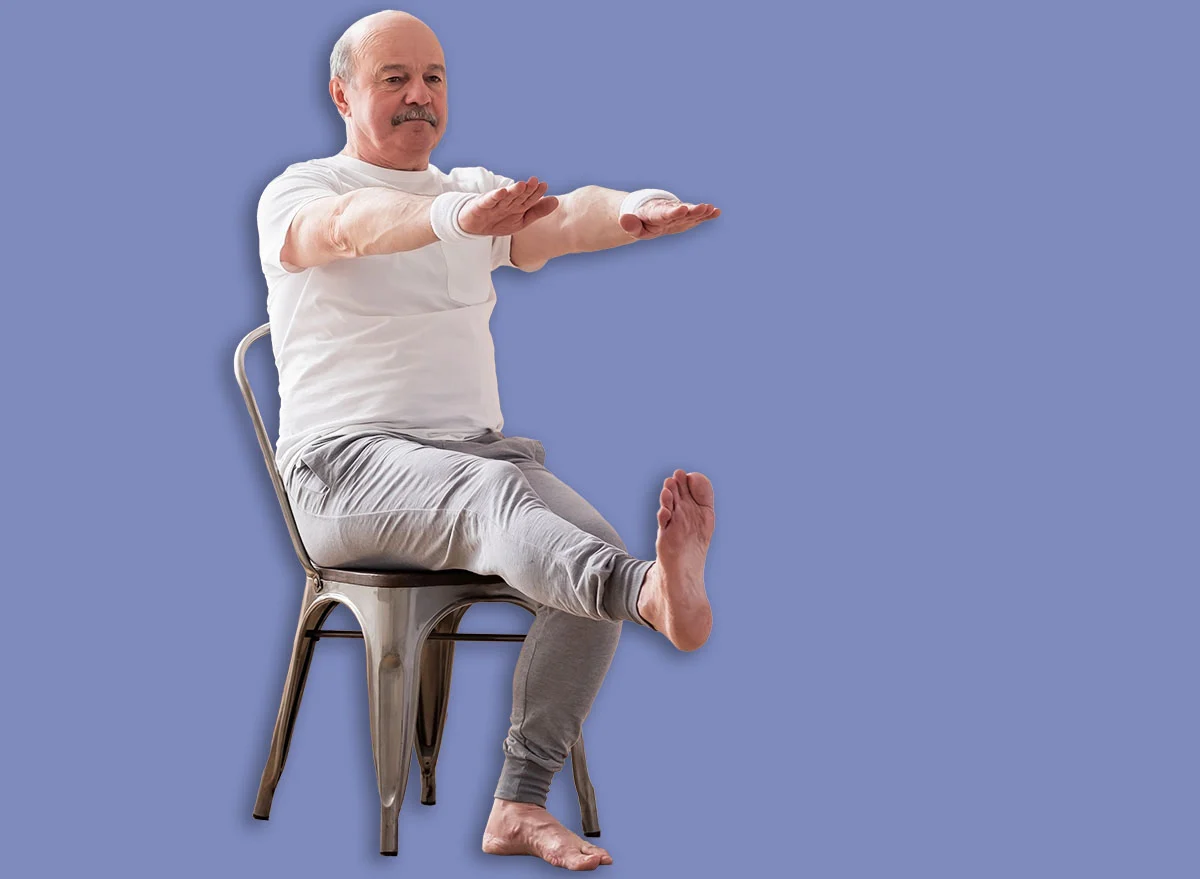
- The Setup: Sit upright in a sturdy chair with your back supported and your feet flat on the floor.
- The Extension: Slowly straighten one leg until it is parallel to the floor. Pause at the top for one second, squeezing the thigh muscle hard.
- The Return: Lower your foot slowly to the starting position. Maintain control throughout the movement—avoid "swinging" your leg.
- Volume: Perform 12–15 repetitions per leg. To increase difficulty, you may add a light ankle weight as you progress.
4. Glute Bridges: Strengthening the Posterior Chain
You cannot have strong thighs without a strong posterior chain. The glute bridge targets the hamstrings and glutes, which serve as the "brakes" and stabilizers for the thigh muscles.
Why It Works
Weak hips often lead to "quad dominance," where the front of the thighs do all the work, leading to fatigue and potential knee pain. By strengthening the glutes, you ensure that the load is distributed correctly across the entire lower body. This creates a balanced, powerful foundation that makes every other movement—from walking to squatting—easier and safer.
How to Execute
- The Setup: Lie on your back on a comfortable mat. Bend your knees and place your feet flat on the floor, hip-width apart.
- The Lift: Engage your core and glutes, and lift your hips toward the ceiling until your body forms a straight line from your shoulders to your knees.
- The Hold: Hold at the top for two seconds, ensuring you are pushing through your heels.
- The Return: Lower your hips slowly back to the floor.
- Volume: Aim for 3 sets of 12–15 repetitions.
Implications: The Path to Long-Term Vitality
The implementation of these exercises is not a temporary fix but a lifestyle strategy. As you incorporate these movements into your weekly routine—ideally 3 to 4 times per week—you will likely notice a significant shift in your daily confidence.
Monitoring Progress
The beauty of these exercises is their measurability. Track your repetitions in a small journal. When you can comfortably perform 15 reps of an exercise with perfect form, it is time to increase the difficulty—either by slowing down the movement (increasing "time under tension") or by adding a modest amount of weight.
Safety First: Official Recommendations
Before beginning any new exercise program, it is essential to consult with a primary care physician or a physical therapist, particularly if you have a history of heart conditions, severe arthritis, or balance disorders.
- Warm-up: Always perform 5 minutes of light movement, such as marching in place or gentle torso twists, before starting your strength exercises.
- Listen to Your Body: A "burning" sensation in the muscles is a sign of progress; sharp, shooting pain in the joints is a sign to stop immediately.
- Hydration and Nutrition: Ensure you are consuming adequate protein, which is the building block for the muscle repair triggered by these exercises.
By committing to these four movements, you are making a proactive investment in your future. You are choosing to maintain your independence, protect your mobility, and continue to engage with the world on your own terms. Strength is not just about the numbers on a scale; it is about the freedom to move through life with stability, grace, and confidence.