Published September 10, 2026
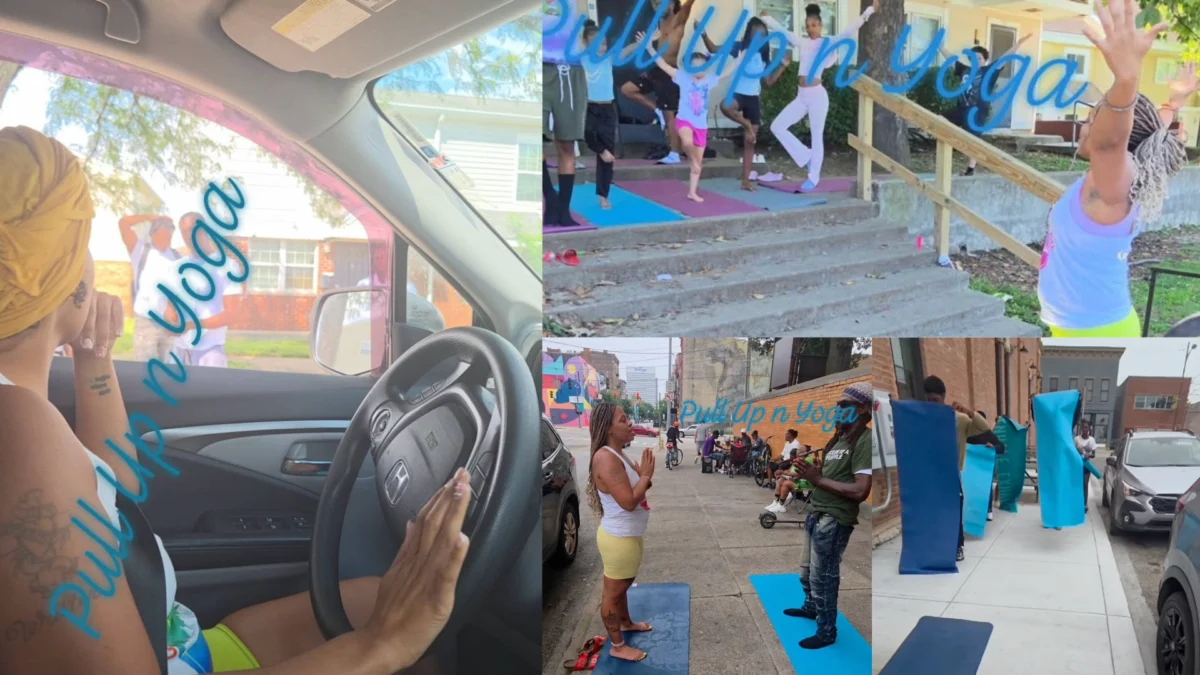
In the bustling streets of Cincinnati, a familiar white SUV rolls slowly past corner stores and quiet apartment complexes. Most passersby don’t look twice at the vehicle until a window rolls down, and a warm, inviting voice calls out: “Peace, y’all. You want to do some yoga real quick?”
For Blu Cauthen, a yoga teacher and community advocate, this is not a marketing pitch or a paid gig. It is a mission of radical accessibility. Her project, “Pull Up n’ Yoga,” has become a grassroots phenomenon, stripping away the high-end studio aesthetic—the expensive memberships, the Sanskrit terminology, and the exclusionary "wellness" tropes—to meet people exactly where they are. Whether it is a sidewalk, a public park, or a front yard, Cauthen is proving that the benefits of mindfulness are not a luxury good, but a human right.
The Core Concept: Taking Yoga to the People
At its heart, Pull Up n’ Yoga is a simple, decentralized experiment in community healing. Cauthen navigates the streets of her hometown, identifying individuals or groups who appear to have a moment to spare. Her approach is disarmingly casual. She doesn’t demand perfection or even physical prowess; she demands only a moment of presence.
The sessions are free, no-strings-attached, and remarkably effective. A typical class lasts anywhere from five to fifteen minutes. It might involve a few foundational stretches, intentional breathwork, or a brief sound bath using a portable gong stored in her truck. Most importantly, it creates a temporary "third space"—a zone of tranquility amidst the urban cacophony.
What makes Cauthen’s work particularly compelling is her ability to read a room. When faced with skepticism, she lowers the barrier to entry. "We’re gonna take three deep breaths together," she might suggest to a group of reluctant teenagers. Even those who claim they aren’t interested find themselves gravitating toward the mats. It is an exercise in human connection, one that Cauthen describes as "infectious."
A Journey Toward Purpose: The Chronology of a Movement
To understand the genesis of Pull Up n’ Yoga, one must look at Cauthen’s own path to wellness. Her introduction to yoga came not from a studio, but from a place of necessity. While training to be a firefighter and balancing the rigors of paramedic school, motherhood, and full-time work, Cauthen found herself at a breaking point.
Seeking an anchor in the chaos, she turned to YouTube, learning the basics of yoga and breathwork on her own terms. It was a private practice that eventually led her to pursue professional teacher training. However, the experience of formal training was jarring. During her graduation ceremony, she observed her family’s visible discomfort in a space where they were the only Black participants.
This moment was a turning point. Cauthen realized that while the physical and mental benefits of yoga were transformative, the culture of the industry was alienating to her community.
- 2019: Cauthen opened what is widely recognized as the first Black-owned yoga studio in Cincinnati. It served as a hub for African dance, children’s events, and inclusive yoga, proving that a demand for such spaces existed.
- 2023: Recognizing that even a studio space can be intimidating or geographically inaccessible to some, Cauthen launched the pilot for “Pull Up n’ Yoga.” The goal was to eliminate the barrier of the "studio walk-in," reaching those who might never consider themselves the "yoga type."
- 2026: The program has evolved into a staple of the local landscape, with Cauthen actively seeking to scale the impact from one-off street sessions to a more robust, mobile wellness infrastructure.
Supporting Data and the "Yoga Desert" Reality
The concept of "yoga deserts"—neighborhoods lacking access to affordable wellness resources—is a documented issue in urban planning. While boutique yoga studios have proliferated in affluent urban cores, lower-income neighborhoods are often left behind.
Data from the American Psychological Association (APA) suggests that chronic stress is disproportionately higher in communities dealing with socioeconomic instability. Yet, the traditional wellness industry remains heavily skewed toward demographics that can afford $20-per-class drop-in fees. Cauthen’s model acts as a direct, non-institutional intervention.
According to her own anecdotal evidence and Instagram analytics, the demand for these sessions is high. When she pulls up to a corner, the participation rate is remarkably high, often involving groups that are traditionally excluded from wellness discourse: young men "handling their street business," families, and elders. Her social media channels, which serve as a digital archive of these sessions, demonstrate a consistent trend: when the pressure to perform is removed, the willingness to engage with mindfulness increases exponentially.
Official Responses and Community Impact
The response to Cauthen’s initiative has been a mixture of awe and, from some corners of the internet, protective concern. Critics often ask about her safety, questioning why she would choose to operate in certain neighborhoods. Cauthen’s response is defiant and rooted in lived experience.
"I feel safer in the hood than doing it in the suburbs," she says. "I love being surrounded by my people. I love getting to see us in our environment. We don’t have to worry about code-switching. I get to be who I am, and we all get to be who we are together."
This sentiment underscores a vital aspect of her work: it is not just about physical health; it is about psychological safety. For many of the people Cauthen works with, the stress of existing in a high-pressure environment is constant. A 10-minute session that lowers the heart rate and clears the mind is not just a "workout"—it is a de-escalation tactic. She recounts instances where groups on the verge of conflict have instead found common ground after participating in a shared, calming practice.
One participant, a young man who had just finished a session, described his experience as an "eleven out of ten." Another attendee, a woman who had just finished a session on a city sidewalk, noted that the experience was "a breath of fresh air."
Implications: The Future of Mobile Wellness
The success of Pull Up n’ Yoga carries significant implications for the future of public health and urban wellness programs. Cauthen’s vision is no longer limited to her SUV. She is currently fundraising and planning for a "mobile wellness bus"—a fully equipped, roving studio that can bring yoga, meditation, and health resources to festivals, corporate events, and underserved neighborhoods.
The implications are twofold:
- Breaking Down Institutional Barriers: By proving that effective wellness programming does not require a fixed physical location or high overhead costs, Cauthen is providing a blueprint for other cities to follow.
- Redefining Wellness as Community Care: Her work highlights that mental health is a community issue, not just an individual one. By normalizing "taking a breath" in public spaces, she is shifting the culture from one of constant "hustle" to one of collective care.
However, Cauthen remains grounded in her humility. She is quick to correct those who suggest she is "bringing peace" to the streets. "I don’t bring people peace," she insists. "I show them how to find peace within themselves."
Conclusion: A Model for the Nation
As Cincinnati continues to navigate the complexities of urban life, Blu Cauthen stands as a reminder that the most profound change often happens on the sidewalk, in the grass, or on a borrowed mat. Her work bridges the gap between the wellness industry’s elite aspirations and the reality of daily life for the average citizen.
As she looks toward the future—a future involving a larger, more permanent mobile footprint—the impact of her work remains clear. She is not just teaching yoga; she is teaching resilience. In a world that often demands we be in a constant state of fight or flight, Cauthen’s SUV is a rolling sanctuary, a testament to the power of a simple, shared breath. She has successfully turned the "street corner" into a classroom of self-discovery, proving that peace is not something that happens in a studio—it is something we create together, wherever we choose to pull up.