










In the rapidly evolving landscape of medical technology, few fields have seen as much recent disruption as cardiovascular imaging. Elucid, a pioneer in noninvasive diagnostic software, has recently bolstered its market position, securing a significant capital injection that includes a strategic investment from a major medtech player. This influx of resources arrives as the company shifts its focus from clinical validation to aggressive commercial expansion, aiming to redefine how clinicians diagnose and manage atherosclerotic cardiovascular disease (ASCVD).
By leveraging proprietary AI-driven algorithms, Elucid is moving the industry toward a paradigm shift that mirrors the transition in oncology: moving away from "one-size-fits-all" population-based treatments toward hyper-personalized, biology-informed care.
Main Facts: The New Frontier of Noninvasive Diagnostics
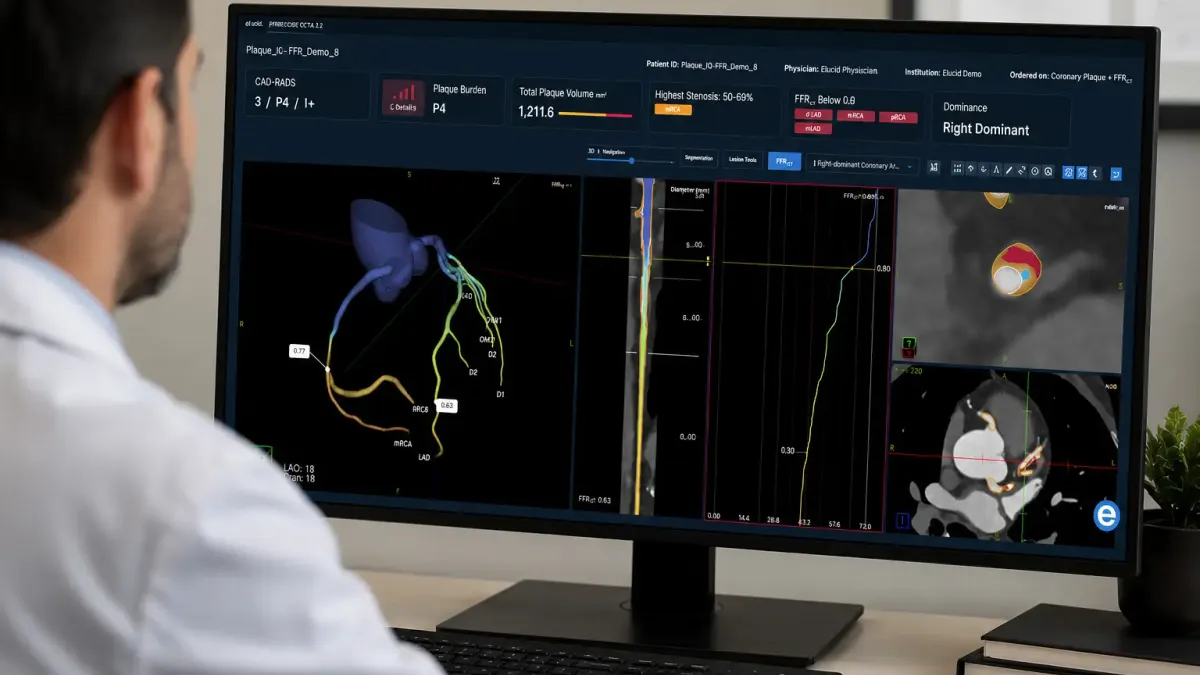
Elucid’s core value proposition lies in its ability to extract actionable, high-fidelity data from standard coronary computed tomography angiography (CCTA). While traditional imaging often provides visual snapshots of the heart, Elucid’s FDA-cleared Plaque-IQ software processes these images to generate detailed, three-dimensional models. These models go beyond simple visualization; they quantify and classify plaque morphology, allowing physicians to understand the "biology" of the plaque—its composition, stability, and propensity to cause future cardiac events.
The company is currently pushing the boundaries of this technology with its BioIntegrated FFR-CT (fractional flow reserve) product. This tool integrates three critical pillars of cardiac health:
- Anatomy: Detailed mapping of coronary structures.
- Biology: Precise characterization of plaque composition.
- Physiology: Noninvasive assessment of blood flow and ischemia.
By combining these factors, Elucid provides a comprehensive decision-support system that enables cardiologists to identify significant blockages without the need for invasive, high-risk procedures like cardiac catheterization.
Chronology: A Trajectory of Growth and Validation
The evolution of Elucid from a research-driven startup to a commercial powerhouse has been marked by several key milestones:
- 2024: Elucid receives landmark FDA clearance for Plaque-IQ, setting the stage for widespread clinical adoption.
- Early 2026: Following a rapid adoption cycle, the company reports that over 70% of covered lives in the United States now have access to insurance plans that reimburse coronary plaque analysis.
- Mid-2026: The company secures a major funding round, bringing its total capital raised to approximately $185 million. This round included participation from IAG Capital Partners and Elevage Medical Technologies (a Patient Square Capital platform).
- Present Day: Elucid’s FFR-CT platform remains under rigorous FDA review, representing the next frontier for the company’s regulatory and clinical roadmap.
This trajectory underscores a deliberate strategy: secure regulatory validation for foundational imaging tools, build a robust reimbursement framework, and then layer on advanced physiological assessment tools to create an end-to-end diagnostic suite.
Supporting Data: Why Reimbursement Matters
The commercial success of medical AI often lives or dies by the willingness of payers to cover the cost. Elucid has managed to clear this hurdle more effectively than many of its peers.
According to recent data, major national payers—including Aetna, Humana, Cigna, and UnitedHealthcare—have formally integrated coverage for coronary plaque analysis into their policies. Furthermore, the Centers for Medicare and Medicaid Services (CMS) has recognized the clinical utility of this approach, providing a critical reimbursement pathway for elderly and vulnerable patient populations.
For the healthcare system, the economic argument is clear: by providing a noninvasive, highly accurate alternative to invasive diagnostic catheterization, Elucid’s technology has the potential to drastically reduce hospital costs, decrease the incidence of unnecessary procedures, and optimize resource allocation in busy cardiology departments.
Official Responses: A Vision for Personalized Medicine
The strategic importance of Elucid’s work is perhaps best articulated by its leadership. In a recent statement, Elucid CEO Kelly Huang framed the company’s mission as a fundamental transformation of cardiac care.
"Analogous to oncology’s shift from population-based, one-size treatment, Elucid is applying AI to integrate anatomy, biology and physiology to bring personalized treatment to coronary artery disease management," Huang said.
The inclusion of a major, yet unnamed, global medtech company in its recent funding round is viewed by industry analysts as a "seal of approval." It signals that the incumbent giants of the medical device world see Elucid not just as a competitor, but as a critical piece of the future cardiac diagnostic infrastructure. This partnership is expected to accelerate the commercial roll-out of the platform, providing Elucid with the distribution networks and clinical relationships necessary to scale internationally.
Implications: Competitive Landscapes and Patient Outcomes
The Competitive Battlefield
Elucid is entering a high-stakes arena, competing directly with established players such as Heartflow, which has long dominated the FFR-CT space. However, Elucid’s differentiator is its focus on plaque biology. While competitors primarily focus on the physiological impact of a blockage (the "flow"), Elucid argues that understanding the nature of the plaque itself is essential for predicting which patients are at the highest risk for sudden rupture—the leading cause of heart attacks.

Impact on Clinical Workflow
For the practicing cardiologist, the shift to an integrated platform means less time manually reviewing raw DICOM files and more time interpreting high-level clinical insights. By automating the quantification of plaque burden, the software reduces inter-observer variability, ensuring that patients receive consistent care regardless of the physician’s individual experience level.
The Shift Toward Predictive Cardiology
The long-term implication of Elucid’s platform is the potential to move cardiology from a "reactive" discipline—treating heart attacks after they occur or when symptoms become severe—to a "predictive" one. By identifying vulnerable plaque through noninvasive CT scans, clinicians may soon be able to initiate aggressive lipid-lowering therapies or preventative interventions years before a patient ever experiences chest pain.
Regulatory and Economic Outlook
As the company awaits the final word on its 510(k) submission for the BioIntegrated FFR-CT, the industry is watching closely. If cleared, Elucid will hold one of the most comprehensive portfolios in the diagnostic imaging market. The combination of established reimbursement, high-level investor backing, and a clear regulatory roadmap puts Elucid in a prime position to become a standard-bearer for the next generation of cardiovascular imaging.
Conclusion: The Path Ahead
Elucid stands at a pivotal junction. Having secured the necessary financial runway through its $185 million fundraising success and having proven its worth to both private and public payers, the company is now tasked with execution.
The integration of its plaque analysis and upcoming FFR-CT technology into the standard-of-care workflow is not merely a technical challenge, but a cultural one. Persuading clinicians to trust AI-generated models over traditional manual interpretations requires ongoing education, clinical evidence, and seamless software integration.
However, the trend is clear: the integration of anatomy, biology, and physiology is the future of cardiovascular care. As Elucid continues to forge deep industry partnerships and expand its footprint, it is increasingly likely that its AI platform will serve as the engine behind a new, more precise, and more effective approach to heart health. For the millions of patients currently managing or at risk of atherosclerotic cardiovascular disease, the evolution of Elucid’s diagnostic platform represents a significant step toward a future where heart disease is managed with the same precision and insight as modern cancer care.