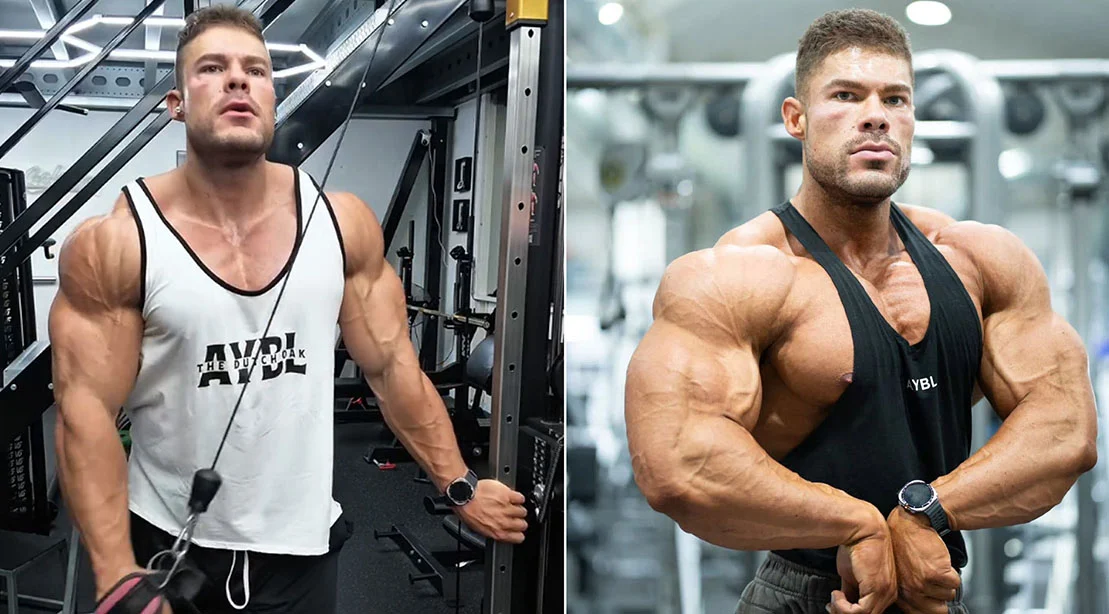
The pursuit of aesthetic perfection in professional bodybuilding is a relentless journey, one defined by the fine-tuning of muscle fiber recruitment, metabolic stress, and mechanical tension. For Wesley Vissers—the Dutch sensation known globally as "The Dutch Oak"—this journey has culminated in a prestigious Arnold Classic victory and a steadfast fixation on the 2026 Olympia Classic Physique title.
To bridge the gap between his current standing and the pinnacle of the sport, Vissers has opened his training ledger, revealing a streamlined, highly effective upper-body protocol. Eschewing unnecessary complexity in favor of fundamental physiological principles, Vissers’ latest workout is designed to pack massive, dense muscle onto the chest, shoulders, and triceps.
Main Facts: The Philosophy of "The Dutch Oak"
Wesley Vissers is not a bodybuilder who relies on gimmicks or overly convoluted training systems. In his recent correspondence with fans via Instagram, he emphasized that his training methodology is "straightforward" and designed specifically to "match up with actually building muscle."
For Vissers, the goal is simple: maximize hypertrophy by ensuring that every repetition serves a specific purpose. This means focusing on the triad of hypertrophy-based training: a deep, elongated stretch, heavy loading, and a full, peak contraction. By stripping away non-essential movements and focusing on biomechanical efficiency, Vissers has crafted a session that is as demanding as it is effective. The routine, while accessible to intermediate lifters, requires a high threshold of intensity, demanding that the trainee embrace the discomfort of a heavy set and the burn of deep muscle fiber exhaustion.
Chronology: The Evolution of a Contender
The timeline of Vissers’ career has been one of consistent, calculated progression. Following his breakthrough victory at the Arnold Classic, the pressure to evolve for the Olympia stage has shifted his training philosophy toward a more precise, target-oriented approach.
Historically, bodybuilding training often favored "volume at all costs," but Vissers has moved toward a model of "intensity at all costs." In the lead-up to the 2026 Olympia, his training chronology involves micro-cycles of intensity where he meticulously tracks his recovery capacity against the mechanical load placed on his upper body. By prioritizing the chest, shoulders, and triceps in a single, high-octane session, he ensures that these "aesthetic pillars" receive the priority they require to achieve the silhouette demanded by the Classic Physique division.
Supporting Data: The Anatomy of the Workout
Vissers’ workout is a masterclass in biomechanical targeting. Each exercise is selected to minimize "dead space" in the movement and maximize the time under tension for the intended muscle group.
The Chest Foundation
Vissers begins with the Seated Chest Press. Unlike a flat barbell bench press, the machine variation allows the athlete to focus entirely on the muscular output rather than stabilization. Vissers utilizes heavy weights here, but warns against losing the mind-muscle connection. He stresses the importance of the stretch at the eccentric phase and a squeeze at the concentric phase to facilitate an "incredible pump."
Following the warm-up and primary activation, Vissers moves to the Smith Machine Bench Press set to a 20-degree incline. This specific angle is critical. By elevating the torso slightly, the trainee shifts the stress onto the upper pectorals and anterior deltoids. Crucially, the Smith machine provides a fixed path, which allows the lifter to avoid the subconscious tendency to arch the back excessively, thereby keeping the shoulders pinned and ensuring the chest receives the brunt of the load.
The final chest movement is the Pec-Deck Fly. This is the finisher. The goal here is horizontal adduction, isolating the pecs completely. Vissers advocates for a deliberate pace, ensuring that the muscle fibers are exhausted through full range-of-motion control.
Shoulder and Tricep Specialization
Vissers is a firm believer in the "warm-up synergy" of muscle groups. Because the anterior delts are already taxed from the chest pressing, he transitions into Cable Lateral Raises. Utilizing a cuff attachment, he isolates the side delts. His rationale is simple: "You cannot ever have big enough side delts." By hitting them immediately after chest, he leverages the existing blood flow to maximize metabolic stress.
The triceps routine is equally surgical. He utilizes Side Triceps Pushdowns with a cable cuff. This allows for a more natural line of pull than a standard rope attachment, targeting the lateral head of the triceps while the medial head acts as a stabilizer. Finally, the session concludes with Seated Dumbbell Overhead Triceps Extensions. This move is essential for the "full sweep" of the arm, as it places the long head of the triceps in a position of maximum stretch—a key component of Vissers’ hypertrophy philosophy.
Official Responses and Methodology
When asked about the difficulty of this routine, Vissers remains humble, insisting that while the exercises are not "difficult to master," the intensity is what separates the average gym-goer from the elite competitor. The methodology relies on a set-and-rep scheme that is easily replicable but difficult to execute at high intensity:
- Chest Press (Seated): 3 sets for warm-up and mass initiation.
- Smith Machine Incline Press: 2 sets of all-out intensity.
- Pec-Deck Fly: 2 sets to complete exhaustion.
- Cable Lateral Raises: 2 sets for shoulder hypertrophy.
- Cable Side Triceps Pushdowns: 2 sets targeting the lateral head.
- Overhead Dumbbell Triceps Extensions: 2 sets for the long head sweep.
- Target Rep Range: 8–12 repetitions, emphasizing a "dig deep" mentality.
Vissers’ official stance is that progress is rarely about finding a "secret" exercise, but about mastering the execution of basic movements to the point where failure is the only outcome.
Implications for the Future of Classic Physique
The implications of Vissers’ training approach extend beyond his own performance. As the Classic Physique division continues to grow in popularity, the "Vissers Method"—which emphasizes proportional, aesthetic, and functional muscle growth over sheer size—is setting a new standard.
By sharing this information, Vissers is signaling a shift toward transparency in elite bodybuilding. Fans and aspiring bodybuilders are no longer content with "mysterious" training logs; they want to understand the science of the pump, the mechanics of the stretch, and the reality of the grind.
If Vissers successfully captures the 2026 Olympia title, this workout may well be remembered as the blueprint for his championship run. It is a testament to the fact that greatness is not found in complex routines, but in the relentless, repetitive, and heavy pursuit of muscular development. For those looking to mirror the physique of The Dutch Oak, the path is clear: get under the bar, dig deep, and commit to the stretch.
For those interested in following the ongoing journey of Wesley Vissers as he prepares for the 2026 Olympia, his daily training insights and competition updates can be tracked via his official Instagram account.